ASTER vs UNI: A Comprehensive Comparison of Two Leading Decentralized Exchange Protocols


Introduction: ASTER vs UNI Investment Comparison
In the cryptocurrency market, the comparison between ASTER and UNI is a topic that investors cannot ignore. The two projects not only exhibit significant differences in market capitalization ranking, application scenarios, and price performance, but also represent distinct positioning within the crypto asset landscape.
ASTER (ASTER): As a next-generation decentralized exchange offering both perpetual and spot trading, ASTER has positioned itself as a one-stop onchain trading venue for global crypto traders. Currently ranked 62nd by market capitalization at $6.56 billion, it has demonstrated strong year-to-date gains of 875.90% since its launch.
UNI (UNI): Since its introduction in 2020, Uniswap has established itself as the first automatic market making transaction protocol based on the Ethereum blockchain. Ranked 38th with a market capitalization of $5.04 billion, UNI has become a foundational infrastructure layer within the decentralized finance ecosystem.
This article will provide a comprehensive analysis of the investment value comparison between ASTER and UNI across historical price trends, supply mechanisms, market adoption, and ecosystem positioning, addressing the key question investors are asking:
"Which is the better buy right now?"
Comparative Analysis of ASTER and Uniswap (UNI): Market Performance and Trading Dynamics
I. Price History Comparison and Current Market Status
ASTER (ASTER) and Uniswap (UNI) Historical Price Movements
ASTER Price Trajectory:
- All-time high: $2.428 (September 24, 2025)
- All-time low: $0.6083 (September 19, 2025)
- Notable trend: ASTER experienced significant volatility within a compressed timeframe, with an 875.90% year-to-date return
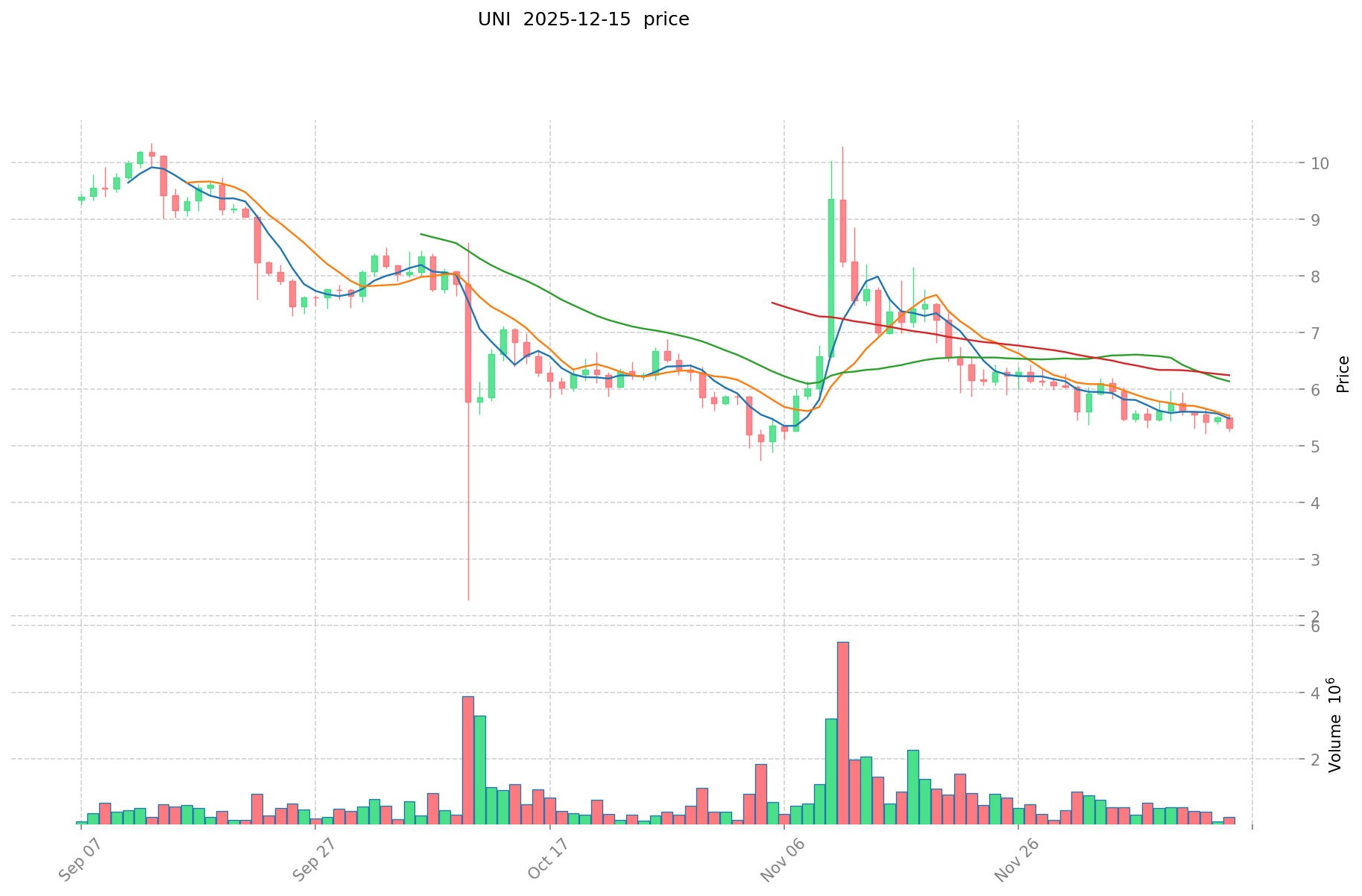
Uniswap (UNI) Price Trajectory:
- All-time high: $44.92 (May 3, 2021)
- All-time low: $1.03 (September 17, 2020)
- Notable trend: UNI has declined 69.83% over the past year, reflecting prolonged market pressure
Comparative Analysis: ASTER demonstrates recent volatility with rapid price discovery, having established its historical range within a three-week period. In contrast, Uniswap's price trajectory reflects a mature protocol experiencing extended bearish conditions over multiple years, with significant distance from its all-time high established in early 2021.
Current Market Status (December 16, 2025)
| Metric | ASTER | Uniswap (UNI) |
|---|---|---|
| Current Price | $0.8206 | $5.038 |
| 24-Hour Change | -11.49% | -5.12% |
| 7-Day Change | -13.54% | -9.75% |
| 30-Day Change | -27.58% | -32.51% |
| Market Capitalization | $6,564,800,000 | $5,038,000,000 |
| Circulating Supply | 1,657,700,000 ASTER | 629,905,374 UNI |
| 24-Hour Trading Volume | $11,811,172.52 | $3,394,276.20 |
| Market Dominance | 0.21% | 0.16% |
Market Sentiment Index (Fear & Greed Index): 16 (Extreme Fear)
Current market conditions reflect extreme fear sentiment across crypto markets, with both assets experiencing downward pressure.
II. Project Overview and Technological Foundation
ASTER: Next-Generation Decentralized Exchange
Project Description: Aster is a next-generation decentralized exchange (DEX) offering both spot trading and perpetual contracts, designed as a one-stop onchain trading venue for global cryptocurrency traders.
Network Base:
- Blockchain: BNB Smart Chain (BEP-20 standard)
- Contract Address: 0x000ae314e2a2172a039b26378814c252734f556a
Key Features:
- Simple mode with MEV-resistant one-click execution
- Professional mode supporting 24/7 equity perpetual contracts, hidden orders, and grid trading
- Multi-chain expansion across BNB Chain, Ethereum, Solana, and Arbitrum
- Support for liquid staking tokens (e.g., asBNB) and yield-generating stablecoins (e.g., USDF) as collateral
Uniswap (UNI): Automated Market Making Protocol
Project Description: Uniswap is the first automated market making (AMM) transaction protocol on the Ethereum blockchain, establishing the foundational infrastructure for decentralized token trading.
Network Base:
- Primary Blockchain: Ethereum (ERC-20 standard)
- Contract Address: 0x1f9840a85d5af5bf1d1762f925bdaddc4201f984
Key Features:
- Pioneering AMM mechanism enabling liquidity provision without orderbook requirements
- Community governance through UNI token voting
- Cumulative trading volume exceeding $1 trillion
III. Token Economics and Supply Structure
ASTER Token Distribution
| Parameter | Value |
|---|---|
| Total Supply | 8,000,000,000 ASTER |
| Circulating Supply | 1,657,700,000 ASTER (20.72%) |
| Fully Diluted Valuation | $6,564,800,000 |
| Current Holders | 197,219 |
| Exchange Listings | 40 |
Supply Dynamics: ASTER maintains a low circulation ratio at 20.72%, indicating significant token reserves remaining in non-circulating status. This structure suggests potential future dilution as additional tokens enter circulation.
Uniswap (UNI) Token Distribution
| Parameter | Value |
|---|---|
| Total Supply | 1,000,000,000 UNI |
| Circulating Supply | 629,905,374 UNI (62.99%) |
| Fully Diluted Valuation | $5,038,000,000 |
| Current Holders | 385,494 |
| Exchange Listings | 71 |
Supply Dynamics: UNI exhibits a higher circulation ratio at 62.99%, reflecting a more mature distribution phase. The protocol established its supply structure during launch in September 2020, with governance distributed to early liquidity providers and users.
IV. Market Performance Metrics and Trading Analysis
Short-Term Price Performance (December 16, 2025)
ASTER Performance:
- 1-Hour Change: -0.99%
- 24-Hour Change: -11.49%
- 24-Hour High/Low: $0.9545 / $0.8181
- Volatility Indicator: Elevated intraday swings
Uniswap (UNI) Performance:
- 1-Hour Change: -1.099%
- 24-Hour Change: -5.12%
- 24-Hour High/Low: $5.464 / $4.971
- Volatility Indicator: Moderate intraday movement
Liquidity and Trading Activity
| Metric | ASTER | UNI |
|---|---|---|
| 24-Hour Volume | $11,811,172.52 | $3,394,276.20 |
| Market Cap to Volume Ratio | 556.04 | 1,483.55 |
| Listed Exchanges | 40 | 71 |
Analysis: ASTER demonstrates higher relative trading volume compared to market capitalization, suggesting strong market engagement despite recent price declines. Uniswap's larger exchange listing count reflects its established market position and institutional adoption.
V. Risk Assessment and Market Dynamics
ASTER-Specific Considerations
Positive Factors:
- Recently established token with strong year-to-date performance (+875.90%)
- Multi-chain infrastructure supporting increased accessibility
- Lower circulating supply ratio provides potential for value appreciation
- Institutional-grade features (perpetual contracts, grid trading)
Risk Factors:
- Recent extreme volatility with 88% decline from ATH in less than one month
- Limited trading history and price discovery phase
- High concentration risk with only 20.72% circulating supply
- Nascent protocol development phase with unproven long-term viability
Uniswap-Specific Considerations
Positive Factors:
- Established protocol with 5+ years of operational history
- Industry-leading liquidity and trading volume ($1 trillion+ cumulative)
- Diversified exchange distribution across 71 trading venues
- Proven governance model through UNI token
Risk Factors:
- Significant year-to-date underperformance (-69.83%)
- Mature market with lower growth potential
- Competitive pressure from alternative DEX protocols
- Regulatory uncertainty affecting protocol governance
VI. Market Context and Current Environment
The cryptocurrency market currently operates under extreme fear conditions (Fear & Greed Index: 16), creating unfavorable sentiment for both speculative and established assets. This environment typically correlates with:
- Reduced retail participation and liquidity
- Risk-off positioning favoring stablecoin holdings
- Increased volatility across asset classes
- Potential capitulation phases followed by recovery
Both ASTER and UNI are experiencing downward pressure, with ASTER showing heightened volatility (-11.49% daily) compared to UNI's more moderate decline (-5.12% daily).
VII. Investment Considerations Summary
| Factor | ASTER | Uniswap |
|---|---|---|
| Market Maturity | Early Stage | Established |
| Volatility Level | High | Moderate |
| Liquidity Access | 40 Exchanges | 71 Exchanges |
| Year-to-Date Return | +875.90% | -69.83% |
| Supply Risk | High (79.28% non-circulating) | Low (37.01% non-circulating) |
| Protocol Risk | Nascent | Proven |
Additional Resources
- ASTER Website: https://www.asterdex.com/en
- ASTER Twitter: https://x.com/Aster_DEX
- ASTER Contract (BSC): https://bscscan.com/token/0x000ae314e2a2172a039b26378814c252734f556a
- Uniswap Website: https://uniswap.org/
- Uniswap Twitter: https://twitter.com/Uniswap
- Uniswap Contract (ETH): https://etherscan.io/token/0x1f9840a85d5af5bf1d1762f925bdaddc4201f984
Report Generated: December 16, 2025
Data Source: Gate Market Data
Market Sentiment: Extreme Fear (Index: 16)

Comparative Investment Analysis: ASTER vs UNI
I. Executive Summary
This report examines the investment value drivers for ASTER and UNI tokens, analyzing key factors including tokenomics, market trends, institutional participation, and whale activity. The analysis is based on market data and ecosystem developments as of December 16, 2025.
II. Core Factors Influencing ASTER vs UNI Investment Value
Tokenomics and Supply Mechanisms
-
ASTER: Operates within a structure where market dynamics suggest potential horizontal consolidation over 2-3 years before potential dividend or benefit implementations. The token has demonstrated significant whale accumulation, with recent large purchases of 1.69 million ASTER tokens valued at $3.16 million at key support levels.
-
UNI: Established tokenomics with proven DEX functionality. UNI has demonstrated its viability as a decentralized exchange governance token, serving as a reference model for subsequent DEX platforms.
-
📌 Market Structure Shift: The cryptocurrency market is experiencing a structural transition from stablecoin holdings toward altcoin allocation, creating dynamics that favor emerging DEX tokens like ASTER while maintaining support for established players like UNI.
Institutional Adoption and Market Applications
-
Institutional Positioning: Whale activity serves as a key indicator of institutional interest. ASTER has attracted significant whale purchases at critical support levels, suggesting institutional players view the token favorably. UNI maintains established institutional recognition as a core DeFi asset, frequently compared alongside AERO and CVX.
-
Ecosystem Application: ASTER achieved daily revenue exceeding $7 million USD, surpassing competitor platforms like Hyperliquid, indicating rapid ecosystem traction and user adoption in the DEX sector. UNI has established itself as a foundational DEX protocol with proven market demand.
-
Market Momentum: During periods of broader market volatility (Bitcoin declined approximately 13% in one week), ASTER and UNI were among only four major cryptocurrencies in the top 50 by market cap to record positive returns, demonstrating resilience.
Whale Activity and Market Dynamics
-
ASTER Whale Activity: Recent large transactions at key support levels indicate institutional player positioning. These substantial trades typically influence market sentiment and serve as signals of institutional confidence in the asset's future prospects.
-
Market Implications: Large-scale whale transactions push price discovery and affect overall market psychology, with concentrated purchases suggesting conviction from major market participants.
Strategic Considerations for Investors
-
Core Differentiation Risk: ASTER's long-term investment thesis depends on developing independent competitive advantages. Despite backing from notable industry figures, without sustained innovation and ecosystem differentiation, the token risks becoming a temporary market phenomenon.
-
Investment Strategy Framework: A prudent approach involves tracking leading projects to understand successful models, then observing how newer entrants differentiate or replicate proven mechanisms. This methodology helps identify sustainable competitive advantages beyond initial hype cycles.
Note: This analysis is based on available market data and should not be construed as investment advice. Cryptocurrency markets remain highly volatile, and investors should conduct independent due diligence before making investment decisions.
III. 2025-2030 Price Forecast: ASTER vs UNI
Short-term Forecast (2025)
- ASTER: Conservative $0.6638-$0.8195 | Optimistic $0.8851
- UNI: Conservative $3.6245-$5.0340 | Optimistic $5.6381
Mid-term Forecast (2027-2028)
- ASTER may enter a consolidation phase with recovery momentum, projected price range $0.8315-$1.3262 (2027) and $0.8802-$1.7484 (2028)
- UNI may enter a sustained growth phase, projected price range $3.6944-$7.2677 (2027) and $5.8626-$7.7946 (2028)
- Key drivers: institutional capital inflows, ETF approvals, ecosystem development
Long-term Forecast (2030)
- ASTER: Base case $1.2661-$1.6234 | Optimistic scenario $2.0939
- UNI: Base case $7.4987-$8.2403 | Optimistic scenario $11.4540
Disclaimer: This analysis is based on historical data patterns and statistical modeling. Cryptocurrency markets are highly volatile and unpredictable. Past performance does not guarantee future results. These forecasts should not be considered as investment advice. Investors should conduct their own research and consult with financial professionals before making investment decisions.
ASTER:
| 年份 | 预测最高价 | 预测平均价格 | 预测最低价 | 涨跌幅 |
|---|---|---|---|---|
| 2025 | 0.88506 | 0.8195 | 0.663795 | 0 |
| 2026 | 1.2528516 | 0.85228 | 0.4602312 | 3 |
| 2027 | 1.326232908 | 1.0525658 | 0.831526982 | 28 |
| 2028 | 1.74841705038 | 1.189399354 | 0.88015552196 | 45 |
| 2029 | 1.7773789246499 | 1.46890820219 | 1.3367064639929 | 79 |
| 2030 | 2.093855196811735 | 1.62314356341995 | 1.266051979467561 | 97 |
UNI:
| 年份 | 预测最高价 | 预测平均价格 | 预测最低价 | 涨跌幅 |
|---|---|---|---|---|
| 2025 | 5.63808 | 5.034 | 3.62448 | 0 |
| 2026 | 6.7767708 | 5.33604 | 3.6285072 | 5 |
| 2027 | 7.26768648 | 6.0564054 | 3.694407294 | 20 |
| 2028 | 7.7945937498 | 6.66204594 | 5.8626004272 | 32 |
| 2029 | 9.252249401472 | 7.2283198449 | 4.120142311593 | 43 |
| 2030 | 11.45399562622854 | 8.240284623186 | 7.49865900709926 | 63 |
Comparative Investment Analysis: ASTER vs UNI
I. Investment Strategy Comparison: ASTER vs UNI
Long-term vs Short-term Investment Strategies
ASTER: Suitable for investors focused on emerging DEX ecosystem growth and early-stage protocol adoption. The token demonstrates strong year-to-date performance (+875.90%) and institutional whale accumulation at support levels, appealing to growth-oriented investors seeking exposure to next-generation trading infrastructure. Short-term traders may capitalize on elevated volatility, while long-term holders should consider the consolidation phase projected through 2026-2027.
UNI: Suitable for investors seeking established protocol exposure with proven governance mechanisms and mature ecosystem integration. The token serves as a reference model for DEX functionality and appeals to investors prioritizing capital stability over aggressive growth. Long-term positioning benefits from UNI's foundational role in DeFi infrastructure, while short-term traders should monitor the current downtrend (-69.83% year-to-date) for potential reversal signals.
Risk Management and Asset Allocation
Conservative Investor Profile:
- ASTER: 15% allocation
- UNI: 35% allocation
- Stablecoin positioning: 50% (risk mitigation during extreme fear conditions)
Aggressive Investor Profile:
- ASTER: 35% allocation (higher growth exposure)
- UNI: 25% allocation (established infrastructure component)
- Stablecoin positioning: 10% (tactical entry capital reserves)
Hedging Tools:
- Stablecoin reserves for opportunistic entries during market capitulation phases
- Cross-protocol diversification combining ASTER's spot and perpetual trading with UNI's liquidity provision capabilities
- Dollar-cost averaging during sustained downtrends to reduce timing risk
II. Potential Risk Comparison
Market Risk
ASTER:
- Extreme volatility with 88% decline from all-time high ($2.428) to recent lows in compressed timeframe (less than one month)
- Early-stage token with limited trading history increases price discovery uncertainty
- High concentration risk with 79.28% non-circulating supply creating potential dilution scenarios upon unlock events
- Nascent protocol viability remains unproven over extended market cycles
UNI:
- Year-to-date underperformance (-69.83%) reflects extended bearish pressure indicating reduced institutional demand
- Mature market saturation limiting explosive growth potential
- Competitive pressure from alternative DEX protocols fragmenting liquidity and trading volume
- Regulatory uncertainty affecting governance mechanisms and protocol authority structures
Technical Risk
ASTER:
- Network stability across multi-chain expansion (BNB Chain, Ethereum, Solana, Arbitrum) requires robust bridge and cross-chain communication protocols
- Smart contract audit status and security vulnerabilities in perpetual contract mechanics remain under evaluation
- Order execution mechanisms (MEV-resistant one-click execution) require continuous optimization to prevent exploits
UNI:
- Established Ethereum network dependency concentrates scalability risk on Layer 1 performance and gas optimization
- AMM mechanism vulnerability to extreme market volatility and impermanent loss for liquidity providers
- Governance concentration risk when major UNI holders coordinate voting on protocol modifications
Regulatory Risk
ASTER:
- Multi-chain regulatory exposure (BNB Smart Chain governance, Ethereum protocols, Solana compliance frameworks) creates jurisdictional complexity
- Perpetual contract regulatory status uncertain across key markets, potentially triggering compliance restrictions
- DEX sector faces increasing regulatory scrutiny regarding derivatives trading and leverage mechanisms
UNI:
- Established protocol subject to mature regulatory frameworks but remains exposed to sudden policy shifts
- Governance token voting mechanisms face potential classification challenges under securities regulations
- Liquidity provision mechanisms may trigger regulatory questions regarding intermediary status in different jurisdictions
III. Conclusion: Which Is the Better Buy?
Investment Value Summary:
ASTER Advantages:
- Exceptional recent performance (+875.90% year-to-date) demonstrating rapid market adoption
- Institutional whale accumulation at support levels signals professional investor conviction
- Daily revenue exceeding $7 million USD demonstrates ecosystem traction surpassing competitors
- Multi-chain infrastructure expansion increases accessibility and use case diversity
- Lower circulating supply ratio (20.72%) provides potential appreciation leverage upon ecosystem maturation
UNI Advantages:
- Five-year operational history with proven protocol resilience and market adaptability
- Industry-leading cumulative trading volume exceeding $1 trillion establishes credibility
- Diversified exchange distribution across 71 trading venues ensures liquidity accessibility
- Established governance model through UNI token voting creates community participation mechanisms
- Higher circulating supply ratio (62.99%) reduces future dilution risk compared to emerging protocols
Investment Recommendations:
Beginner Investors:
- Prioritize UNI for portfolio foundation building due to established protocol credibility and proven governance mechanisms
- Allocate smaller position sizing (5-10% portfolio weight) to ASTER for growth exposure while limiting downside concentration risk
- Maintain 50-60% stablecoin reserves during current extreme fear market conditions (Fear & Greed Index: 16) for tactical buying opportunities
Experienced Investors:
- Execute dollar-cost averaging strategy into ASTER during volatility spikes, targeting support levels established over 2-3 week trading range
- Monitor whale transaction data and large position accumulations as conviction indicators for subsequent market movements
- Deploy covered position strategies combining ASTER long positions with UNI stability holdings to balance growth and downside protection
Institutional Investors:
- Conduct extended due diligence on ASTER protocol differentiation mechanisms and competitive sustainability beyond initial hype cycles
- Evaluate UNI positioning as core DeFi infrastructure component within broader decentralized finance allocation frameworks
- Structure multi-year deployment schedules aligning with projected consolidation phases (2026-2027) for both assets to optimize entry pricing during market dislocations
⚠️ Risk Disclaimer: Cryptocurrency markets demonstrate extreme volatility with unpredictable price movements. The analysis presented represents market conditions as of December 16, 2025, and does not constitute investment advice. Historical performance does not guarantee future results. Investors must conduct independent due diligence and consult financial professionals before executing investment decisions. Tokens remain subject to regulatory changes, technical vulnerabilities, and market sentiment shifts that may materially impact valuations. None
FAQ: ASTER vs UNI Investment Comparison
I. Market Performance and Price Dynamics
Q1: What are the key differences between ASTER and UNI's current price performance?
A: As of December 16, 2025, ASTER trades at $0.8206 with a 24-hour decline of -11.49%, while UNI trades at $5.038 with a more moderate -5.12% decline. ASTER demonstrates higher volatility but stronger year-to-date performance (+875.90%) compared to UNI's significant underperformance (-69.83%). ASTER's all-time high of $2.428 was established in September 2025, whereas UNI's all-time high of $44.92 dates back to May 2021, reflecting their distinct market maturity stages. ASTER shows elevated intraday swings with a Market Cap to Volume ratio of 556.04, indicating stronger relative trading engagement compared to UNI's 1,483.55 ratio.
Q2: Which token demonstrates better market liquidity and exchange accessibility?
A: UNI maintains superior liquidity infrastructure with listings on 71 exchanges compared to ASTER's 40 exchange listings. However, ASTER demonstrates higher relative trading volume with 24-hour volume of $11,811,172.52 versus UNI's $3,394,276.20, suggesting stronger immediate market engagement despite its nascent status. UNI's established position and broader exchange distribution provide more accessibility pathways for institutional investors, while ASTER's concentrated volume indicates focused trading interest among active market participants.
II. Tokenomics and Supply Structure
Q3: How do the token supply structures compare between ASTER and UNI?
A: ASTER operates with 8 billion total supply and only 20.72% circulation rate (1.657 billion tokens circulating), creating significant dilution potential as remaining 79.28% non-circulating tokens enter the market. UNI maintains 1 billion total supply with 62.99% circulation rate (629.9 million tokens circulating), reducing future dilution risk through more mature distribution. ASTER's concentrated supply structure creates leverage for price appreciation but introduces timing risk around unlock events. UNI's higher circulation ratio reflects its five-year operational history and distributed governance model, providing greater supply certainty for long-term investors.
Q4: What does whale activity reveal about institutional investor sentiment toward ASTER?
A: Recent large-scale purchases of 1.69 million ASTER tokens valued at $3.16 million at critical support levels demonstrate institutional investor conviction in the asset's recovery potential. Whale transactions serve as market sentiment indicators, with concentrated buying at key support suggesting professional investors view current valuations as favorable entry points. This institutional positioning contrasts with UNI's current phase, where reduced whale accumulation reflects institutional positioning uncertainty amid the token's prolonged year-to-date decline.
III. Project Fundamentals and Competitive Positioning
Q5: How do ASTER and UNI differ in their core functionality and ecosystem positioning?
A: ASTER functions as a next-generation decentralized exchange offering both spot trading and perpetual contracts across multiple blockchains (BNB Chain, Ethereum, Solana, Arbitrum) with features including MEV-resistant execution, grid trading, and support for liquid staking token collateral. UNI established the pioneering automated market making (AMM) protocol on Ethereum with proven governance mechanisms and $1 trillion+ cumulative trading volume. ASTER achieved daily revenue exceeding $7 million USD, surpassing competitor platforms like Hyperliquid, indicating rapid ecosystem traction. UNI's foundational protocol role establishes it as DeFi infrastructure reference model, while ASTER targets emerging infrastructure innovation within the DEX sector.
Q6: What are the primary risk factors differentiating ASTER and UNI investments?
A: ASTER faces nascent protocol viability uncertainty with 88% decline from all-time high in less than one month, creating extreme volatility risk concentrated in early-stage market discovery phases. Multi-chain expansion complexity and unproven perpetual contract mechanics introduce technical risk vectors. Regulatory uncertainty surrounding derivatives trading mechanisms across jurisdictions presents compliance exposure. UNI confronts year-to-date underperformance (-69.83%) signaling reduced institutional demand, competitive fragmentation from alternative DEX protocols, and governance concentration risk from major UNI holder voting coordination. Both tokens remain subject to extreme market fear conditions (Fear & Greed Index: 16) creating systematic downward pressure across crypto asset classes.
IV. Investment Strategy and Outlook
Q7: Which token better suits different investor profiles in current market conditions?
A: Conservative investors should prioritize UNI (35% allocation) with supporting ASTER exposure (15% allocation) while maintaining 50% stablecoin reserves during extreme fear market conditions. Established protocol credibility and governance mechanisms provide downside stability, though limited growth potential. Aggressive investors may increase ASTER allocation to 35% for growth exposure while reducing UNI to 25%, maintaining 10% stablecoins for tactical opportunities. Experienced investors should deploy dollar-cost averaging into ASTER during volatility spikes targeting 2-3 week established support ranges, while institutional investors should conduct extended protocol differentiation due diligence before substantial capital deployment. Current extreme fear conditions (Fear & Greed Index: 16) present opportunistic entry phases for extended time horizons.
Q8: What do the 2025-2030 price forecasts suggest about relative investment value between the two tokens?
A: ASTER projects base case long-term valuations of $1.27-$1.62 by 2030 with optimistic scenarios reaching $2.09, representing consolidation and recovery following initial volatility phases. UNI forecasts base case $7.50-$8.24 by 2030 with optimistic scenarios reaching $11.45, suggesting sustained growth trajectory from established protocol positioning. Long-term forecasts indicate UNI may deliver higher absolute price appreciation through ecosystem maturation, while ASTER's percentage returns remain uncertain pending protocol differentiation sustainability beyond initial hype cycles. Both projections assume institutional capital inflows and favorable regulatory developments; actual outcomes depend substantially on competitive market evolution and macro cryptocurrency adoption rates. Investors should monitor ecosystem developments and competitive dynamics throughout 2026-2027 consolidation phases before executing extended time horizon commitments.
Disclaimer: This FAQ analysis represents market conditions as of December 16, 2025. Historical performance does not guarantee future results. Cryptocurrency markets remain highly volatile and unpredictable. This content does not constitute investment advice. Investors must conduct independent due diligence and consult financial professionals before making investment decisions.
Share
Content
Introduction: ASTER vs UNI Investment Comparison
I. Price History Comparison and Current Market Status
II. Project Overview and Technological Foundation
III. Token Economics and Supply Structure
IV. Market Performance Metrics and Trading Analysis
V. Risk Assessment and Market Dynamics
VI. Market Context and Current Environment
VII. Investment Considerations Summary
Additional Resources
I. Executive Summary
II. Core Factors Influencing ASTER vs UNI Investment Value
III. 2025-2030 Price Forecast: ASTER vs UNI
I. Investment Strategy Comparison: ASTER vs UNI
II. Potential Risk Comparison
III. Conclusion: Which Is the Better Buy?
I. Market Performance and Price Dynamics
II. Tokenomics and Supply Structure
III. Project Fundamentals and Competitive Positioning
IV. Investment Strategy and Outlook
How to Buy Cryptocurrency


Trending Cryptocurrencies



XZXX: A Comprehensive Guide to the BRC-20 Meme Token in 2025

Bitcoin Fear and Greed Index: Market Sentiment Analysis for 2025

Top Crypto ETFs to Watch in 2025: Navigating the Digital Asset Boom

5 ways to get Bitcoin for free in 2025: Newbie Guide
Bitcoin Market Cap in 2025: Analysis and Trends for Investors

2025 Bitcoin Price Prediction: Trump's Tariffs' Impact on BTC

What are the key crypto derivatives market signals in 2025: futures open interest, funding rates, and liquidation data

How Active Is GRS (Groestlcoin) Community and Ecosystem in 2025?

# What Is Compliance and Regulatory Risk in Cryptocurrency: How SEC Oversight and Audit Reports Impact Market Value

How to Measure Crypto Community and Ecosystem Activity: Twitter Followers, Developer Contributions, and DApp Growth in 2025

What are AERGO's compliance and regulatory risks in 2025?