Exchange tokens were originally designed to provide trading fee discounts and incentivize users, making them a vital part of the crypto exchange platform ecosystem. As the crypto industry has shifted from centralized exchanges toward the broader Web3 landscape, the role of exchange tokens has expanded from a single-purpose trading tool to a core asset that connects on-chain services, wallet systems, and ecosystem applications.
Today, competition among exchange tokens extends far beyond trading scenarios, increasingly focusing on on-chain infrastructure, multi-chain ecosystems, and entry points for Web3 users. BGB, BNB, and GT each represent distinct development strategies for exchange ecosystems, with differences reflected not only in their functional design but also in their long-term approaches to the Web3 ecosystem.
BGB, BNB, and GT: A Comparative Overview
BGB, the platform token of the Bitget ecosystem, is primarily used for trading fee discounts, Launchpad participation, on-chain Gas payments, and ecosystem equity scenarios. As Bitget expands its Web3 wallet and on-chain product offerings, BGB’s use cases are extending from traditional exchange functions to on-chain interactions and multi-chain ecosystems.
BNB, the core exchange token of the Binance ecosystem, was initially used for trading fee discounts. However, with the development of BNB Chain, BNB’s role now extends well beyond that of a typical exchange token. Today, BNB is widely used for on-chain Gas fees, DeFi, NFT, GameFi, and on-chain governance.
GT, the platform token of the Gate ecosystem, is mainly used for trading fee discounts, VIP equity, participation in the on-chain ecosystem, and platform incentives.
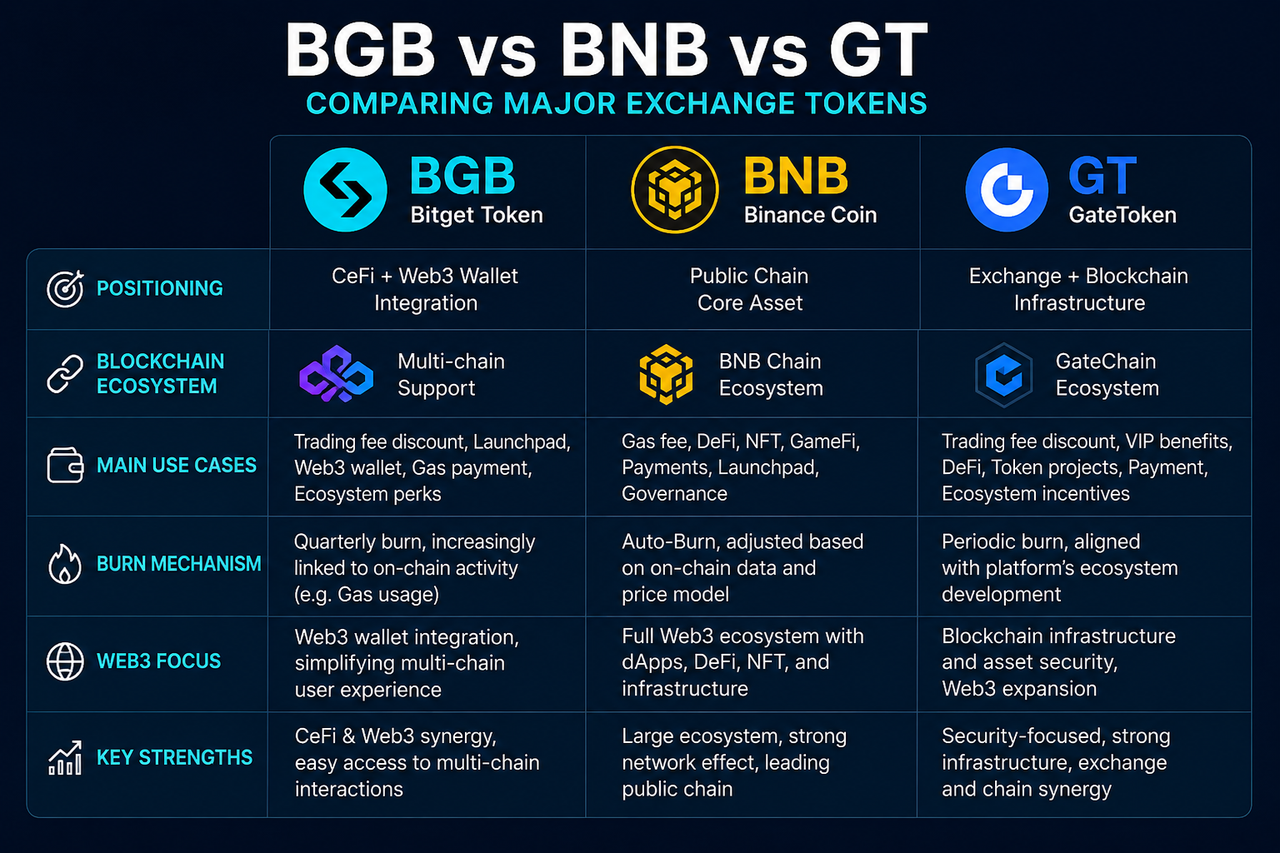
How Do the Ecosystem Roles of BGB, BNB, and GT Differ?
While BGB, BNB, and GT all serve as exchange tokens, each takes a distinctly different approach to ecosystem development.
BNB’s main competitive edge lies in its robust public chain ecosystem. As BNB Chain continues to grow, BNB has become a foundational asset for a standalone chain network, powering DeFi, NFT, blockchain gaming, and multi-chain infrastructure.
GT is more focused on the synergy between the trading platform and on-chain infrastructure. GateChain’s asset security and on-chain management systems create a strong connection between GT and both the platform’s ecosystem and its underlying technology.
In contrast, BGB’s current development priority is the integration of CeFi and Web3 Wallets. Beyond its core exchange features, BGB’s capabilities in on-chain payments and wallet ecosystems are steadily advancing.
Overall, these three tokens represent three classic models within the exchange token ecosystem: public chain-driven, infrastructure-synergy, and wallet-integration.
How Do BGB, BNB, and GT Differ in On-Chain Use?
On-chain capabilities have become a key competitive factor for exchange tokens.
BNB has the broadest on-chain utility, serving as the core Gas token of BNB Chain. Users need BNB to pay Gas fees for on-chain transfers, DeFi participation, and NFT applications, making BNB a foundational asset for the entire on-chain ecosystem.
GT’s on-chain utility centers on GateChain, including on-chain asset management, select DeFi applications, and ecosystem integration. Its focus is not limited to Gas payments but extends to on-chain infrastructure and asset security.
BGB’s on-chain use cases currently focus on Web3 Wallets and multi-chain payments. In certain on-chain interactions, users can pay Gas fees directly with BGB, eliminating the need to hold the native token of the corresponding public chain.
How Do the Burn Mechanisms of BGB, BNB, and GT Differ?
The burn mechanism is a fundamental aspect of exchange token tokenomics, designed to reduce circulating supply and support long-term deflationary dynamics.
BNB uses an Auto-Burn mechanism, where the number of tokens burned is automatically adjusted based on on-chain data and a predetermined formula. This approach prioritizes automation and on-chain transparency and is closely tied to overall ecosystem activity.
GT employs a fixed-term burn model, with a focus on platform ecosystem development and long-term supply management.
BGB is increasingly linking on-chain activity to its burn mechanism. For example, certain on-chain Gas usage data is now factored into the burn process. This means the token’s supply is no longer determined solely by trading data but is gradually being tied to Web3 use cases.
Summary
BGB, BNB, and GT are all mainstream exchange tokens, but each has its own development path and ecosystem priorities.
BNB has evolved from an exchange token into a core asset for a comprehensive public chain ecosystem. GT emphasizes synergy between exchange platforms and on-chain infrastructure. BGB is steadily moving toward the integration of CeFi and Web3 Wallets.
FAQs
Why Is BNB’s On-Chain Ecosystem Larger?
Because BNB is deeply integrated into the BNB Chain public blockchain ecosystem and is widely used for on-chain Gas fees, DeFi, NFT, and blockchain gaming.
What Are BGB’s Main Features?
BGB focuses on integrating exchange platform functions with Web3 Wallets and is expanding into on-chain payments and multi-chain interactions.
What Sets GT Apart from Other Exchange Tokens?
GT is oriented toward the synergy between trading platforms and on-chain infrastructure, with a strong connection to GateChain’s asset security system.
Why Is the Burn Mechanism Important for Exchange Tokens?
The burn mechanism is essential for adjusting token supply and establishing a long-term deflationary model, making it a core element of exchange token tokenomics.
Are Exchange Tokens Only Used for Trading Fee Discounts?
No. Leading exchange tokens are now widely used for on-chain payments, DeFi, wallet ecosystems, Launchpad participation, and a variety of Web3 interactions.







