The global cross-border payment market has long been dominated by the banking system, with SWIFT as the core infrastructure for international payments. For decades, most international remittances have required the bank account system and correspondent clearing networks, making cross-border payments essentially a "collaborative network between banks."
However, with the rise of digital payments and the stablecoin market, more and more companies are turning to blockchain networks for international fund settlement. This shift is driving the development of Onchain FX infrastructure. Unlike traditional banking networks that rely on clearinghouses and correspondent banks, Onchain FX emphasizes moving global capital through stablecoin liquidity and blockchain settlement networks. Codex FX is one of the standout projects in this space.
Codex FX vs. SWIFT: A Quick Breakdown
SWIFT (Society for Worldwide Interbank Financial Telecommunication) is the primary communication network for international payments between banks. Its core role is to allow banks to exchange payment information securely to settle cross-border funds.
In the traditional SWIFT system, an international remittance typically passes through multiple banks and correspondent clearing institutions. For example, when a user sends money from one country to another, the funds may travel through the Correspondent Banking (correspondent banking) network layer by layer.
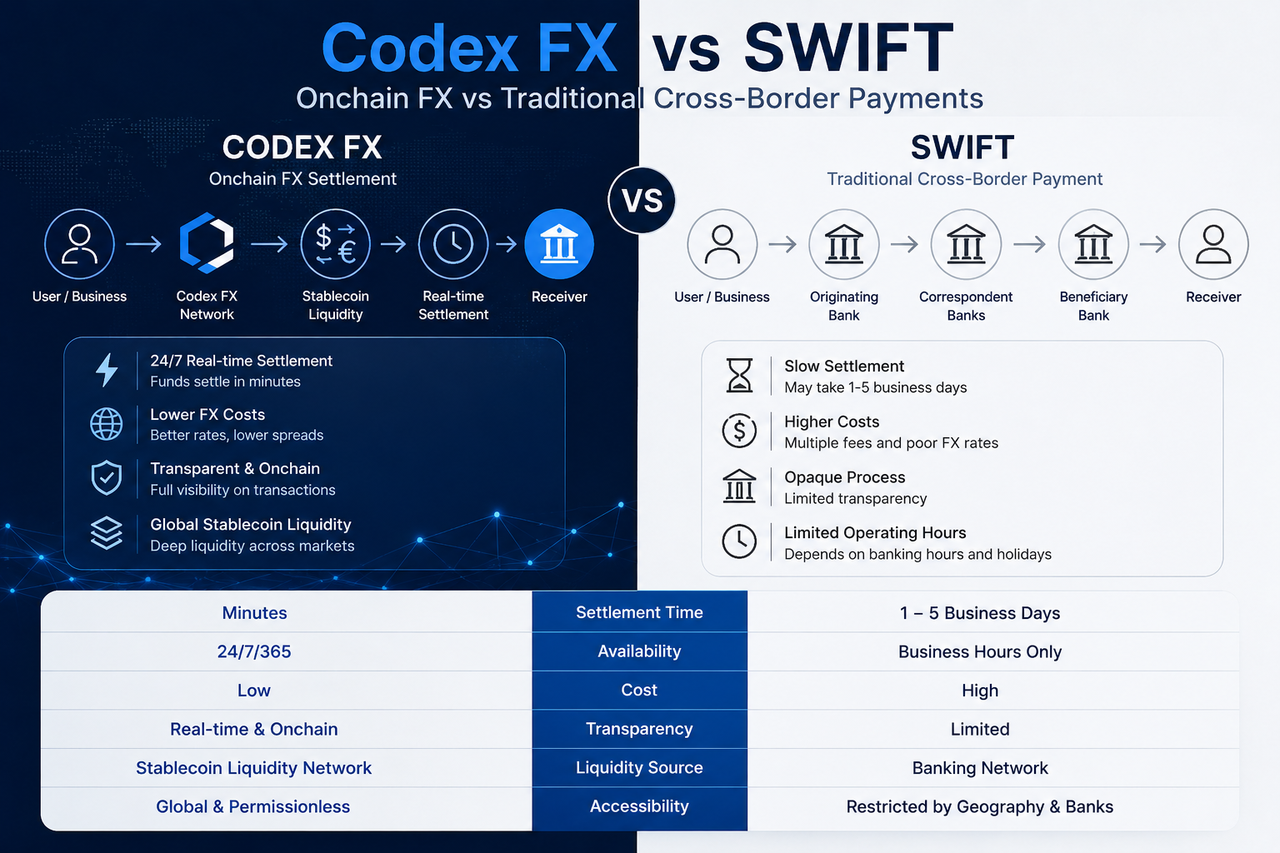
As the Onchain FX system within the Codex network, Codex FX aims to optimize global payments and cross-border settlement using stablecoins and on-chain liquidity networks.
Unlike SWIFT, Codex FX focuses on direct value transfer via stablecoins, rather than relying on information sync and clearing between bank accounts. Its system is built around stablecoin liquidity, real-time FX routing, and on-chain settlement, making international payments faster.
| Comparison Aspect |
Codex FX |
SWIFT |
| Core Structure |
On-chain stablecoin settlement network |
Bank communication and clearing network |
| Payment Medium |
Stablecoins |
Bank account system |
| Operating Hours |
24/7 |
Primarily business days |
| Intermediaries |
Few |
Multiple layers of correspondent banks |
| Settlement Speed |
Minutes |
Hours to days |
| FX Transparency |
High |
Relatively limited |
| Global Accessibility |
Strong |
Constrained by regional financial systems |
| Liquidity Source |
Stablecoin liquidity network |
Bank clearing system |
What's the Core Difference Between Codex FX and SWIFT?
While both Codex FX and SWIFT handle international payments, they operate on fundamentally different principles.
SWIFT is a communication network for exchanging messages between banks. Codex FX, on the other hand, is an on-chain stablecoin settlement network. SWIFT relies on interbank cooperation and clearing; Codex FX emphasizes direct fund movement through stablecoins and blockchain networks.
SWIFT's payment speed is often constrained by bank operating hours and the correspondent clearing structure. Codex FX's on-chain settlement, by contrast, enables near-real-time global payments.
These differences lead to clear distinctions in payment efficiency, liquidity structure, and user experience.
Why Is Onchain FX Faster at Settlement?
Traditional international payments go through multiple intermediary banks, meaning funds often take hours or even days to arrive. In certain cross-border scenarios, delays are worsened by time zones, holidays, and banking system limitations.
Onchain FX networks settle directly on the blockchain using stablecoins. Since blockchain networks operate 24/7, funds can flow continuously across global markets without waiting for bank business hours.
Codex FX focuses on Fast Finality (fast final confirmation) and real-time liquidity routing, reducing the wait times seen in traditional systems. This structure is ideal for use cases that demand high-efficiency fund movement, such as international trade, remittances, and corporate treasury.
How Do Codex FX and SWIFT Differ in Liquidity Structure?
SWIFT's liquidity system is built on bank accounts and correspondent banking networks. Fund flows between countries typically require large banks to maintain international clearing capabilities.
Codex FX, in contrast, relies on stablecoin liquidity pools and on-chain fund routing for global payments. This means funds can enter target markets directly through stablecoin networks, bypassing complex banking intermediaries.
This difference also gives Onchain FX stronger global accessibility, especially in emerging markets.
How Do the Risk Profiles of On-Chain and Traditional Bank Payments Differ?
While on-chain payments improve settlement efficiency, their risk profile is different from traditional banking.
Traditional banking offers mature regulatory frameworks and strong compliance and consumer protection mechanisms. However, it suffers from lower efficiency and reliance on complex intermediaries.
On-chain payment networks prioritize openness and real-time processing, but stablecoin regulation, on-chain liquidity, and fiat on-ramp/off-ramp systems remain key challenges. For Codex FX, balancing payment efficiency with global compliance will be critical to its long-term growth.
Summary
Codex FX and SWIFT represent two contrasting global payment systems. SWIFT is built on traditional banking and correspondent clearing networks, while Codex FX creates a real-time payment network using stablecoins and on-chain liquidity.
As stablecoins increasingly enter international trade, corporate treasury, and global payments, Onchain FX infrastructure is becoming more important. Compared to traditional bank cross-border payment systems, Codex FX emphasizes real-time settlement, low-friction liquidity, and global stablecoin payment capabilities.
FAQs
What is the biggest difference between SWIFT and Codex FX?
SWIFT is a communication network for interbank payments, while Codex FX is an Onchain FX network built on stablecoins and on-chain settlement.
Will Codex FX replace SWIFT?
For now, they represent different payment architectures. Traditional banking networks still dominate global finance, but stablecoin payments are growing quickly.
Does Codex FX rely on banks?
On-chain settlement depends on stablecoin networks, but real-world fiat on-ramp and off-ramp still need banks and payment channels.
Why does Codex FX emphasize emerging markets?
Because emerging markets often face high cross-border payment costs and low settlement efficiency—stablecoin payments can reduce friction in international fund flows.