Web3 wallets are an important entry point for users entering the blockchain ecosystem. From early asset storage tools to interaction platforms that support connections with decentralized applications, wallet products have become a key part of the digital asset infrastructure.
MetaMask has long been one of the most representative traditional wallets in the Web3 space, while AntFun belongs to a new generation of wallet products that combine AI and social networking capabilities. Although both help users connect to blockchain networks, they differ significantly in product philosophy, functional structure, and user experience. Comparing the two offers useful insight into the direction of the wallet industry.
What Is AntFun?
AntFun is a Web3 application that combines a multichain wallet, AI services, and social networking features.
In addition to digital asset management, AntFun also supports on-chain identity building, social relationship creation, and intelligent information services. Users can not only manage assets, but also discover projects, participate in community interactions, and access AI-assisted information through the platform.
From a product positioning perspective, AntFun places greater emphasis on user relationship networks and information flows. Its goal is to turn the wallet into a comprehensive gateway that connects users, communities, and applications.
MetaMask is a Web3 wallet widely used across the Ethereum ecosystem and compatible networks.
MetaMask’s main functions include asset management, transaction signing, smart contract authorization, and connections to decentralized applications. Its core positioning is to help users securely access blockchain networks and complete on-chain interactions.
Over the years, MetaMask has become important infrastructure for DeFi, NFTs, and Web3 applications. For many users, it is also the first wallet they use to interact with the blockchain ecosystem.
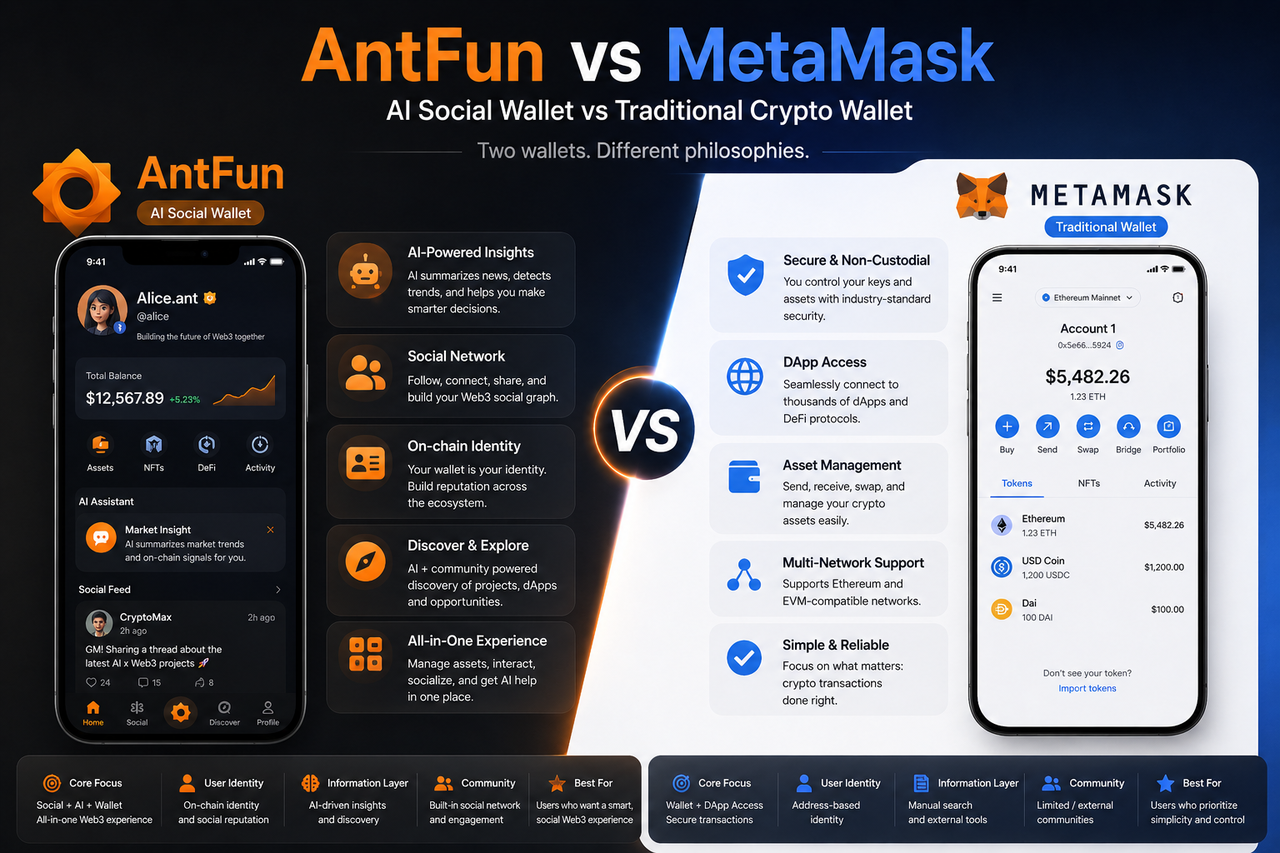
The biggest difference between AntFun and MetaMask lies in their product goals.
MetaMask’s core task is to provide secure and reliable on-chain interaction capabilities. Its product design centers on asset management and DApp connections, focusing on the connection between users and blockchains.
AntFun, by contrast, tries to go a step further by addressing how users discover information, build relationships, and participate in communities. The wallet is only one part of the broader ecosystem, while social networking and AI services are also core parts of the product.
Put simply, MetaMask is closer to a blockchain tool, while AntFun is closer to a comprehensive application that combines a wallet with a social platform.
AI functionality is one of the clearest areas of difference between the two.
MetaMask mainly focuses on wallet infrastructure and does not treat AI services as a core product module.
AntFun, on the other hand, makes artificial intelligence an important part of its product system. AI can support information filtering, project discovery, content recommendations, and on-chain data interpretation across multiple stages of the user experience.
This design means AntFun does more than execute transactions and manage assets. It can also help users understand ecosystem information and discover potential resources.
MetaMask is not, by nature, a social product.
Although users can participate in on-chain activities through wallet addresses, MetaMask does not provide a complete social relationship network, follow system, or community interaction function.
AntFun builds its social ecosystem around on-chain identity. Users can create personal profiles, follow other accounts, join content discussions, and form an on-chain social graph.
This model turns the wallet from a one-way tool into part of a user relationship network.
What Are the Differences in User Experience?
MetaMask offers a relatively direct user journey.
After creating a wallet, users mainly store assets, connect to DApps, and execute transactions. The overall process is centered on blockchain interaction.
AntFun’s user journey is more diverse. In addition to managing assets, users also need to build an identity, expand social relationships, and participate in information-based interactions.
As a result, MetaMask is better suited to scenarios focused on on-chain operations, while AntFun places more emphasis on continuous community participation and ecosystem exploration.
| Comparison Dimension |
AntFun |
MetaMask |
| Core positioning |
AI social wallet |
Basic Web3 wallet |
| Digital asset management |
Supported |
Supported |
| DApp connection |
Supported |
Supported |
| Multichain support |
Supported |
Supported |
| AI features |
Core component |
Not a core function |
| Social networking |
Supports on-chain social graphs |
Does not provide a complete social system |
| Identity display |
Supports on-chain identity |
Limited functionality |
| Content discovery |
Driven by AI and social features |
Relies on external platforms |
| Community interaction |
Built-in support |
Mainly through third-party communities |
| Product direction |
User gateway platform |
Blockchain interaction tool |
Conclusion
AntFun and MetaMask are both Web3 wallet products, but they address different needs. MetaMask mainly solves the connection problem between users and blockchains, making it a typical traditional Web3 wallet. AntFun builds on wallet capabilities by integrating AI services and social networking features, aiming to create a new type of user gateway that covers identity, relationships, and information flows.
From the perspective of industry development, MetaMask represents the infrastructure stage of Web3 wallets, while AntFun represents an exploratory path toward wallets becoming more AI-powered, social, and platform-oriented.
FAQs
What Is the Main Difference Between AntFun and MetaMask?
The main difference between AntFun and MetaMask lies in product positioning. MetaMask focuses on digital asset management and DApp connections, while AntFun adds AI services and social networking capabilities on top of wallet functions.
AntFun and MetaMask do not address exactly the same needs. MetaMask places more emphasis on blockchain interaction capabilities, while AntFun focuses more on identity, social networking, and information services. As a result, they belong to different product directions.
MetaMask itself does not provide a complete social networking system. Users mainly interact on-chain through wallet addresses, while social activity is usually carried out through external community platforms.
What Do AntFun’s AI Features Do?
AntFun’s AI features are mainly used for information aggregation, content recommendations, project discovery, and on-chain data interpretation, helping users access and understand Web3 information more efficiently.
Is AntFun a Social Wallet?
AntFun falls within the social wallet category. In addition to digital asset management, it also supports on-chain identity display, social relationship building, and community interaction.