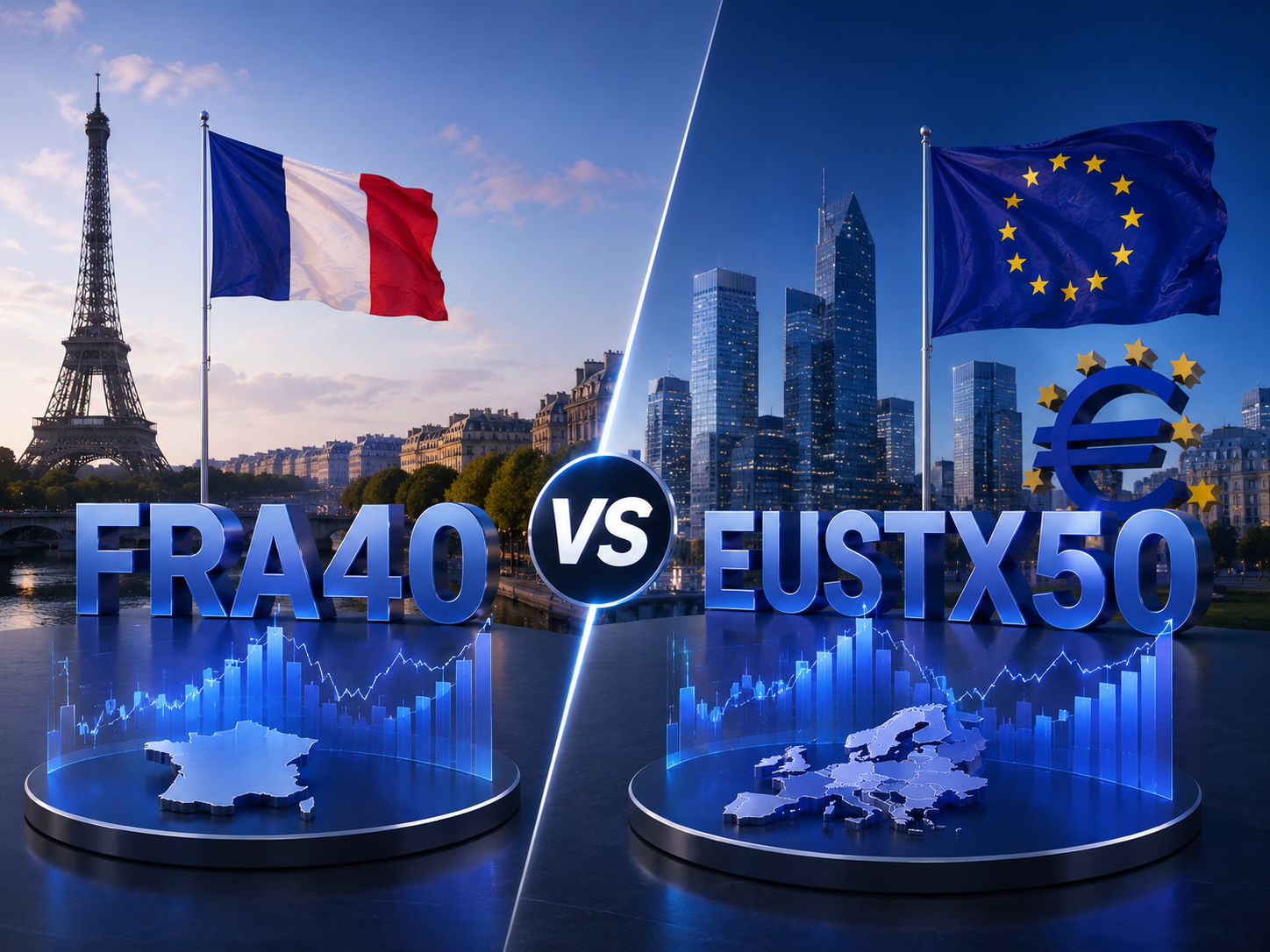
Understanding the differences between FRA40 and EUSTX50 goes beyond a simple comparison of the number of constituent stocks in each index. It requires grasping how the French market and the eurozone market differ in terms of industrial structure, sector weights, risk sources, and asset allocation logic. FRA40 places greater emphasis on the influence of French luxury, industrial, financial, and energy companies, while EUSTX50 brings multiple eurozone markets—including France, Germany, the Netherlands, Spain, and Italy—into a single framework.
What Is FRA40?
FRA40 typically refers to the French CAC 40 Index, one of the most representative stock indices in the French securities market. Composed of 40 publicly traded companies with large market capitalizations and strong liquidity, the index is widely used to measure the overall performance of French large-cap blue chips.
The vast majority of FRA40 constituents are among France's most internationally competitive corporations, including LVMH, Hermès, L'Oréal, Airbus, TotalEnergies, BNP Paribas, AXA, Sanofi, and Schneider Electric. While these companies are listed in France or carry French market representation, their operations span the globe. As a result, FRA40 is not merely a snapshot of the French domestic economy—it also reflects the competitiveness of French enterprises in global consumer, industrial, financial, and energy markets.
From an index positioning standpoint, FRA40 is best suited for observing the French market itself. Its performance is influenced by the global influence of the French luxury sector, the stability of the French financial system, international orders for French industrial companies, and changes in the European policy environment.
What Is EUSTX50?
EUSTX50 typically corresponds to the Euro Stoxx 50 Index, a key benchmark for tracking the performance of large-cap blue-chip companies in the eurozone. Unlike FRA40's singular focus on France, EUSTX50 covers multiple core eurozone economies, drawing constituent stocks from France, Germany, the Netherlands, Spain, Italy, Belgium, and other countries.
Representative EUSTX50 companies include ASML, SAP, LVMH, Siemens, Allianz, Airbus, Sanofi, TotalEnergies, and Schneider Electric. Because of its broader country coverage, EUSTX50's industry structure is more regionally diversified than FRA40, allowing it to simultaneously reflect the performance of European industrial, financial, consumer, pharmaceutical, energy, and technology sectors.
In terms of market positioning, EUSTX50 acts as a more comprehensive proxy for the eurozone blue-chip market. It includes not only French corporations but also German industrial giants, Dutch tech leaders, and Spanish and Italian financial institutions, making it ideal for observing the overall capital market of the eurozone and the earnings cycles of large European enterprises.
Differences in Constituent Stocks
The most immediate difference between FRA40 and EUSTX50 lies in the scope of their constituents. FRA40 covers only 40 large companies from the French market, while EUSTX50 includes 50 large-cap blue chips from across the eurozone. Consequently, their market representation differs significantly.
FRA40's constituents are heavily concentrated in French companies, making its trajectory more sensitive to the performance of leading French firms. French luxury, energy, banking, insurance, aerospace, and industrial manufacturing sectors carry substantial weight. Given that France is home to world-leading high-end consumer brands, companies like LVMH, Hermès, and L'Oréal exert considerable influence on FRA40.
EUSTX50's constituents are far broader in scope. Beyond French firms, companies such as Germany's SAP, Siemens, and Allianz, the Netherlands' ASML, Spain's Santander, and Italy's Intesa Sanpaolo all affect the index's performance. Therefore, EUSTX50's movements tend to reflect broader eurozone economic conditions and changes in the earnings of large European firms rather than the performance of a single national market.
In short, FRA40 represents a collection of French blue chips, while EUSTX50 represents a collection of eurozone blue chips. There is some overlap in constituent stocks, but their market coverage and analytical perspectives are clearly distinct.
Differences in Industry Structure
FRA40's industry structure exhibits a distinctly French character, with luxury goods, finance, energy, industry, and healthcare sectors consistently holding significant weight. The unique strength of the French capital market lies in its high-end consumer brands. Companies like LVMH, Hermès, and L'Oréal not only represent the French brand economy but also act as barometers for global luxury spending trends.
EUSTX50's industry structure is more diversified. In addition to French luxury and energy players, EUSTX50 includes German industrial and software companies, Dutch semiconductor equipment makers, and Spanish and Italian financial institutions. As a result, its industry composition more closely mirrors the overall eurozone economy.
This structural difference means that FRA40 is more sensitive to global luxury demand and the performance of leading French firms, while EUSTX50 is more responsive to the combined effects of European industrial cycles, the eurozone's financial system, European technology companies, and multinational consumer brands.
If global demand for premium goods remains strong, FRA40 is likely to benefit from its luxury heavyweights. Conversely, if the European economy recovers broadly, industrial orders improve, and the financial climate turns favorable, EUSTX50's performance may be more representative of the general trend.
Differences in Weight Concentration
FRA40 typically exhibits higher weight concentration than EUSTX50. Because the index contains only 40 French companies, a handful of large firms can exert outsized influence on its overall direction. This is especially true for leading luxury, energy, and financial stocks, which can drive significant moves when they rally or decline.
While EUSTX50 is also composed of large-cap blue chips, its country and industry diversity generally leads to greater weight dispersion. French companies still hold a prominent place, but the contributions of German, Dutch, Spanish, and Italian stocks help reduce the index's dependence on any single market.
This concentration difference affects the volatility profile of each index. At certain times, FRA40 may be more susceptible to the performance of a few marquee names like LVMH, Hermès, TotalEnergies, and Airbus. EUSTX50, by contrast, is more likely to reflect the broad-based changes across the entire eurozone market.
For this reason, FRA40 is better suited for analyzing the concentrated performance of core French companies, while EUSTX50 is ideal for monitoring the regional performance of European blue chips.
Differences in Risk Sources
The primary risks for FRA40 stem from the structure of the French market and the cycles of France's core industries. Given the heavy weight of luxury goods, shifts in global high-end consumer demand can directly impact French blue-chip performance. Slower Asian consumption, declining international tourism, or a downturn in the luxury market can all pressure FRA40.
French financial, energy, and industrial companies are also influenced by European interest rates, energy prices, and the global manufacturing cycle. Policy changes from the European Central Bank, fluctuations in the euro exchange rate, and France's domestic economic environment all affect FRA40's performance.
EUSTX50's risk sources are broader. Since the index covers the entire eurozone, the German manufacturing cycle, Dutch tech sector performance, the banking systems of Southern Europe, French consumer brands, and European energy prices all contribute to its risk profile. While EUSTX50 enjoys higher country diversification, this also makes its risk factors more complex.
In terms of risk attributes, FRA40 is more concentrated on the French market and its competitive industries, while EUSTX50 is more tied to the overall eurozone economy and the earnings cycle of European blue chips.
Differences in Market Positioning
FRA40 is positioned as a French blue-chip stock index. Investors typically use it to track large French companies, the high-end consumer brand sector, the French financial system, and French industrial firms.
EUSTX50, on the other hand, is positioned as a eurozone blue-chip stock index. Investors turn to it to gauge the overall direction of Europe's core economies rather than any single national market.
From an asset allocation perspective, FRA40 is more appropriate for research into the French market and its leading companies, while EUSTX50 is better suited for assessing the performance of European regional assets. These indices are not simple substitutes; they serve as different-level tools for observing the European market.
If an investor wants to analyze French luxury goods and industrial leaders, FRA40 offers a more targeted approach. If the goal is to evaluate the overall performance of large eurozone companies, EUSTX50 provides a more representative view.
Summary
Both FRA40 and EUSTX50 are European blue-chip indices, but they represent different market scopes and analytical frameworks. FRA40 focuses on 40 large publicly listed French companies, highlighting the influence of French luxury, finance, industry, energy, and healthcare sectors. EUSTX50 covers 50 large-cap blue chips across the eurozone, providing a more comprehensive picture of the core European economies.
FRA40's key advantage is its clear national focus, directly reflecting the performance of leading French companies and France's competitive industries. EUSTX50's strength lies in its broader regional coverage, capturing the overall condition of eurozone blue chips. Understanding these differences helps investors more accurately analyze the French stock market, the European market, and the regional selection logic in global capital allocation.
FAQ
What is the biggest difference between FRA40 and EUSTX50?
FRA40 tracks 40 large-cap French blue chips, while EUSTX50 tracks 50 large-cap blue chips across the eurozone. Their market scope and representation are fundamentally different.
Is FRA40 included in EUSTX50?
There is partial overlap between the two indices. French stocks such as LVMH, Airbus, Sanofi, and TotalEnergies appear in both, but neither index contains the other—they are separate benchmarks.
Why is FRA40 more influenced by the luxury sector?
France is home to world-leading luxury brands like LVMH, Hermès, and L'Oréal, which carry significant weight in the French capital market. Consequently, the luxury sector has a pronounced impact on FRA40's performance.
Why is EUSTX50 more representative of the European market?
EUSTX50 includes companies from multiple eurozone countries—France, Germany, the Netherlands, Spain, Italy, and more—spanning a wider range of industries. This makes it a better reflection of the overall performance of large eurozone firms.
Which index has more diversified industries?
EUSTX50 generally has greater industry and country diversification. FRA40 is more concentrated on the French market and France's competitive sectors.
How can crypto users understand the difference between FRA40 and EUSTX50?
Crypto users can think of FRA40 as a gauge for the French blue-chip market and EUSTX50 as a gauge for the eurozone blue-chip market. The former is more focused on leading French companies, while the latter is better for observing broader European market trends.