As the DeFi yield market continues to expand, user demand for fixed income, yield rate arbitrage, and yield hedging is also increasing. Traditional yield protocols usually provide only static returns and do not allow users to actively participate in markets driven by yield rate fluctuations.
In today’s DeFi ecosystem, RateX is regarded as one of the important protocols in yield derivatives and on-chain interest rate markets. Through yield tokenization and the YT market, RateX turns “yield rate” itself into a tradable asset, creating a trading structure similar to traditional financial interest rate markets.
What Is RateX’s Yield Tokenization Process?
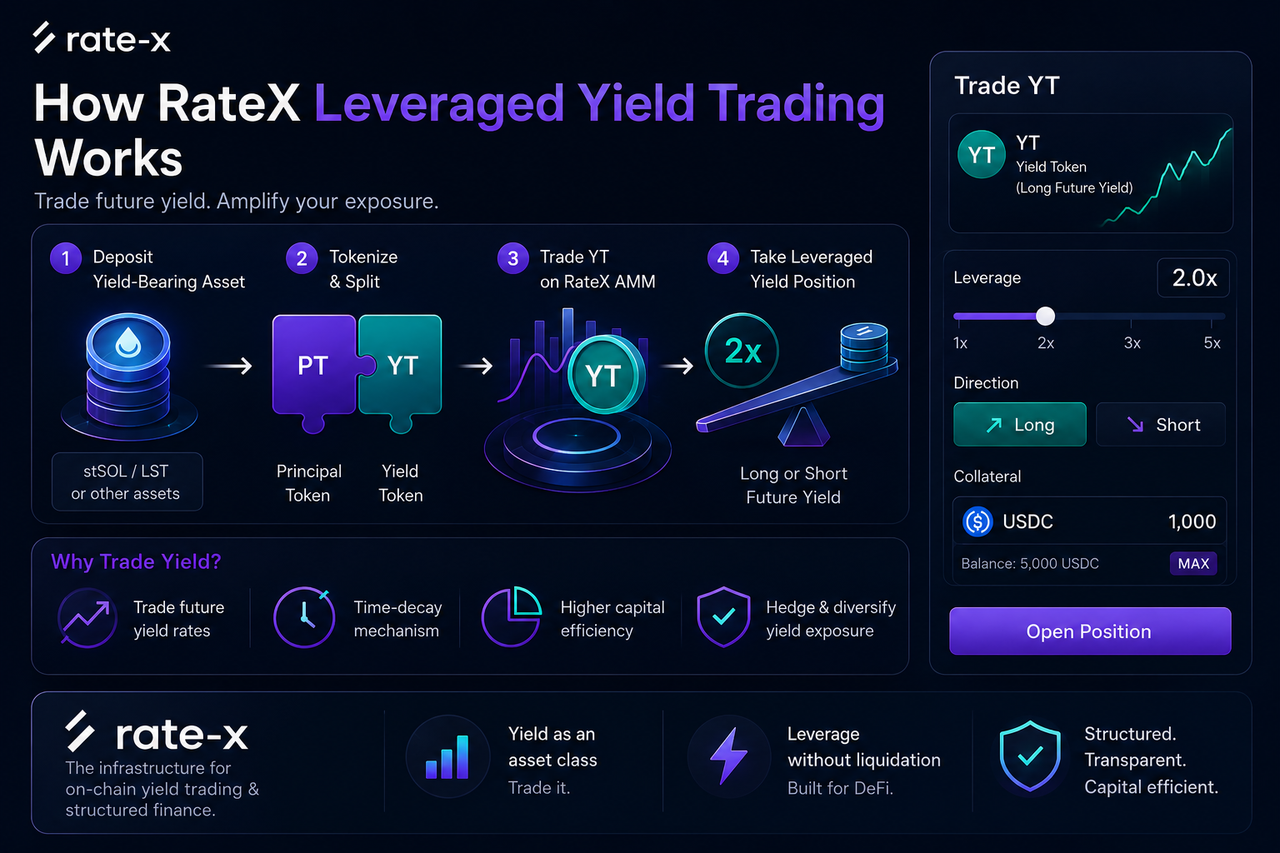
RateX’s leveraged yield trading is built on its yield tokenization mechanism.
When users deposit yield bearing assets into the protocol, the system automatically completes the yield splitting process. The original asset is converted into a Standardized Yield asset, after which the protocol generates PT and YT.
The full process can be understood as follows:
| Stage |
Function |
| Deposit yield bearing assets |
Gain yield exposure |
| Yield splitting |
Separate principal from future yield |
| Generate PT |
Corresponds to principal value |
| Generate YT |
Corresponds to the right to future yield |
| YT enters market trading |
Users trade future yield rates |
This structure allows yield rates to become independently tradable on-chain assets for the first time, while also providing the foundation for leveraged yield trading.
Why Can YT Enable Leveraged Yield Trading?
The price of YT is directly related to future yield rates, so it is usually more volatile than the underlying yield bearing asset.
For example, when the market yield rate rises from 5% to 10%, the value of future yield may increase significantly, so the price of YT usually experiences a larger move. This change in yield rates amplifies YT’s price sensitivity, giving it a natural leverage like quality.
RateX further allows users to amplify this exposure to yield rate fluctuations through its margin mechanism and yield market liquidity design.
Unlike traditional leveraged trading, the trading object on RateX is not the price of assets such as BTC or ETH, but the future yield rate itself. In practice, users are trading “yield expectations.”
This model is closer to the interest rate derivatives market in traditional finance than to an ordinary perpetual futures market.
How Do Users Conduct Leveraged Yield Trading on RateX?
The process of leveraged yield trading usually includes several stages: depositing assets, splitting yield, receiving YT, and establishing a yield rate position.
When users are bullish on future yield rates, they can buy YT. If market yields rise, the value of YT usually rises as well, creating potential profit.
If users believe future yield rates may decline, they can choose to sell YT or establish reverse yield rate exposure.
Because YT itself is highly sensitive to yield changes, even a small shift in market yield rates may lead to a large movement in YT price. This feature gives yield trading a risk and return structure similar to a leveraged market.
Why Does Time Decay Affect the Price of YT?
YT is a yield asset with a maturity date, so time directly affects its price.
As maturity approaches, YT represents less and less future yield, so its value usually declines gradually. This phenomenon is known as Time Decay.
For example, a YT with one year remaining until maturity usually has a higher value than a YT that is close to maturity, because the former corresponds to a longer period of future yield.
This structure means that:
As a result, the YT market is not only affected by supply and demand. It is also shaped by yield rate expectations and changes in time value.
How Does RateX’s AMM Support Yield Trading?
Traditional AMMs are mainly used for ordinary token trading. But yield markets have a clear time based component, so ordinary constant product models are not well suited to yield trading.
RateX has designed a dedicated time decay AMM for yield markets. As PT and YT approach maturity, the protocol dynamically adjusts its liquidity curve and pricing logic.
This design can reduce slippage in long dated yield asset trading and improve capital efficiency in the market.
Compared with ordinary AMMs, RateX’s yield AMM focuses more on:
| Core Factor |
Impact |
| Time decay |
Determines the remaining value of yield |
| Yield rate changes |
Affect the price of YT |
| Maturity structure |
Affects market pricing |
| Liquidity depth |
Affects trading slippage |
This mechanism allows yield markets to gradually develop a trading logic that is independent from ordinary spot markets.
What Are the Risks of Leveraged Yield Trading on RateX?
Although leveraged yield trading improves the efficiency of yield markets, it also carries significant risks.
First, the price of YT is usually more sensitive than that of the underlying yield bearing asset. As a result, even a small change in market yield rates may cause a noticeable movement in YT price.
Second, the yield market itself is still a relatively new area within DeFi, and its liquidity and market depth are still developing. During periods of high volatility, prices may be affected by liquidity conditions.
In addition, time decay is an important risk factor in yield trading. Even if market yield rates do not change significantly, the value of YT may gradually decline as maturity approaches.
How Is RateX’s Leveraged Yield Trading Different From Traditional Leveraged Trading?
Traditional leveraged trading usually revolves around asset prices, such as movements in BTC or ETH. RateX’s leveraged yield trading, by contrast, centers on changes in future yield rates.
The biggest difference between the two lies in the trading object.
| Comparison Dimension |
Traditional Leveraged Trading |
RateX Yield Trading |
| Core trading object |
Asset price |
Future yield rate |
| Source of volatility |
Market price changes |
Yield rate changes |
| Time impact |
Relatively weak |
Clearly present |
| Financial structure |
Margin trading |
Yield derivatives |
| Market logic |
Perpetual futures |
Interest rate market |
This difference means RateX is closer to an on-chain interest rate derivatives market than to a traditional crypto asset leverage market.
Conclusion
RateX’s leveraged yield trading is helping move the DeFi yield market from a passive yield model toward an active yield rate market. Through yield tokenization, the YT market, and a time decay AMM, RateX gives future yield rates independent tradability for the first time.
Compared with traditional DeFi yield protocols, RateX places greater emphasis on yield rate price discovery, yield rate trading, and structured finance logic. This model not only improves capital efficiency in yield markets, but also helps DeFi interest rate markets gradually develop a more complete financial structure.
FAQs
What Is a Yield Token (YT)?
YT is a token that represents the right to future yield. Its value fluctuates as future yield rates change.
What Is the Essence of RateX’s Leveraged Yield Trading?
At its core, it means establishing trading positions based on changes in future yield rates, rather than simply trading asset prices.
Why Is YT More Volatile?
Because YT directly reflects expectations for future yield, changes in yield rates can amplify its price fluctuations.
Why Is Time Decay Important?
As maturity approaches, the future yield represented by YT decreases, so its value usually declines gradually.
What Are the Risks of RateX Yield Trading?
The main risks include yield rate volatility risk, time decay risk, market liquidity risk, and smart contract risk.







