With the rapid rise of generative AI and AI Agents, the AI industry’s demand for data, models, and hash power resources continues to surge. Yet, traditional AI platforms often rely on centralized architectures, where data sources, model training, and return distribution lack transparency—leading to challenges such as ambiguous data ownership, limited collaboration efficiency, and opaque value distribution within the AI ecosystem.
The technical framework behind Sahara AI was developed to address these issues. As a native AI Layer1 blockchain platform, Sahara AI leverages blockchain verifiability and decentralized mechanisms to create an open, collaborative environment for AI data, models, Agents, and developers. Its goal is to establish an AI infrastructure system that enables traceable, approvable, and distributable returns. See more at AI Infrastructure System.
What is the overall architecture of Sahara AI?
Sahara AI’s architecture is built around the coordination of AI data, models, inference services, and AI Agents. Unlike traditional public blockchains that focus primarily on financial transactions, Sahara AI is engineered for AI asset management and workflow collaboration.
The platform utilizes an “on-chain confirmation + off-chain execution” model. The blockchain records the ownership, approval relationships, and return flows for AI data, models, and Agents, while actual model training and inference are handled by an off-chain computation layer. This approach preserves blockchain transparency while avoiding the high costs of running complex AI computations directly on-chain.
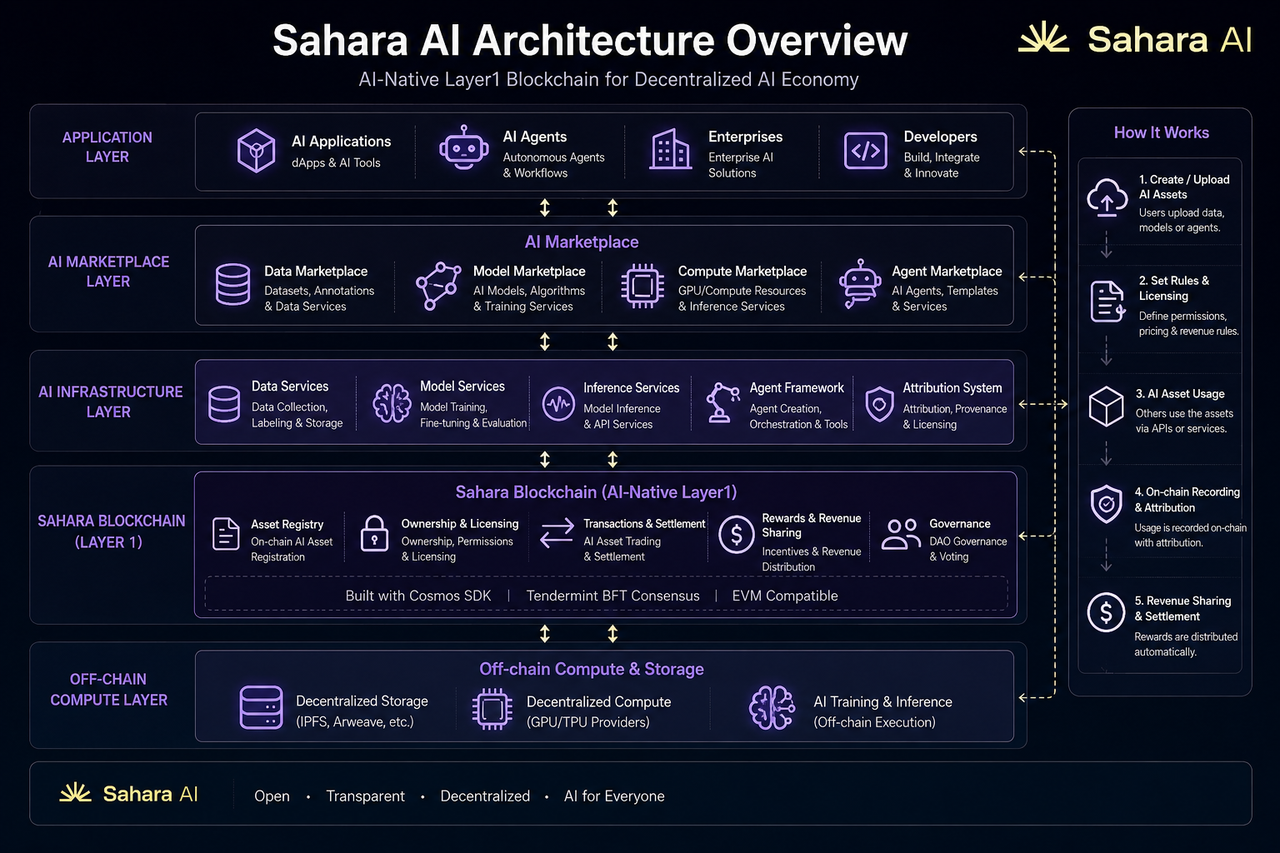
Sahara AI’s architecture consists of five main layers: the blockchain layer, data layer, AI execution layer, Marketplace layer, and application layer. The blockchain layer records AI asset status and transactions; the data layer manages data sources and approvals; the AI execution layer handles model training and inference; and the Marketplace and application layers facilitate AI service collaboration and ecosystem applications.
Why does Sahara AI use Cosmos SDK and Tendermint?
Sahara AI is built on the Cosmos SDK and Tendermint BFT consensus mechanism, offering high flexibility for modularity and scalability.
Cosmos SDK enables developers to customize blockchain modules for specific use cases. For Sahara AI, features like AI data approval, return attribution, and the AI Marketplace require a flexible underlying architecture—making Cosmos SDK an ideal choice for expanding AI-focused functionalities.
Tendermint BFT ensures fast transaction confirmation and high throughput, both critical for AI services that require frequent interactions and robust network security.
Sahara AI also supports EVM compatibility, allowing developers to easily deploy Ethereum-compatible applications and Smart Contracts, which significantly lowers the entry barrier for Web3 developers.
Why does Sahara AI use off-chain AI execution?
AI model training and inference demand extensive GPU and computational resources, which blockchains are not designed to handle efficiently.
Running AI inference entirely on-chain would result in excessive computational costs and degrade network performance. Sahara AI addresses this with a hybrid strategy: the blockchain records AI asset status, approval relationships, and return logic, while actual computations are performed off-chain.
This design ensures Sahara AI maintains both blockchain transparency and high AI computational efficiency. For instance, when a user invokes an AI model, the on-chain system logs the interaction and return distribution, while inference is executed by off-chain computation nodes.
How does Sahara AI manage AI data and models?
Sahara AI treats AI data, models, and Agents as digital assets with confirmable ownership, tracked through an Attribution System.
On traditional AI platforms, data contributors often have no visibility into whether their data is used or how returns are distributed. Sahara AI records data sources, model contributors, and AI service calls, then allocates returns according to established rules.
This mechanism is built around Attribution, Provenance, Licensing, and Revenue Sharing modules. Attribution logs contribution sources; Provenance tracks asset history; Licensing manages approvals; and Revenue Sharing automates return distribution.
With this system, AI data and models become on-chain digital assets that are approvable, tradable, and fully traceable.
How does the Sahara AI Marketplace operate?
The Sahara AI Marketplace is the ecosystem’s core trading layer, enabling the sharing and approval of AI data, models, and inference services.
Developers can upload AI models or data resources and define approval rules. When users access AI services, the system records these actions and automatically handles fee settlement and return distribution based on preset rules.
Compared to traditional AI service platforms, Sahara AI Marketplace prioritizes open collaboration and transparent returns. It supports not only AI model trading, but also datasets, AI APIs, and AI Agent cooperation.
This Marketplace structure positions Sahara AI as more than just a blockchain network—it serves as foundational infrastructure for the AI collaborative economy.
How is the AI Agent Economy realized in Sahara AI?
AI Agents are a cornerstone of the Sahara AI ecosystem. These intelligent programs autonomously complete tasks, invoke tools, and execute AI workflows.
Within Sahara AI, Agents can call models, access data, perform AI services, and collaborate with other Agents. All Agent actions and return flows are recorded on-chain, enabling Agents to participate directly in the AI economy.
What are the potential advantages of Sahara AI’s technical architecture?
Sahara AI’s architecture is designed to enhance transparency, collaboration efficiency, and return distribution within the AI industry.
Compared to traditional AI platforms, Sahara AI emphasizes the verifiability of data and model sources. By recording AI asset status on-chain, the platform improves data transparency and enables precise return attribution.
Its open collaboration model also reduces dependency on centralized AI platforms. Developers, data contributors, and AI service providers can work together within a unified ecosystem, leveraging on-chain mechanisms for seamless value transfer.
Furthermore, the modular Cosmos SDK architecture allows for flexible ecosystem expansion, positioning Sahara AI as a sustainable AI infrastructure for long-term growth.
That said, decentralized AI infrastructure is still an emerging field, with ongoing challenges in performance optimization, ecosystem scaling, and real-world adoption.
Summary
Sahara AI delivers open infrastructure for AI data, models, Agents, and return distribution through on-chain confirmation and off-chain execution. Its technical framework includes the Sahara Blockchain, AI Marketplace, Attribution System, and AI Agent Economy—supporting both AI asset management and the collaborative AI economy.
FAQs
Why does Sahara AI use off-chain AI execution?
AI model training and inference require substantial hash power, making on-chain execution prohibitively expensive. Sahara AI uses a hybrid architecture—on-chain recordkeeping with off-chain computation—to optimize both cost and performance.
What consensus mechanism does Sahara AI use?
Sahara AI is built on the Tendermint BFT consensus mechanism and leverages the Cosmos SDK as its core development framework.
Does Sahara AI support EVM?
Yes. Sahara AI is EVM-compatible, enabling developers to deploy Ethereum-based applications and Smart Contracts with ease.
What is the role of Sahara AI Marketplace?
The AI Marketplace facilitates the trading and approval of AI data, models, inference services, and AI Agents.
What is the key difference between Sahara AI and traditional AI platforms?
Sahara AI focuses on AI data ownership confirmation, return attribution, and open collaboration, while traditional AI platforms typically rely on centralized management models.







