Bitcoin short liquidations can accelerate an existing rally because exchanges forcibly close leveraged short positions as prices rise, creating buy orders that add to the upward pressure. If enough liquidation prices are clustered together, that forced buying can push Bitcoin higher again, trigger another group of shorts, and create a short-squeeze feedback loop.
For traders and investors trying to understand why some Bitcoin rallies suddenly become much faster than the original catalyst would suggest, the distinction matters. Liquidations can magnify a move dramatically, but they usually don't explain what started it or whether higher prices can last. That requires looking at spot demand, derivatives positioning, liquidity conditions and the broader forces behind a Bitcoin rally.
Key Takeaways
Bitcoin short liquidations turn bearish positions into forced buying. When a leveraged short reaches its liquidation threshold, the exchange automatically closes the position.
Liquidation clusters can create a short squeeze. Forced buy orders may lift Bitcoin into additional liquidation levels, producing a self-reinforcing feedback loop.
Higher leverage makes the process more sensitive. A trader using 50x leverage has far less room for an adverse move than one using modest leverage.
Open interest, funding rates and liquidation data help reveal derivatives positioning, but none predicts a squeeze with certainty.
Liquidation-driven buying is temporary. A sustainable rally normally needs continued spot demand, improving liquidity or another source of new buying.
How Can Short Liquidations Accelerate a Bitcoin Rally?
A short position is a bearish trade designed to benefit from lower prices. In Bitcoin futures and other derivatives markets, leveraged traders can control positions worth considerably more than the capital posted as margin.
The catch is that leverage works in both directions.
Suppose a trader controls a $50,000 Bitcoin short using $1,000 of effective margin at 50x leverage. Ignoring fees, maintenance-margin rules and other exchange-specific details, even a relatively small adverse price move can put such a position under severe pressure. Actual liquidation prices depend on the contract, margin mode, maintenance margin and platform rules, so a simple “2% move equals liquidation” shouldn't be treated as universal.
If the account no longer meets its maintenance-margin requirement, the liquidation mechanism used in crypto futures can take over the position. Instead of waiting for the trader to voluntarily buy Bitcoin back, the exchange automatically closes the short.
Closing a short requires buying back the exposure. That is where liquidation mechanics begin affecting the wider market.
How a Short Squeeze Creates Forced Buying
A short squeeze occurs when rising prices force traders betting on lower prices to close their bearish positions, adding still more buying pressure.
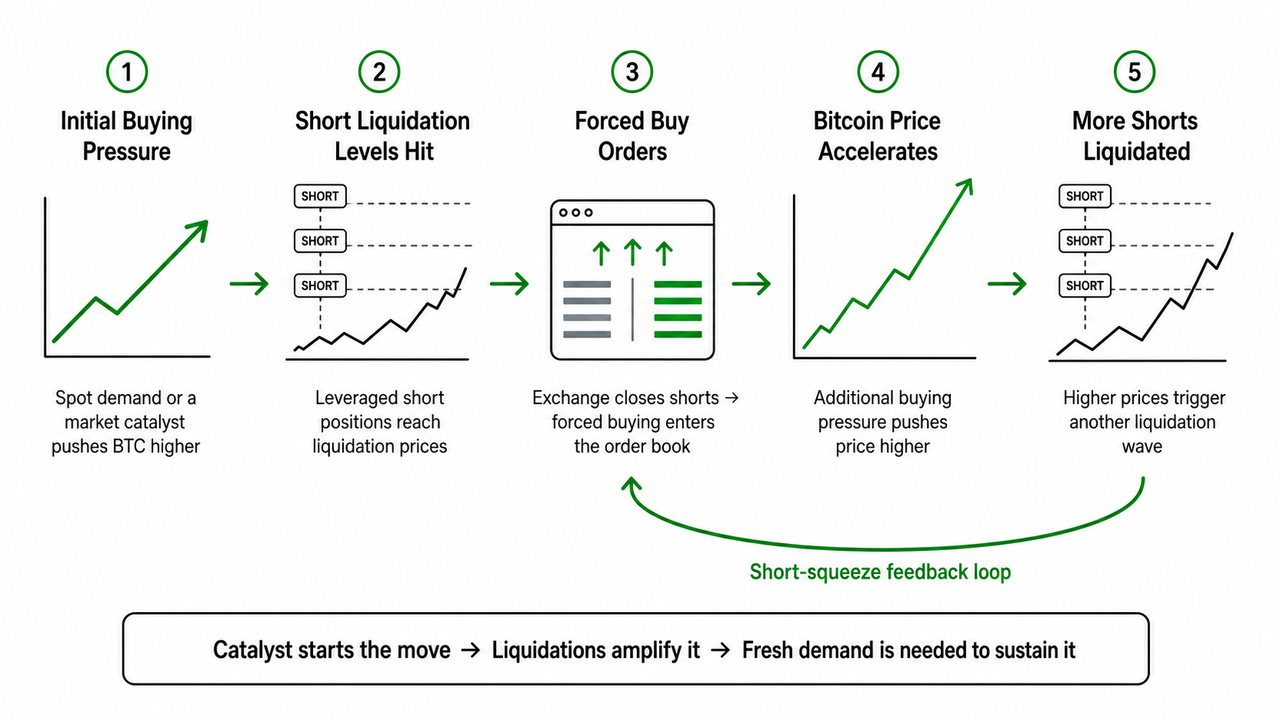
A simplified liquidation cascade looks like this:
Initial demand → Bitcoin rises → short liquidation levels are reached → forced buy orders enter → price rises further → more shorts are liquidated.
Imagine Bitcoin is moving toward key resistance while many leveraged short positions have liquidation prices just above it. New spot demand pushes BTC through the resistance level. The first group of shorts is forced out.
Those forced closures add buy orders to the order book. If that demand is large relative to available sell-side liquidity, Bitcoin may jump into the next cluster of liquidation prices. Another group gets closed, creating additional buying pressure.
The result can be a rapid upward move even though the amount of voluntary buying hasn't increased proportionally. Short liquidations are effectively converting traders' bearish bets into mandatory purchases.
This is why crypto moves can become unusually sharp once a squeeze begins.
Why Leverage and Open Interest Matter for Short Liquidations
Leverage determines how much market exposure a trader controls relative to posted collateral. Higher leverage generally leaves a smaller buffer between the entry price and the point at which adverse market moves threaten the position.
The basics of futures leverage and margin are therefore central to understanding liquidation cascades. A market containing many highly leveraged positions can react far more violently to the same initial price increase than one dominated by unleveraged spot holders.
Open interest adds another part of the picture. It measures outstanding derivatives positions that haven't yet been closed or settled. Rising open interest means more futures exposure is being created, although it doesn't by itself reveal whether that exposure is positioned for higher or lower prices.
Funding rates provide additional context. In perpetual derivatives markets, funding rates help keep contract prices aligned with spot markets. Persistently negative funding can sometimes accompany heavy bearish positioning, while positive funding may indicate stronger long-side demand. Neither reading guarantees that a squeeze is coming.
A trader studying the mechanics in real time can use the BTC/USDT perpetual futures market on Gate.com to compare price action with metrics such as open interest and funding while keeping in mind that derivatives data is descriptive rather than predictive.
What Liquidation Data Can Tell Traders
Liquidation data becomes most useful after it is combined with leverage, open interest, funding rates, volume and price structure.
Large short-liquidation readings confirm that bearish leveraged positions were forcibly removed. They don't prove that the liquidations started the rally.
Recent market moves show how quickly the process can develop. On August 19, 2026, more than $1 billion of Bitcoin short positions were reported liquidated in roughly one hour as BTC surged, illustrating how automated liquidation engines can remove large amounts of bearish exposure within a short period.
Across the broader crypto market, reports based on CoinGlass data put the two-day short-liquidation wave around August 19–21 at roughly $3.8 billion, although totals can vary depending on the exchanges and time windows included. Some data reconstructions produced lower short-only totals for narrower periods, so liquidation figures are best interpreted with their measurement window attached rather than treated as perfectly interchangeable statistics.
January 6, 2026 provides another useful example of why the distinction matters. CoinGlass data cited that day showed about $415 million in total crypto liquidations over 24 hours, including roughly $339 million in shorts. Bitcoin shorts accounted for about $169 million, rather than the entire $415 million figure.
Why a Liquidation-Driven Rally Still Needs a Catalyst
Short squeezes often amplify rallies rather than create them from nothing.
An initial catalyst might come from stronger spot demand, Bitcoin ETF inflows, improving risk appetite, regulatory developments or broader financial conditions. Changes in global liquidity conditions can also influence how much capital investors are willing to allocate to Bitcoin and other digital assets.
The August 2026 rally illustrates that interaction. Bitcoin's rise occurred alongside renewed institutional demand and a major short squeeze, while macro attention focused on U.S. Treasury plans to expand long-duration Treasury buybacks and political efforts surrounding the CLARITY Act. Those factors improved risk appetite at the same time that forced short covering magnified the latest move.
That sequence is important. A major catalyst attracts voluntary buyers. Price rises. Short liquidations then inject involuntary buyers into a market that is already moving upward.
The Short-Squeeze Feedback Loop
The strength of a liquidation wave depends heavily on how positions are distributed.
If only a small number of traders are short, forced closures may have little effect. If many traders have leveraged short positions concentrated around similar liquidation prices, crossing one price zone can activate many buy orders almost simultaneously.
Order-book liquidity also matters. A billion dollars of forced buying entering a deep market does not necessarily have the same price impact as the same pressure hitting a thinner market. During volatile periods, market participants may cancel resting orders or widen spreads, reducing available liquidity precisely when liquidation orders arrive.
The loop ends when the vulnerable short positions have been cleared, sellers absorb the buying pressure, or the market attracts enough new supply to halt the rise.
Risk Management Around Short Liquidations
Liquidation data should not be treated as a signal to automatically buy into a rally.
By the time massive short liquidations appear in headline data, much of the forced buying may already have occurred. Once bearish positions are flushed out, one source of demand disappears. Bitcoin can continue higher if fresh spot demand enters, but it can also consolidate or retrace.
Long liquidations create the mirror-image risk. If traders become heavily leveraged after a rapid rally and prices reverse, exchanges may forcibly close long positions, generating sell orders and accelerating the decline.
For leveraged traders, practical risk management means paying attention to position size, margin requirements, liquidation price and the consequences of changing volatility. Gate's explanation of futures liquidation mechanisms and risk controls shows why maintenance margin and position risk matter before a liquidation event, not only after one appears in derivatives data.
Past performance and previous liquidation events don't establish how Bitcoin will react to the next crowded derivatives position, and none of these mechanics constitutes investment advice.
Conclusion
Bitcoin short liquidations accelerate rallies by turning leveraged bearish positions into forced buy orders. When many liquidation levels are concentrated close together, those purchases can push price higher, trigger additional forced closures and form a short-squeeze feedback loop.
That makes derivatives positioning an important amplifier of Bitcoin price movements, especially when leverage and open interest are elevated. It isn't usually enough to sustain a rally on its own. Once short covering runs out, continued gains depend on new demand, available liquidity, macro conditions and the broader balance between buyers and sellers.
The useful distinction is simple: a catalyst can start the upward move; short liquidations can make it move much faster.
FAQ
What is a Bitcoin short liquidation?
A Bitcoin short liquidation occurs when an exchange forcibly closes a leveraged bearish position because the trader can no longer meet the required margin conditions. Closing the short creates buying activity because the position's exposure must be repurchased.
Can short liquidations push Bitcoin prices higher?
Yes. Forced short covering generates buy orders, and large liquidation clusters can create enough additional demand to accelerate an existing Bitcoin rally. The effect is usually strongest when market liquidity is limited and leveraged positioning is crowded.
What causes a Bitcoin short squeeze?
A short squeeze generally begins when Bitcoin rises against traders holding short positions. As liquidation prices or voluntary stop levels are reached, shorts close through buying, which can push BTC higher and force additional bearish positions out.
Does high open interest mean a short squeeze is coming?
No. High open interest shows that a large amount of derivatives exposure remains outstanding, but it doesn't identify the direction of every position or guarantee future liquidations. Funding rates, price structure, leverage and liquidation data provide additional context.
Can liquidations sustain a Bitcoin rally?
Usually not by themselves. Liquidation buying ends once vulnerable short positions have been closed. A longer-lasting rally generally needs continued spot demand, institutional flows, stronger liquidity conditions or another source of fresh buying.
Are short liquidations the same as spot Bitcoin demand?
No. Spot demand represents investors voluntarily purchasing Bitcoin, while short liquidation buying results from leveraged positions being forcibly or urgently closed. Both can push prices upward, but their persistence and market implications differ.
Author: Jared
Disclaimer
* The information is not intended to be and does not constitute financial advice or any other recommendation of any sort offered or endorsed by Gate.
* This article may not be reproduced, transmitted or copied without referencing Gate. Contravention is an infringement of Copyright Act and may be subject to legal action.
Yala is a modular Bitcoin DeFi infrastructure that connects BTC liquidity with multi-chain ecosystems through its YU stablecoin and MetaMint protocol. It enables Bitcoin holders to earn native DeFi yields across EVM and non-EVM networks securely and seamlessly.
PAXG (Pax Gold) is a tokenized asset backed by physical gold, issued by the fintech company Paxos and traded on the Ethereum blockchain as an ERC-20 token. The core concept is to tokenize physical gold on-chain, with each PAXG token representing ownership of a certain amount of gold. This structure enables investors to hold and trade gold in the form of a digital asset.
PAXG (Pax Gold) is a tokenized asset backed by physical gold reserves, launched by fintech firm Paxos and issued as an ERC-20 token on the Ethereum blockchain. The core concept is to digitally represent real-world gold assets, allowing investors to hold and trade gold via the blockchain network. Because each PAXG token corresponds to a specific quantity of physical gold, its price is theoretically expected to closely track the global gold market.
The Altcoin Season Index is a market indicator that measures how many leading altcoins have outperformed Bitcoin over a rolling 90-day period, showing whether market momentum is concentrated in Bitcoin or spreading across a broader group of cryptocurrencies. For sophisticated retail crypto traders and investors, as well as institutions and businesses tracking digital-asset trends, it is a practical way to judge market breadth, relative performance, and whether capital is rotating beyond Bitcoin.