With the rapid evolution of the BTCFi concept, the market has once again turned its attention to Bitcoin's on-chain financial infrastructure. Historically, vast amounts of BTC remained idle for long periods, unable to directly engage in DeFi activities. However, the emergence of Layer 2 and smart contract technologies has begun to introduce more sophisticated financial capabilities to Bitcoin.
Zest Protocol stands out as a key BTCFi protocol in this landscape. Its lending system is designed to create an on-chain capital market closely aligned with the Bitcoin native ecosystem, while improving capital efficiency for BTC in DeFi use cases.
What Is the Lending Model of Zest Protocol?
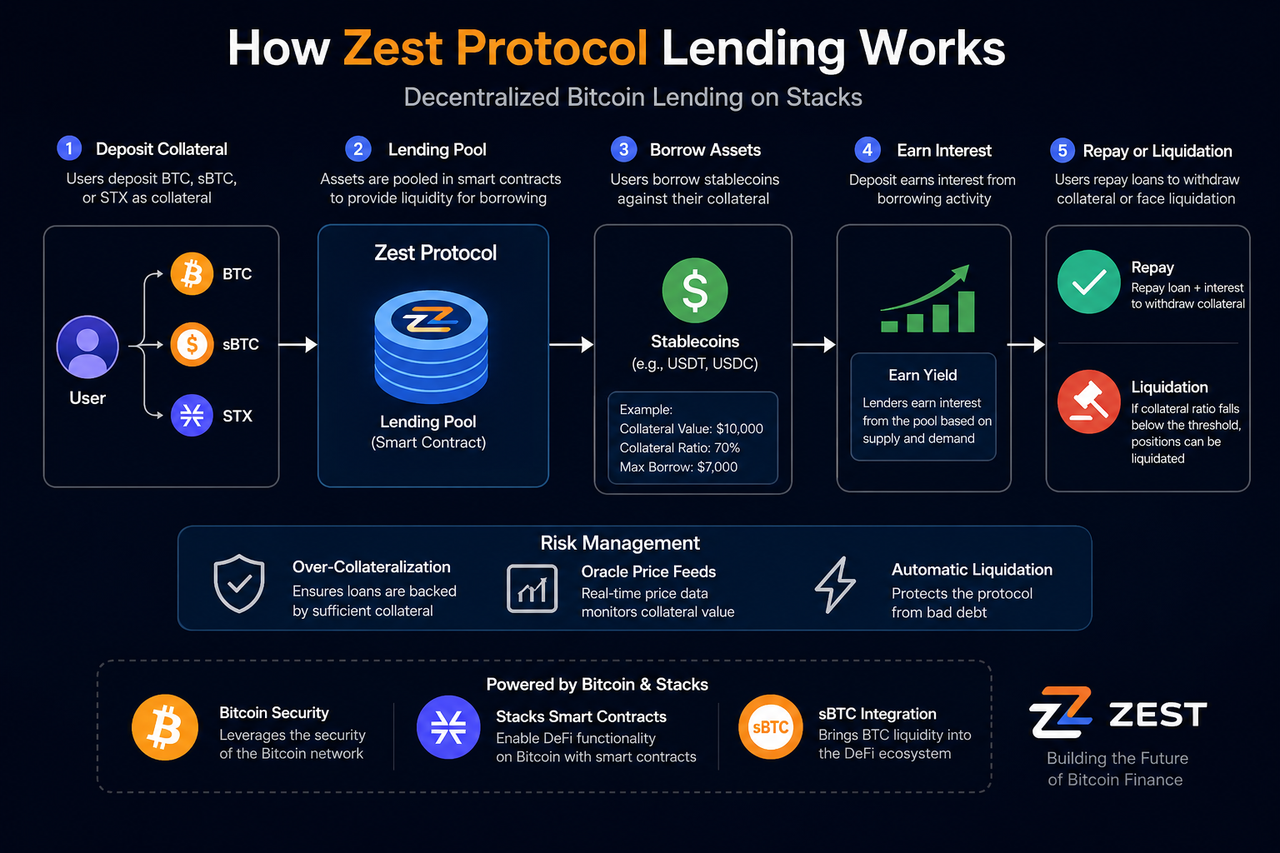
Zest Protocol employs an over-collateralized lending model, a common approach in DeFi. The core logic is simple: users must first deposit collateral assets worth more than the amount they wish to borrow, enabling them to lend out other assets.
Within Zest Protocol, users can deposit assets such as BTC, sBTC, or STX as collateral. The protocol determines the borrowable amount based on asset prices, risk parameters, and market liquidity. The process includes depositing collateral, calculating the borrowing limit, executing the loan, settling interest rates, and managing risk liquidation.
Given the high volatility of crypto assets, the protocol typically requires users to maintain a high collateral ratio to mitigate systemic bad debt risk. This is a fundamental mechanism shared by most on-chain lending protocols to ensure fund safety.
How Do Users Deposit Assets in Zest Protocol?
Before lending can begin, users must first connect a wallet and deposit assets into the protocol’s liquidity pool.
Since Zest Protocol primarily operates on the Stacks network, users generally need a wallet that supports Stacks and its ecosystem assets. Once assets are deposited, the protocol creates a corresponding deposit position and starts accruing returns.
When users deposit BTC-related assets, the funds typically enter the BTCFi liquidity pool, providing liquidity to the borrowing market. This structure mirrors the liquidity pool logic found in Ethereum DeFi. However, because the Bitcoin mainnet lacks native smart contract support, Zest Protocol relies heavily on Layer 2 and pegged asset frameworks.
How Does Zest Protocol Calculate the Borrowing Limit?
The borrowing limit is primarily determined by the collateral ratio.
After a user deposits assets, the protocol calculates the maximum borrowable amount based on market price and risk parameters. For instance, if a user deposits BTC valued at $10,000 and the protocol sets a collateral ratio of 70%, the user can theoretically borrow up to approximately $7,000 worth of assets.
This mechanism is designed to ensure that even during market volatility, the protocol retains sufficient collateral to cover outstanding debt.
If the market price of BTC declines, the user’s collateral ratio gradually drops. When it falls below the system’s safety threshold, the protocol may automatically initiate the liquidation process.
How Does the Interest Rate Mechanism of Zest Protocol Work?
Interest rates in Zest Protocol are driven by market supply and demand dynamics.
When borrowing demand rises and liquidity in the pool shrinks, borrowing rates typically increase. Conversely, when liquidity is abundant, rates tend to decline. This creates an on-chain capital supply and demand market.
For depositors, assets in the pool continuously generate interest income. Borrowers, in turn, pay the associated borrowing cost to access liquidity.
A key advantage of BTCFi lending is that users can obtain liquidity in stablecoins or other on-chain assets without selling their BTC. This allows BTC to participate in financial activities while maintaining full asset exposure.
How Is the Liquidation Mechanism of Zest Protocol Triggered?
The liquidation mechanism is a critical risk control feature in DeFi lending protocols.
Due to the high volatility of BTC and other crypto assets, if a user’s collateral value continues to decline, the protocol faces potential bad debt. Therefore, when the collateral ratio drops below the minimum safety threshold, the system automatically triggers liquidation.
The process typically unfolds in the following stages:
- BTC market price declines
- User’s collateral ratio decreases
- Liquidation threshold is reached
- Liquidators repay a portion of the debt
- They receive discounted collateral assets as a reward
This mechanism helps the protocol maintain solvency and is a cornerstone of stable DeFi lending markets.
How Do Stacks and sBTC Support the Lending Process?
The Bitcoin mainnet does not support complex smart contracts natively. Therefore, Zest Protocol implements its lending logic primarily through the Stacks network.
Stacks is a Layer 2 network built on Bitcoin that enables smart contracts and DeFi applications. sBTC is an asset pegged to BTC, designed to bring BTC into the smart contract environment.
In Zest Protocol, Stacks handles on-chain lending execution, while sBTC serves as a BTC liquidity entry point. Smart contracts manage lending relationships, interest rate calculations, and risk liquidation.
This architecture allows Bitcoin to gradually acquire financial capabilities similar to those of Ethereum DeFi, driving the BTCFi market toward a more comprehensive on-chain financial system.
How Is Zest Protocol Different from Traditional DeFi Lending?
Although Zest Protocol, Aave, and Compound all use an over-collateralized model, there are major differences in their underlying ecosystems and asset structures.
| Dimension |
Zest Protocol |
Ethereum DeFi |
| Core Assets |
BTC, sBTC |
ETH, USDC |
| Underlying Network |
Bitcoin + Stacks |
Ethereum |
| Smart Contract Environment |
Layer 2 |
Native EVM |
| Market Maturity |
Early BTCFi |
Mature DeFi |
| Main Objective |
BTC Financialization |
General On-Chain Finance |
The core distinction of Bitcoin DeFi lies in building a financial market around native BTC assets, rather than simply replicating Ethereum DeFi. Accordingly, BTCFi emphasizes Bitcoin’s security, native BTC liquidity, and a non-custodial financial model.
Summary
As a decentralized lending protocol within the Bitcoin DeFi ecosystem, Zest Protocol aims to improve BTC’s capital efficiency and establish a native on-chain financial market for Bitcoin.
By leveraging an over-collateralized model, Stacks smart contracts, and the sBTC liquidity structure, Zest Protocol enables users to lend, borrow, and earn returns using BTC-related assets.
FAQs
What Collateral Assets Does Zest Protocol Support?
Currently, Zest Protocol supports BTC-related assets, sBTC, and Stacks ecosystem assets such as STX.
What Is Over-Collateralized Lending?
Over-collateralized lending requires users to provide collateral worth more than the borrowed amount, reducing the protocol’s bad debt risk.
How Does Zest Protocol Control Risk?
The protocol manages risk through collateral ratio monitoring, real-time price tracking, and an automatic liquidation mechanism.
What Role Does sBTC Play in the Lending Process?
sBTC is a BTC-pegged asset that enables Bitcoin to enter the smart contract environment and participate in the BTCFi lending market.
What Is the Difference between Zest Protocol and Aave?
Zest Protocol is built for the Bitcoin DeFi market, while Aave operates primarily in the Ethereum DeFi ecosystem. Their asset structures and underlying networks are fundamentally different.