In a multi-chain and modular DeFi landscape, assets often face three core challenges: fragmented liquidity, disconnected yield pathways, and complex cross-chain operations. Once users deposit assets into a protocol, they are typically confined to a single ecosystem, limiting capital efficiency and reducing potential yield opportunities.
StakeStone’s significance lies in its attempt to merge “staking yield” with “cross-chain liquidity” into a unified layer. It enables major assets like ETH and BTC to move freely across different chains and applications while continuing to generate underlying returns. For users and protocols aiming to improve capital efficiency, StakeStone offers an infrastructure approach closer to an “asset hub.”
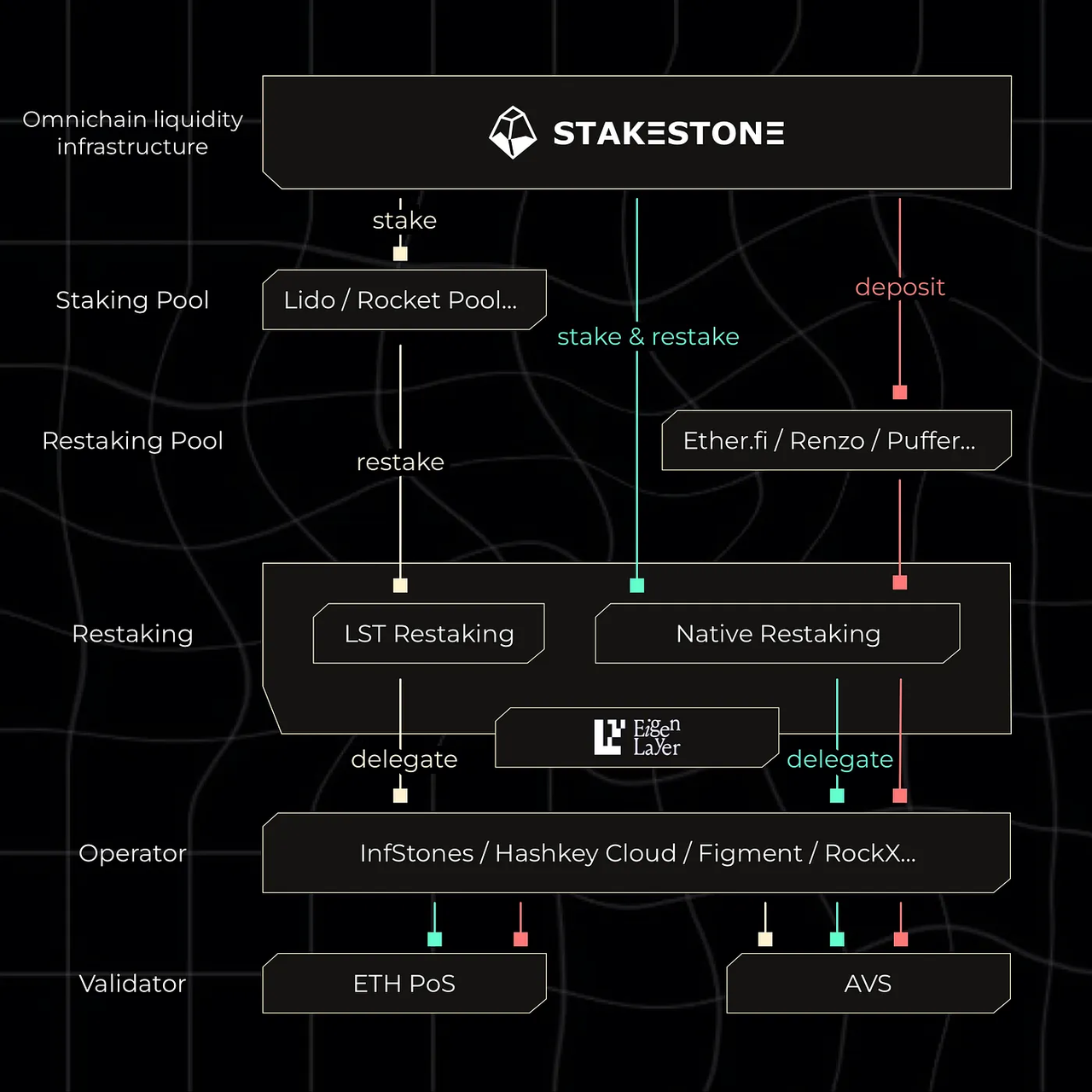
Unlike traditional single-chain staking, StakeStone relies on cross-chain mechanisms and coordination across multiple protocols. This allows assets to flow dynamically between different yield sources, improving overall capital efficiency.
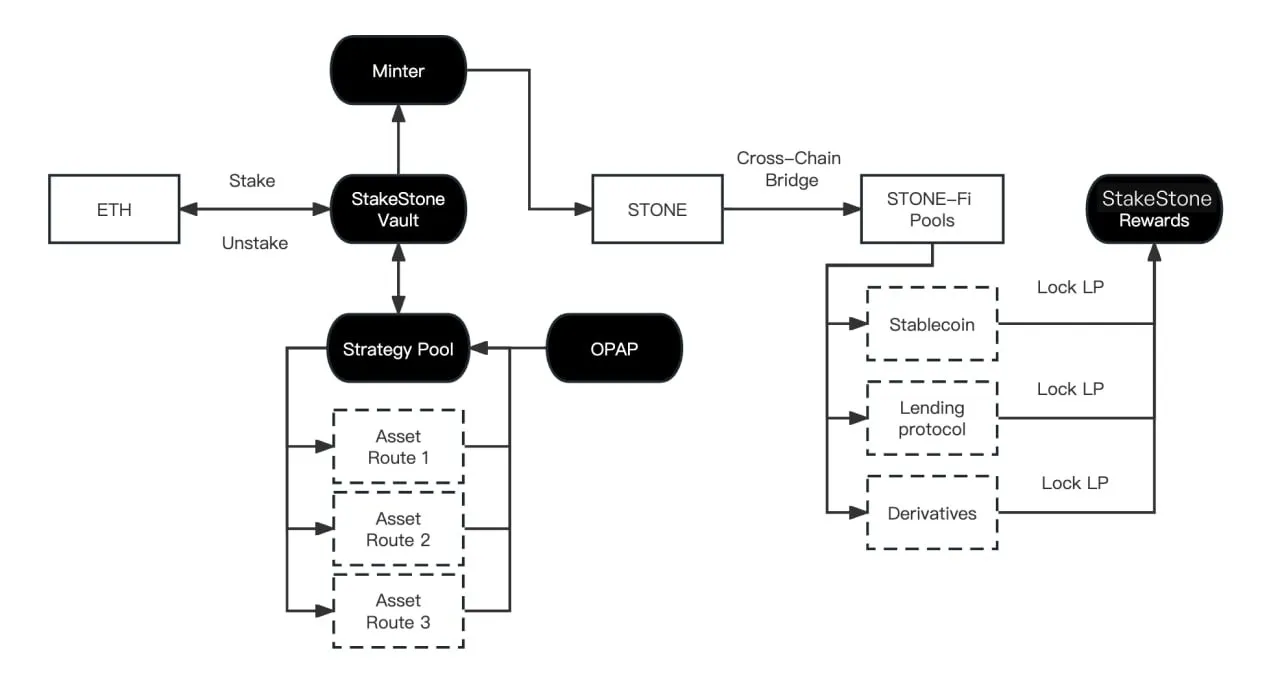
StakeStone operates as a complete capital flow system, with its core process consisting of asset deposits, yield strategy allocation, and yield return.
When users deposit ETH or liquid staking assets into the protocol, those assets enter a unified liquidity pool and generate corresponding ownership tokens, such as STONE. The protocol then allocates these assets across different yield sources based on predefined strategies, including base staking and restaking mechanisms. During this process, some funds may be routed to other blockchain networks to capture better yield opportunities.

The overall flow can be summarized as: asset deposit → yield token issuance → strategy allocation → multi-source yield generation → cross-chain routing → yield accumulation and return.
From a user’s perspective, StakeStone functions like an asset hub. After depositing ETH or BTC, users receive on-chain assets that remain usable and composable within DeFi, rather than being locked in a static contract. This preserves yield generation while expanding potential use cases.
One of StakeStone’s most important features is that it treats “yield” and “liquidity” within the same framework. Many traditional staking solutions provide returns but reduce asset flexibility. StakeStone, by contrast, aims to let users earn yield while keeping their assets usable.
The second feature is its non-custodial design. User assets are not managed through opaque centralized control. Instead, allocation and distribution are executed through on-chain mechanisms and strategy pools, aligning with DeFi’s emphasis on transparency and verifiability.
The third feature is its native cross-chain capability. Rather than treating bridging as an auxiliary function, StakeStone positions cross-chain liquidity as a core component. Assets entering the protocol are not only used to generate yield but are also evaluated for how they can continue creating value across different chains and applications.
StakeStone does not pursue a single static yield source. Instead, it dynamically allocates assets across different yield pathways through its strategy pools. Underlying assets may be distributed into various strategies such as staking, liquidity management, or other opportunities better suited to current market conditions.
The significance of this design lies in its balance between return and risk. Rather than chasing the highest possible APY, StakeStone aims for more sustainable yields. In real markets, higher returns often come with higher risk, and StakeStone’s goal is to avoid short-term spikes followed by sharp declines.
For users, this means the protocol continuously optimizes how assets are deployed based on on-chain conditions, market dynamics, and governance parameters. Assets are no longer passively stored but are actively managed and reallocated at the protocol level.
StakeStone’s cross-chain routing mechanism integrates both yield generation and liquidity demand. It is not simply about moving assets from one chain to another, but ensuring that assets remain yield-generating and composable throughout the process.

In a multi-chain environment, DeFi opportunities are unevenly distributed. Some chains offer deeper liquidity, others provide richer yield strategies, while some are better suited for long-term value storage. StakeStone addresses this by routing assets across chains, positioning them where they can be most effective, both for the ecosystem and for user returns.
The practical benefit is clear: users do not need to sacrifice yield when moving assets across chains, nor do they need to compromise flexibility to pursue returns. The protocol handles routing at the backend, while users simply hold the corresponding on-chain assets.
StakeStone generates returns from multiple layers. The most basic comes from the underlying asset’s yield, such as staking rewards. Additional returns come from strategy pool allocations, as well as ecosystem incentives, integrations, or protocol expansion.
These yields are not distributed as direct cash payouts. Instead, they are reflected in the value of the on-chain assets or ownership tokens held by users. In other words, the longer users hold these assets, the more yield they accumulate in theory, with returns expressed through asset value, redemption mechanics, or internal protocol accounting.
This model aligns with DeFi’s asset-native logic. Yield is not distributed in isolation but is embedded into the value of the asset itself. Users can continue accumulating returns without needing to take frequent actions.
StakeStone integrates asset deposits, yield strategy allocation, and cross-chain routing into an automated system, allowing users to access multi-source yield without complex operations. Its core strength lies in improving capital efficiency through layered yield strategies and cross-chain capabilities, while reflecting returns through asset-backed tokens.
This model reflects a broader shift in blockchain yield systems, evolving from single-source staking toward multi-strategy aggregation.
Typically no. Most strategies are executed automatically by protocol.
Primarily base staking rewards and restaking yields.
Yes. Its yield optimization relies on cross-chain routing mechanisms.
Returns are generally reflected through increases in asset value.
StakeStone combines multiple strategies and cross-chain mechanisms, whereas traditional staking usually depends on a single-chain yield source.