The Ronin ecosystem is built around Web3 gaming, with its primary focus on lowering entry barriers for users accessing blockchain games and enhancing the efficiency of on-chain asset trading. Beyond supporting flagship blockchain games like Axie Infinity, Ronin has evolved into a foundational infrastructure encompassing wallet, NFT, payment, and token systems.
What Is Ronin Network
Ronin distinguishes itself from traditional general-purpose public blockchains by positioning as specialized gaming infrastructure. Originally developed by Sky Mavis to meet Axie Infinity’s on-chain trading and asset management needs, Ronin’s core objective is to address Ethereum’s early high transaction fees and slow confirmation times.
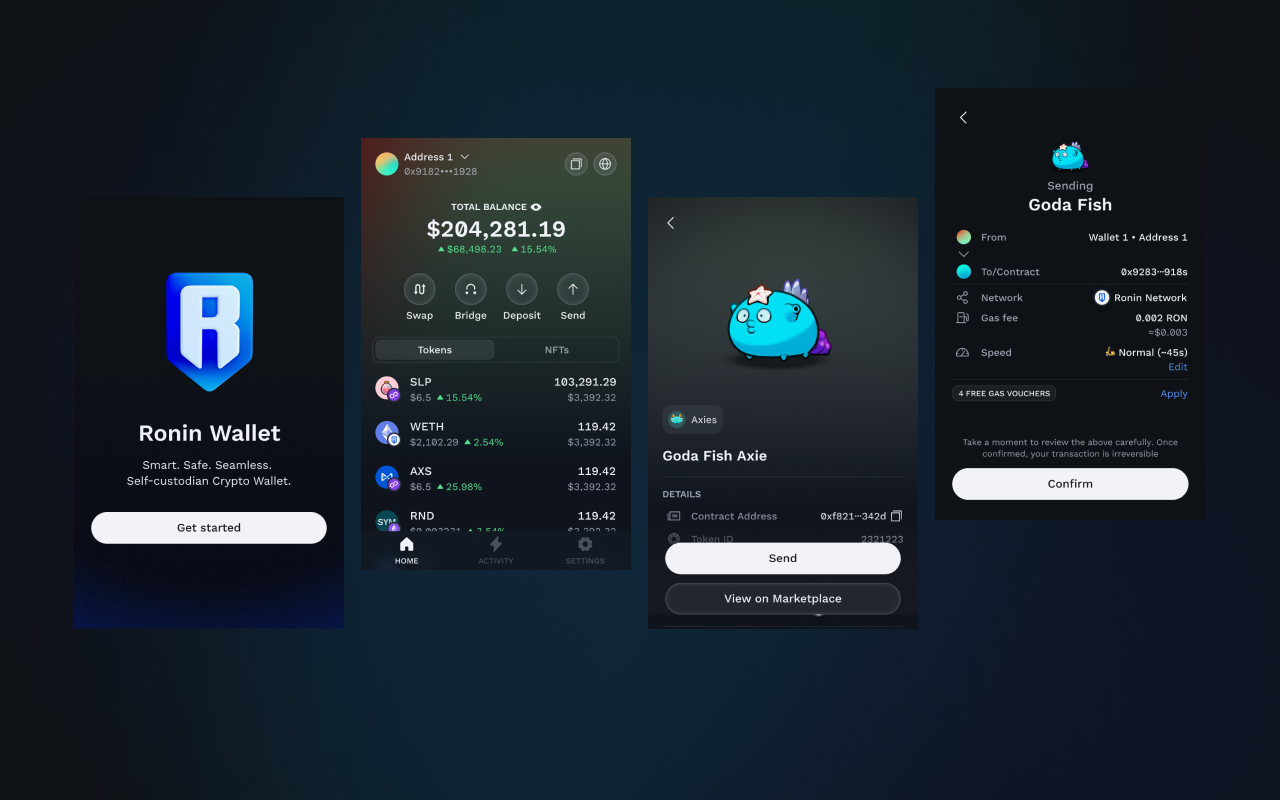
Architecturally, Ronin is an Ethereum-compatible sidechain. Users manage assets via Ronin Wallet and can conduct NFT trades, token transfers, and on-chain interactions within games. Shifting most operations to the Ronin network significantly lowers user costs.
This approach allows blockchain games to maintain asset ownership while delivering a user experience similar to traditional gaming. According to official sources, Ronin’s design has always been game-centric, resulting in an ecosystem structure that is clearly distinct from general Layer1 blockchains.
How Ronin Operates as a Game-Dedicated Sidechain
Ronin’s network is purpose-built for the circulation of gaming assets. Unlike typical blockchains, it does not focus on supporting a broad spectrum of DeFi protocols but instead prioritizes high-frequency in-game transactions, NFT transfers, and user account interactions.
Ronin processes transactions through independent validator nodes, executing most gaming activities on the sidechain. This reduces mainnet congestion and lowers Gas costs for users. Frequent in-game purchases, NFT upgrades, or reward claims all benefit from this lightweight transaction environment.
In essence, Ronin is an application chain tailored to gaming economies. Its ecosystem revolves around core modules such as:
- Game assets
- NFT trading
- On-chain payments
- Player accounts
This targeted structure gives Ronin a strong foothold in blockchain gaming, though its ecosystem breadth is narrower than that of general-purpose public blockchains. Complex financial applications and multi-chain protocols remain largely deployed on networks like Ethereum.
How Ronin’s Consensus Mechanism and Validator Nodes Work
Ronin relies on validator nodes to jointly maintain network status. Its consensus mechanism uses a limited set of nodes to confirm transactions, boosting overall processing efficiency.
Unlike fully open public blockchains, Ronin initially adopted a restricted validator structure to enhance network responsiveness and reduce system load from high-frequency transactions. In gaming, transaction confirmation speed directly impacts user experience, so Ronin prioritizes stability and efficiency.
Validator nodes are responsible for:
- Block production
- Transaction confirmation
- Network synchronization
- Data validation
The system operates through coordinated nodes, with the RON token playing a central role in staking and network incentives.
However, this structure also means Ronin’s decentralization differs from traditional public blockchains. Following a high-profile Bridge security incident, Ronin increased its validator count and strengthened security protocols. Bridge security and validator mechanisms are now critical components of the Ronin ecosystem.
How Ronin Wallet Lowers the Barrier to Blockchain Gaming
Blockchain game users frequently manage NFTs, tokens, and account assets, making the wallet system vital. Ronin Wallet is designed to make Web3 gaming accessible to mainstream users.
Compared to standard crypto wallets, Ronin Wallet is optimized for gaming interactions. Users connect game accounts directly, manage NFTs, trade assets, and make on-chain payments—all through a familiar, platform-like interface rather than complex blockchain tools.
As a result, even users with no blockchain experience can quickly create accounts and manage assets. Official documentation notes that Ronin Wallet integrates payment gateway features to simplify deposits.
Structurally, Ronin Wallet is not just for asset management—it’s the primary gateway to the Ronin ecosystem, facilitating game logins, NFT marketplace trading, and on-chain applications.
The Role of the RON Token in the Ronin Ecosystem
The RON token underpins Ronin’s operational costs. As the ecosystem’s core token, RON is used for transaction fees, network staking, and validator incentives.
RON serves as the network’s Gas token. Users pay RON for NFT transfers, in-game transactions, and on-chain interactions. Ronin’s fee structure is typically lower than Ethereum’s, supporting its low-cost user experience.
Beyond Gas, RON is integral to the validator node system. Node operations and network security mechanisms depend on token staking for incentive distribution, linking token economics with network operation.
The table below summarizes RON’s primary functions in the Ronin ecosystem:
| Functional Module |
RON’s Role |
| Network trading fees |
Pays on-chain transaction costs |
| Node incentives |
Supports validator operations |
| Staking mechanism |
Participates in network security |
| Ecosystem circulation |
Supports blockchain game economies |
| Governance function |
Enables participation in governance |
Thus, RON is both a medium of exchange and a foundational component of the Ronin network. More comprehensive economic and governance models are typically explored in dedicated discussions.
How Ronin Supports Axie Infinity and Blockchain Gaming Ecosystem Growth
Ronin was initially built to support Axie Infinity’s on-chain requirements. As Axie Infinity’s user base expanded, Ethereum’s high fees began to hinder gameplay, prompting Sky Mavis to develop an independent sidechain.
Ronin functions as dedicated infrastructure for Axie Infinity, enabling in-game NFT, character, and token transactions within the network. This reduces transaction wait times and user costs.
This model has enabled Ronin to expand from a single-game network to a broader gaming ecosystem. Third-party projects are now integrating with Ronin, building applications centered on NFTs, gaming assets, and on-chain trading.
Nevertheless, the Ronin ecosystem remains gaming-focused. Compared to general-purpose blockchains, its applications are more concentrated, with ecosystem growth centered on Web3 gaming.
How Ronin Differs from Ethereum, Polygon, and Immutable
Blockchain networks differ in positioning and architecture. Ronin is optimized for blockchain gaming, while Ethereum, Polygon, and Immutable each have distinct expansion paths and ecosystem structures.
The table below highlights key differences:
| Network |
Core Positioning |
Main Scenario |
Trading Fee Profile |
Ecosystem Focus |
| Ronin |
Game-dedicated sidechain |
Blockchain games and NFT |
Relatively low |
Gaming ecosystem |
| Ethereum |
General-purpose public chain |
DeFi and infrastructure |
Relatively high |
Comprehensive ecosystem |
| Polygon |
Expansion network |
Multi-application scenarios |
Low |
Multi-chain expansion |
| Immutable |
Gaming infrastructure |
NFT and blockchain games |
Low |
Gaming and NFT |
Ronin’s standout feature is its tight focus on gaming. Ethereum is more general-purpose, while Polygon and Immutable emphasize scalability and gaming asset frameworks, respectively.
These distinctions mean each network is suited to different applications. For projects requiring high-frequency NFT and gaming transactions, Ronin is particularly well-suited.
Ronin’s Advantages, Limitations, and Security Risks
Ronin’s main advantages stem from its gaming-focused optimizations—low fees, fast confirmations, and a wallet system tailored for blockchain games deliver a user experience close to traditional gaming platforms.
Its specialized structure also allows efficient NFT and gaming asset circulation, reducing infrastructure adaptation costs for developers.
However, specialization limits ecosystem scope. Compared to general-purpose blockchains, Ronin’s capabilities in DeFi, multi-chain protocols, and complex financial applications are less developed.
Ronin has also experienced a Bridge security incident, highlighting the importance of validator and Bridge security in sidechain networks. The team has since expanded validator nodes and enhanced security systems, making Bridge and validator security a key area of research for gaming blockchains.
Summary
Ronin Network is a blockchain built for Web3 gaming, focused on reducing transaction costs and enhancing user interaction efficiency. Its ecosystem centers on game assets, NFTs, wallet infrastructure, and the RON token, setting it apart from general-purpose public blockchains.
Compared to comprehensive blockchains, Ronin prioritizes gaming experience and high-frequency asset flows. As blockchain gaming infrastructure evolves, Ronin has established an independent ecosystem and plays a key role in the Web3 gaming landscape.
FAQ
Is Ronin Network a Layer2?
Ronin is generally considered an Ethereum-compatible sidechain, operating differently from traditional Layer2 solutions.
What Is Ronin Wallet Used For?
Ronin Wallet is used to manage NFTs, gaming assets, and on-chain tokens on the Ronin network, and serves as a key gateway to the blockchain gaming ecosystem.
What Is the Purpose of the RON Token?
RON is primarily used for network transaction fees, staking, and supporting validator node incentives.
How Does Ronin Differ from Polygon?
Ronin is focused on blockchain gaming, while Polygon is designed for multi-application network expansion. Their ecosystem directions and structures are different.
Why Is Ronin Closely Linked to Axie Infinity?
Ronin was launched by Sky Mavis specifically to support Axie Infinity’s on-chain asset trading and gaming operations.