Los usuarios suelen buscar SLOP porque Slonks no es solo una colección NFT estándar: combina discrepancias de imagen generadas por IA, cambios en el estado de los NFT y tokenomics. El valor de SLOP no puede entenderse solo como un Meme Token ni como un token de gobernanza tradicional; es necesario analizarlo en el contexto del sistema Void de Slonks.
Este tema abarca tres aspectos clave: cómo se convierte el valor slop en SLOP, cómo el Void permite que los NFT sean recuperables y cómo el mecanismo de quema de SLOP define la estructura de suministro de Slonks.
Qué es el token SLOP
SLOP transforma el valor de discrepancia de imagen de un Slonks NFT en un activo negociable. Según el mecanismo oficial, SLOP es la versión ERC-20 de slop, donde slop representa el número de píxeles distintos entre la imagen generada por el modelo Slonks y la imagen original de CryptoPunk.
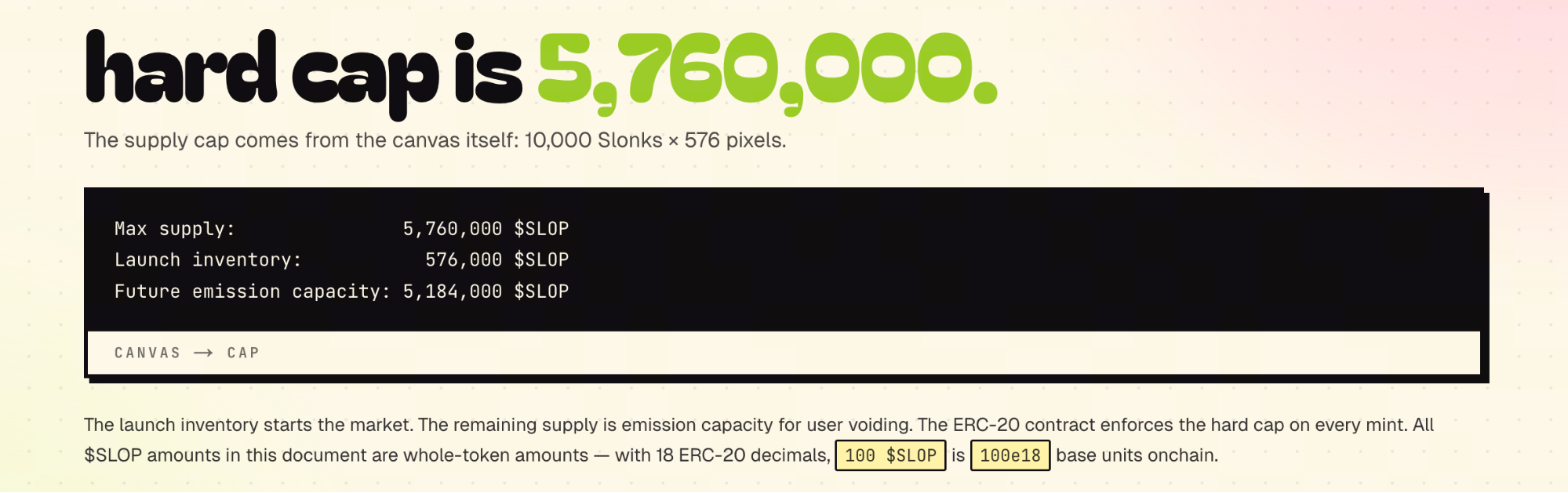
En términos estructurales, SLOP no es un token emitido de forma independiente a los NFT, sino un recurso on-chain generado a partir del estado de cada Slonks NFT. Cada imagen Slonk consta de 576 píxeles, por lo que el valor slop de cada NFT puede variar entre 0 y 576. Cuando un Slonk entra en el Void y se reclama, su valor slop determina la cantidad de SLOP acuñado.
La dinámica de suministro de SLOP es diferente de la de los Meme Tokens tradicionales. No existen reservas de equipo, asignaciones para VC ni airdrop fijos para la comunidad; la emisión del token depende directamente de la actividad NFT.
| Tokenomics de SLOP |
Dato |
| Suministro máximo |
5 760 000 SLOP |
| Suministro circulante inicial |
576 000 SLOP |
| Método de emisión posterior |
Los usuarios voidean NFT |
| Mecanismo de quema |
Revival Burn |
| ¿La fusión acuña tokens? |
No |
| Emisión máxima por NFT |
576 SLOP |
Es decir, SLOP funciona principalmente como un recurso on-chain impulsado por diferencias de imagen NFT, y no como un token preminado convencional.
Cómo el mecanismo Void genera SLOP
El núcleo del Void es trasladar los NFT de Slonks de un estado activo a un estado de contrato, convirtiendo el valor slop del NFT en SLOP. El Void no es una simple dirección de quema, sino un pool de contrato donde quedan almacenados los NFT voideados, que pueden reintegrarse a la circulación mediante Revival.
Primero, el usuario bloquea un Slonk activo en el contrato del juego. El sistema registra al usuario como destinatario del reclamo de SLOP y el NFT no puede transferirse ni modificarse mientras permanece bloqueado.
Cualquier usuario puede presentar una prueba de salida del modelo para verificar el estado actual de la imagen y su valor slop. El contrato acuña la cantidad correspondiente de SLOP según el slop verificado y la transfiere al destinatario registrado.
Por último, el Slonk pasa al Void y se suma al inventario de NFT elegibles para Revival.
| Etapa del proceso |
Acción del usuario |
Acción del sistema |
Resultado |
| Bloquear Slonk |
El usuario envía el NFT |
El contrato registra al destinatario |
El NFT queda pendiente de reclamo |
| Enviar prueba |
Cualquier dirección envía prueba |
El sistema verifica la salida |
Se confirma el valor slop |
| Reclamar SLOP |
El usuario espera o activa el reclamo |
Se acuña el SLOP correspondiente |
El slop se convierte en token |
| Entrar en Void |
El NFT deja de estar activo |
El contrato almacena el Slonk |
Pasa a inventario Revival |
Este proceso muestra que el Void es un mecanismo on-chain completo de “bloqueo, verificación, acuñación y agrupación”, no una simple quema de NFT.
Por qué el valor slop determina la cantidad de SLOP
Como SLOP es la tokenización de slop, el valor slop determina exactamente cuántos SLOP se acuñan. El slop de cada Slonk se calcula como la diferencia de píxeles entre su imagen generada por IA y el CryptoPunk original, sirviendo a la vez como métrica de variación visual y parámetro de emisión.
El sistema analiza el sourceId del Slonk, el embedding activo, los píxeles generados y los píxeles originales de CryptoPunk, calculando el número de píxeles distintos.
Dado que una imagen Slonk contiene 576 píxeles, el máximo de SLOP que puede generarse por Void es 576.
| Valor slop actual |
SLOP generado |
| 15 |
15 SLOP |
| 128 |
128 SLOP |
| 400 |
400 SLOP |
| 576 |
576 SLOP |
Este diseño asegura que el suministro de SLOP esté vinculado algorítmicamente al estado visual del NFT, no a asignaciones manuales. Cuanto mayor sea el slop, mayor la diferencia respecto a la imagen original y mayor la cantidad de SLOP acuñado.
El mecanismo fusiona variaciones visuales NFT, pruebas on-chain y emisión de tokens. SLOP no es solo una recompensa del ecosistema: es una representación líquida de la salida del modelo de Slonks.
Cómo SLOP restaura los NFT en estado Void
El uso principal de SLOP es el Revival, es decir, quemar SLOP para recuperar un Slonk del Void. Así, SLOP tiene tanto un canal de adquisición como una utilidad concreta.
Primero, el usuario solicita un Revival y quema SLOP al coste actual de Revival. El sistema registra la solicitud y, tras un plazo, emplea aleatoriedad on-chain para seleccionar un Slonk del pool Void.
El Slonk seleccionado recibe un nuevo embedding activo y vuelve a la circulación con un nuevo estado de imagen. El tokenId y sourceId del NFT permanecen, pero tanto el nivel de merge como el estado de imagen se actualizan.
Revival es el principal mecanismo de quema de SLOP. Tras la quema, los usuarios no eligen un NFT concreto, sino que participan en un sorteo on-chain para restaurar un Slonk desde el Void.
Este mecanismo otorga a SLOP utilidad real: permite devolver NFT desde el Void al estado activo y reduce el suministro de SLOP mediante quema.
Cómo se diferencia SLOP de los Meme Tokens estándar
La diferencia principal de SLOP respecto a los Meme Tokens es que no se basa en marketing narrativo ni en una emisión fija. Genera un ciclo de oferta y demanda a través del Void NFT de Slonks, el cálculo slop y Revival.
Por lo general, los Meme Tokens se centran en hype comunitario, pool de liquidez y trading, y el token rara vez está vinculado al estado de un NFT o a cálculos on-chain.
SLOP, en cambio, se emite según el valor slop de cada Slonk tras su void y se consume mediante quema en Revival.
| Comparación |
SLOP |
Meme Token estándar |
| Fuente de emisión |
Mecanismo Void de Slonks |
Oferta predefinida |
| Relación con el activo |
Vinculado al NFT |
Normalmente independiente |
| Base de cálculo |
Diferencia de píxeles slop |
Sin base on-chain |
| Uso |
Revival para restaurar NFT |
Trading y uso comunitario |
| Dinámica de suministro |
Afectada por void y quema |
Definida por tokenomics |
Así, SLOP es un recurso funcional dentro del ecosistema NFT de Slonks, no un Meme Token de hype.
Cómo Slonks construye un ciclo con SLOP
El ciclo del ecosistema Slonks gira en torno a NFT, Void, SLOP y Revival. Los NFT pueden ir al Void para generar SLOP y volver del Void mediante la quema de SLOP.
Tras adquirir un Slonk, los usuarios pueden enviarlo al Void y recibir SLOP equivalente a su valor slop. Otros pueden quemar SLOP para activar un Revival y recuperar un Slonk del Void.
El Slonk revivido mantiene su identidad, pero recibe un nuevo estado de imagen y vuelve a la circulación activa.
Nota: Merge cambia la imagen del NFT y aumenta el slop, pero no genera SLOP directamente. Su función principal es potenciar los futuros retornos del Void.
En resumen:
- Merge aumenta el slop
- Void libera SLOP
- Revival quema SLOP
Estos tres mecanismos conforman el ciclo on-chain de Slonks.
Cómo el mecanismo SLOP afecta a la escasez de NFT
El mecanismo de SLOP impacta la escasez de los NFT de Slonks tanto por Void como por Revival. Void reduce el número de NFT activos, mientras que Revival devuelve algunos NFT en estado Void a la circulación, haciendo dinámica la oferta.
Cuando más usuarios voidean sus Slonks, el número de NFT activos disminuye y aumenta la circulación de SLOP. Se reducen los Slonks negociables, pero crece el pool de Revival.
Por el contrario, cuando más usuarios queman SLOP para Revival, los NFT regresan del Void, la oferta de SLOP baja y aumentan los Slonks activos.
Esto convierte la escasez de Slonks en un fenómeno dinámico, determinado no solo por la oferta inicial, sino por cómo los usuarios mueven activos entre NFT y SLOP.
El mecanismo de SLOP va más allá de los tokens: modifica la estructura de suministro NFT, el ritmo de restauración y las estrategias de los usuarios.
Resumen
El papel del token SLOP se entiende solo dentro de los mecanismos Void y Revival de Slonks. No es un Meme Token estándar, sino la representación ERC-20 de slop, que otorga liquidez a las discrepancias de imagen NFT.
En la práctica, los usuarios bloquean su Slonk en el Void, el sistema verifica la salida del modelo y calcula el slop, y luego acuña el SLOP correspondiente. Posteriormente, SLOP puede quemarse en el proceso Revival para devolver algunos NFT en estado Void a la circulación activa.
Por su parte, Merge modifica el estado visual del NFT y aumenta el rendimiento futuro del Void, pero no genera SLOP directamente.
Esta estructura da lugar a una relación cíclica entre los NFT de Slonks, los valores slop y los tokens SLOP, transformando la escasez NFT de un modelo estático a un mecanismo dinámico impulsado por los usuarios.
Preguntas frecuentes
Qué es el token SLOP
SLOP es la versión ERC-20 del valor slop en el ecosistema Slonks. Se genera mediante el mecanismo Void y está vinculado a las discrepancias de imagen de los NFT de Slonks, el estado on-chain y el proceso Revival.
Cuál es el suministro máximo de SLOP
Según el white paper oficial, el suministro máximo teórico de SLOP es 5 760 000, basado en 10 000 NFT Slonk y 576 píxeles por NFT.
Cómo genera SLOP el Void
El Void bloquea un NFT Slonk y calcula su valor slop utilizando una prueba de salida del modelo. Tras el reclamo, el contrato acuña una cantidad de SLOP igual al valor slop.
Merge genera SLOP directamente
No. Merge cambia el estado de imagen del NFT y aumenta el slop, afectando la cantidad de SLOP que puede acuñarse en futuros Void.
Cómo restaura SLOP los NFT
Los usuarios pueden quemar SLOP para iniciar una solicitud de Revival. El sistema selecciona aleatoriamente un Slonk del pool Void y lo restaura a la circulación activa con un nuevo estado de imagen.
Cuál es la diferencia entre SLOP y los Meme Tokens
La emisión y el consumo de SLOP están ligados al mecanismo NFT de Slonks, mientras que los Meme Tokens suelen depender del hype comunitario y el trading. SLOP funciona como un recurso dentro del ecosistema NFT.