A medida que evoluciona el mercado DeFi, los protocolos de trading descentralizado han dejado de ser simples herramientas de trading para convertirse en infraestructura financiera fundamental on-chain. Inicialmente, los DEX resolvían principalmente los intercambios de activos on-chain, pero con el aumento de la demanda de gestión de liquidez, estrategias de rendimiento y derivados on-chain, el mercado ha exigido protocolos con mayor programabilidad y escalabilidad. En este escenario, Uniswap ha continuado impulsando mejoras en el protocolo y presenta Uniswap v4, una versión que apuesta por la modularidad y la extensibilidad para desarrolladores.
Como uno de los protocolos DEX más influyentes del ecosistema DeFi, el diseño de Uniswap ha marcado el rumbo de los mercados de liquidez on-chain. Mientras v3 se centró en la liquidez concentrada, Uniswap v4 da un salto relevante, mejorando la flexibilidad del protocolo y la eficiencia de Gas gracias a innovaciones como Hooks, pools personalizadas y arquitectura Singleton. Estas novedades no solo optimizan la experiencia de trading, sino que acercan Uniswap a convertirse en un sistema operativo de liquidez abierto, ofreciendo una base sólida para que los desarrolladores creen aplicaciones DeFi avanzadas.
¿Qué es Uniswap v4?
Uniswap v4 es la actualización de última generación del protocolo Uniswap, enfocada en la escalabilidad y la personalización para desarrolladores. A diferencia de las versiones previas, v4 no es solo un protocolo de trading AMM, sino que evoluciona hacia una infraestructura abierta capaz de soportar una amplia gama de mecanismos de liquidez.
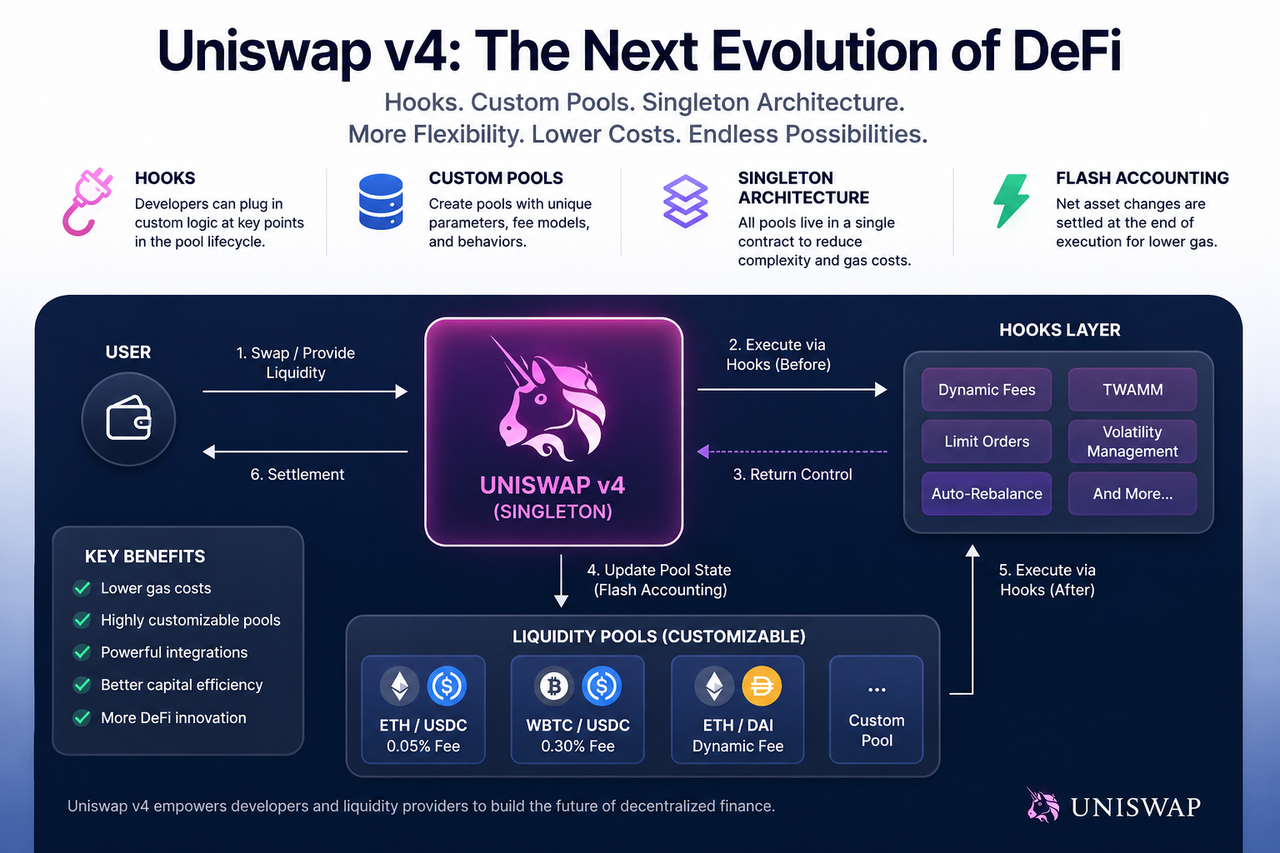
v4 mantiene la arquitectura esencial de AMM y pool de liquidez, pero ahora permite a los desarrolladores insertar lógica personalizada en las operaciones de los pools mediante Hooks. Así, cada pool de liquidez puede personalizarse con funciones flexibles, superando la dependencia de las reglas estándar del protocolo.
¿Qué son los Hooks?
Los Hooks representan una de las innovaciones más destacadas de Uniswap v4. Se trata de módulos de Contrato inteligente conectables que permiten a los desarrolladores ejecutar lógica personalizada en distintos puntos del proceso de trading o de liquidez.
Por ejemplo, los Hooks pueden servir para:
- Ajustar de forma dinámica las tarifas de trading
- Reinvertir automáticamente los retornos de LP
- Crear órdenes límite on-chain
- Gestionar la volatilidad
- Implementar TWAMM (market making automatizado ponderado por tiempo)
- Rebalancear automáticamente la liquidez
Los Hooks transforman Uniswap de un DEX estandarizado a un framework para desarrolladores capaz de soportar lógica financiera diversa.
¿Cómo funciona la arquitectura Singleton?
En versiones anteriores, cada pool de liquidez solía estar vinculado a un contrato independiente. Uniswap v4 introduce la arquitectura Singleton, que consolida todos los pools de liquidez en un único contrato central.
Las principales ventajas de este diseño son:
- Reducción de los costes de Gas en operaciones entre pools
- Mayor eficiencia en las interacciones entre pools
- Menos despliegues redundantes de contratos
- Mejor escalabilidad general del protocolo
Para la agregación de operaciones y estrategias DeFi complejas, la arquitectura Singleton minimiza las transiciones de estado on-chain y optimiza la eficiencia global del trading.
¿Cómo reduce Flash Accounting los costes de Gas?
Flash Accounting es una función clave de optimización de Gas en Uniswap v4. Su principio es que los cambios de activos se liquidan de forma colectiva al final de cada transacción, en lugar de transferir activos en cada paso.
Esto reduce el número de actualizaciones de estado on-chain y disminuye los costes de trading. En rutas de trading complejas que atraviesan varios pools, el ahorro de Gas es aún mayor.
A medida que las interacciones entre protocolos DeFi se hacen más frecuentes, Flash Accounting permite maximizar la eficiencia del capital on-chain.
¿En qué se diferencia Uniswap v4 de v3?
A diferencia de v3, centrada en la liquidez concentrada, v4 apuesta por la programabilidad a nivel de protocolo.
El avance de v3 fue permitir a los LP asignar capital en rangos de precios específicos para mejorar la eficiencia del capital. v4 va un paso más allá y da a los desarrolladores la capacidad de personalizar la lógica de los pools, de modo que cada pool pueda ofrecer funciones únicas para diferentes escenarios.
Además, v4 aprovecha la arquitectura Singleton y Flash Accounting para optimizar los costes de Gas y mejorar la eficiencia de ejecución en rutas de trading complejas.
En resumen, v3 se orienta a optimizar la eficiencia de la liquidez, mientras que v4 está diseñada como una arquitectura de protocolo abierta y modular.
¿Qué impacto tiene Uniswap v4 en DeFi?
La actualización de Uniswap v4 podría transformar la manera en que se desarrollan los protocolos DeFi. Antes, muchos proyectos tenían que crear su propio DEX o sistema de liquidez desde cero. Ahora, gracias a los Hooks, los desarrolladores pueden construir lógica financiera personalizada directamente sobre Uniswap.
Este enfoque baja la barrera de entrada al desarrollo DeFi y puede acelerar la aparición de nuevos productos financieros on-chain, como market making automatizado, estrategias de rendimiento estructuradas y sistemas de gestión de riesgos dinámicos.
Al mismo tiempo, el diseño modular de v4 refuerza aún más la posición de Uniswap como infraestructura central de liquidez on-chain.
Resumen
Uniswap v4 es más que una simple actualización del protocolo DEX: marca una evolución de la infraestructura DeFi hacia la modularidad y la programabilidad. Con funciones como Hooks, pools de liquidez personalizables, arquitectura Singleton y Flash Accounting, Uniswap pasa de ser un protocolo de trading básico a convertirse en una plataforma de liquidez abierta y on-chain.
A medida que las aplicaciones DeFi se vuelven más sofisticadas, la flexibilidad y extensibilidad de Uniswap v4 impulsarán la innovación en productos financieros on-chain y marcarán el camino para la próxima generación de protocolos de trading descentralizado.
Preguntas frecuentes
¿Cuál es la principal diferencia entre Uniswap v4 y v3?
v3 se centra en optimizar la liquidez concentrada, mientras que v4 prioriza los Hooks, la lógica personalizada y la programabilidad del protocolo.
¿Para qué sirven los Hooks?
Los Hooks permiten tarifas de trading dinámicas, reinversión automática, órdenes límite on-chain, gestión de la volatilidad y market making automatizado.
¿Qué función cumple la arquitectura Singleton?
La arquitectura Singleton unifica múltiples pools de liquidez en un único contrato, lo que reduce los costes de Gas y mejora la eficiencia de las interacciones.
¿Uniswap v4 reducirá las tarifas de trading?
v4 utiliza Flash Accounting y la arquitectura Singleton para optimizar las actualizaciones de estado on-chain, ayudando a reducir ciertos costes de trading.
¿Uniswap v4 sigue usando AMM?
Sí. v4 sigue funcionando sobre el modelo AMM, pero con mayor extensibilidad y personalización.
¿Por qué es importante Uniswap v4 para DeFi?
v4 aumenta la flexibilidad del protocolo y la extensibilidad para desarrolladores, consolidando a Uniswap como infraestructura abierta de liquidez líder.