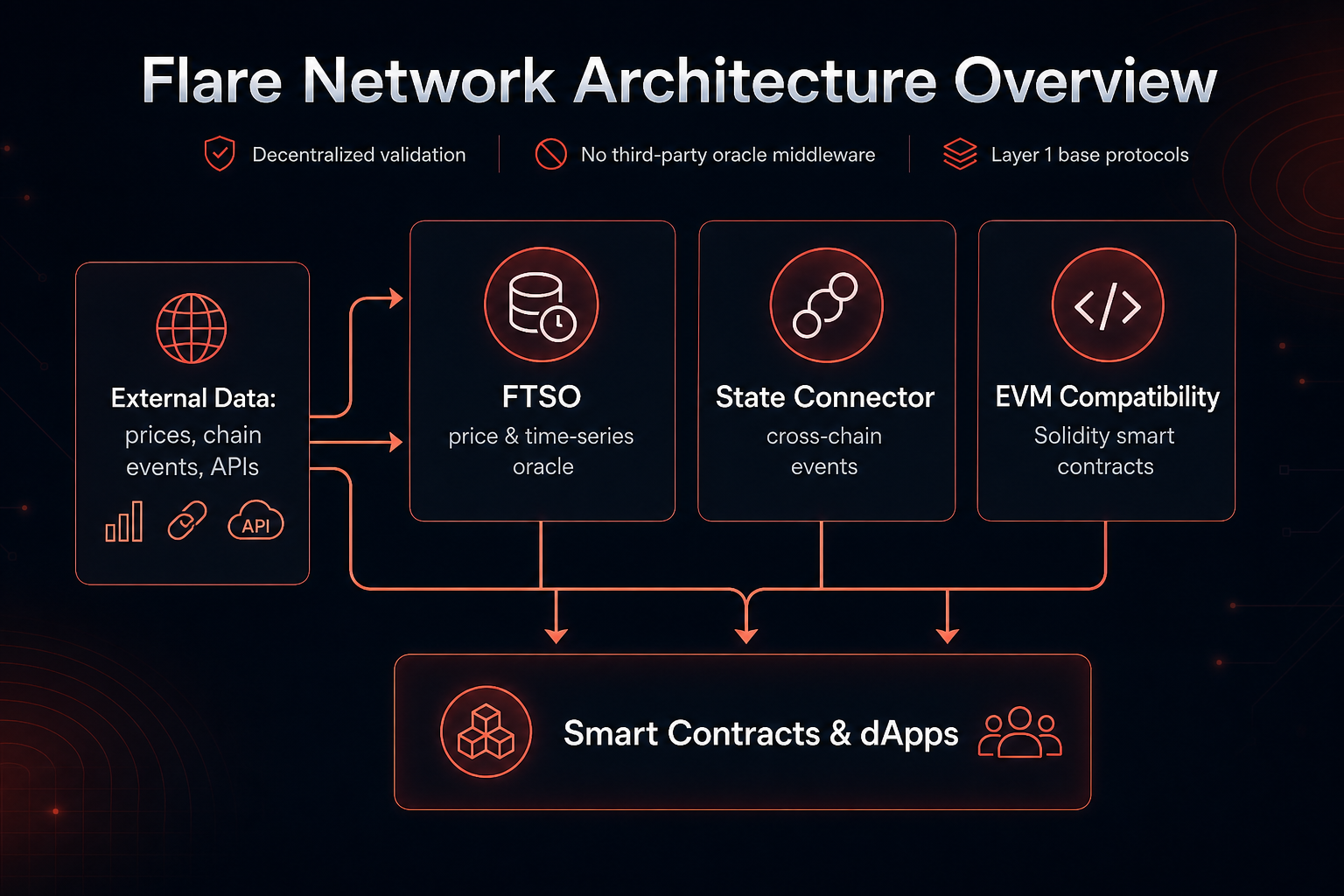
Flare Network is a Layer 1 built for decentralized data and interoperability. Native FTSO and the State Connector help smart contracts read external-chain and real-world data without relying solely on centralized oracles.
Flare Network is a Layer 1 built for decentralized data and cross-chain interoperability. Native FTSO (time-series oracle) and the State Connector help smart contracts read external-chain and real-world data without relying only on centralized oracles. It is EVM-compatible, so Ethereum-style contracts can migrate with limited changes; FLR is used for governance, staking, and network fees.
Unlike chains that leave oracles entirely to the application layer, Flare pushes data availability into protocol design so prices and event confirmations can be reused as infrastructure. Through the mid-to-late 2020s, related capabilities appear in cross-chain DeFi, bridging, NFTs, and data apps—always confirm product details in official docs.
What Is Flare Crypto? A Beginner’s Overview
Flare Crypto refers to the Flare Network and its native token, FLR, which together form a groundbreaking blockchain ecosystem designed to unlock decentralized access to off-chain data. Launched to solve a core challenge in blockchain development—interoperability and data availability—Flare aims to bridge the gap between otherwise isolated blockchains and real-world information.
At its core, Flare is a Layer 1 blockchain that is fully compatible with the Ethereum Virtual Machine (EVM). This means developers can deploy Ethereum-based smart contracts directly onto Flare with minimal modifications. But Flare goes beyond just being “another EVM chain.” It is uniquely optimized to deliver high-integrity, decentralized data to smart contracts via built-in protocols.
Flare empowers decentralized applications (dApps) by giving them secure, trustless access to real-time data such as asset prices, event confirmations on other blockchains, and even internet-based information. This is crucial because many dApps, especially in DeFi, rely heavily on off-chain data to function properly.
What sets Flare apart is that it brings this data on-chain without depending on centralized oracle providers. Instead, it uses its native protocols:
Flare Time Series Oracle (FTSO) for price and time-series data
State Connector for reading and verifying events from other blockchains
The combination of these tools enables Flare to be a “blockchain for data”—a platform where data becomes a public good that is accessible, decentralized, and reliable.
Whether you’re a beginner just diving into crypto or a developer exploring blockchain infrastructure, understanding Flare provides insight into the future of cross-chain communication, data accessibility, and decentralized trust.
How Flare Network Works: Key Features and Architecture
Flare Network stands out in the blockchain ecosystem due to its innovative architecture focused on trustless data acquisition and interoperability. Its core design enables smart contracts on Flare to access a wide range of decentralized and real-world data sources without relying on centralized or third-party oracles. Here’s a deeper look into how it all works:
1. Flare Time Series Oracle (FTSO)
The FTSO is a native decentralized oracle built directly into the Flare blockchain. It collects and delivers accurate, real-time data (like cryptocurrency prices) to decentralized applications (dApps) on the network. Here’s how it works:
Independent data providers submit estimates on-chain.
These estimates are aggregated and weighted based on historical accuracy.
The result is a highly reliable, trust-minimized data feed available to smart contracts.
This system allows developers to build DeFi applications and synthetic assets that depend on accurate, tamper-resistant data without needing centralized oracles.
2. State Connector
The State Connector is another groundbreaking component of Flare’s architecture. It allows the network to securely acquire and verify data from external blockchains and web APIs, making Flare a true interoperability hub.
Key capabilities include:
Cross-chain functionality: Enables dApps on Flare to interact with other blockchains like Bitcoin, Ethereum, and XRP Ledger without bridges.
Decentralized validation: Events from external chains are validated by a consensus mechanism on Flare, ensuring security and reliability.
Support for FAssets: Tokenized representations of non-smart contract tokens (e.g., XRP, BTC, DOGE) that can be used within Flare’s DeFi ecosystem.
This component gives Flare an edge in enabling cross-chain DeFi, NFT trading, and interoperable gaming ecosystems.
3. EVM Compatibility
Flare is fully Ethereum Virtual Machine (EVM)-compatible, which means developers can deploy smart contracts written in Solidity—just like on Ethereum. This compatibility:
Makes it easier to port existing Ethereum dApps to Flare.
Supports tools like MetaMask, Remix, and Hardhat.
Attracts developers familiar with the Ethereum ecosystem.
4. Proof-of-Stake (PoS)-Based Consensus
Flare uses a variant of the Avalanche consensus protocol, which is fast, scalable, and secure. Combined with its PoS system, it provides:
High throughput for dApps
Low-latency finality on transactions
Energy-efficient validation compared to Proof-of-Work (PoW) systems
5. Dual Utility Model
Unlike many blockchains, Flare integrates two core protocols—FTSO and State Connector—directly at the base layer, rather than relying on third-party services. This ensures greater efficiency, lower costs, and higher trustlessness.
Together, these features position Flare Network as a leading infrastructure for decentralized, data-driven, and interoperable applications. Whether for DeFi, GameFi, or cross-chain data flows, Flare’s design offers a scalable and secure foundation for the next generation of blockchain innovation.
Flare vs Other Smart Contract Platforms: What Sets It Apart?
Unlike many Layer 1 blockchains, Flare is uniquely focused on data accessibility and interoperability. Its native protocols allow for:
Cross-chain compatibility: Enabling assets and data to move seamlessly between different blockchains.
Decentralized data access: Providing dApps with reliable, real-time data without relying on centralized sources.
This positions Flare as a powerful platform for building complex, data-driven applications across various sectors.
Use Cases of Flare: Real-World Applications and Integrations
Flare’s capabilities open the door to numerous real-world applications:
Decentralized Finance (DeFi): Flare supports the creation of synthetic assets like FXRP, enabling FXRP-related staking and DeFi flows where supported (returns are not guaranteed).
Cross-chain NFTs and gaming: Developers can build NFT platforms and games that interact with multiple blockchains.
Data-driven dApps: Applications that require real-time data, such as prediction markets or insurance platforms, can leverage Flare’s oracles for accurate information.
Flare Token (FLR): Utility, Supply, and Tokenomics
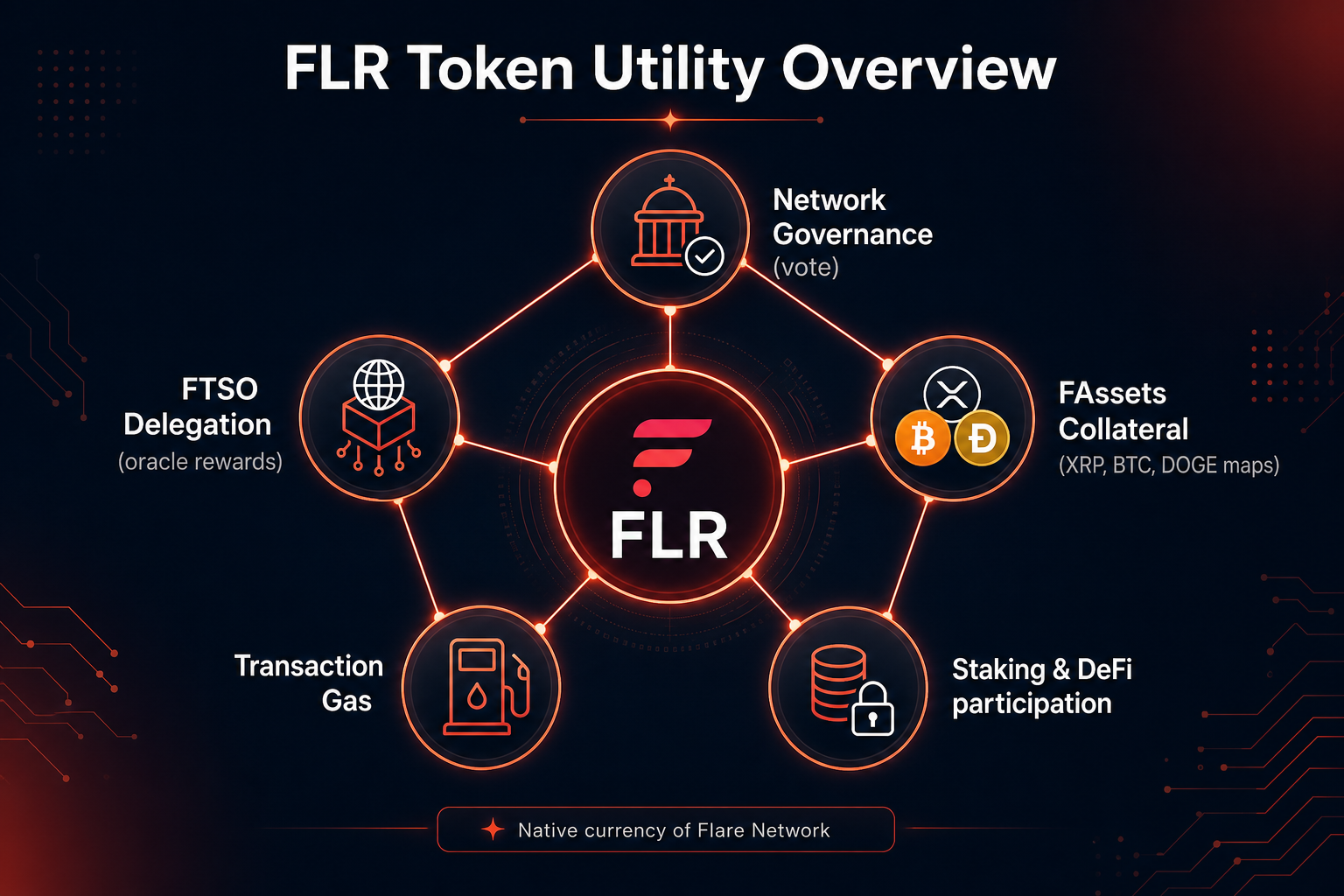
The FLR token is the native cryptocurrency of the Flare Network, designed to power the ecosystem and incentivize participation. As a crucial component of Flare’s infrastructure, FLR has multiple roles that ensure the network remains decentralized, secure, and functional.
Utility of FLR
Network Governance:
FLR holders have the ability to participate in the decision-making process on protocol upgrades and network changes through decentralized governance.
This encourages community involvement and aligns the interests of developers, users, and stakeholders.
Delegation to the Flare Time Series Oracle (FTSO):
Users can delegate their FLR tokens to data providers who contribute to the decentralized oracle system.
In return, they earn rewards in the form of FLR for helping secure accurate, real-time data for smart contracts.
Collateral for FAssets:
FLR can be used as collateral to mint FAssets—synthetic versions of non-smart contract tokens like XRP, DOGE, and LTC—on the Flare Network.
This unlocks the potential for these assets to be used in DeFi applications on Flare.
Transaction Fees and Gas:
Just like ETH on Ethereum, FLR is used to pay for gas fees associated with executing smart contracts and transactions on the network.
Staking and Yield Opportunities:
Beyond delegating for FTSO rewards, FLR holders can also stake their tokens in liquidity pools or DeFi platforms built on Flare for protocol rewards or pool incentives where available (not guaranteed income).
Token Supply and Distribution
Initial Supply: 100 billion FLR tokens were minted at genesis.
Airdrop Distribution: A significant portion of FLR was distributed to XRP holders through a series of airdrops, making it one of the most talked-about launches in the XRP community.
Monthly disbursements: After the initial airdrop, remaining FLR was distributed monthly over about 36 months via FlareDrop. That schedule concluded around January 30, 2026 (confirm on official notices).
Burn Program and Supply Control
In an effort to support long-term tokenomics, Flare ran a multi-year burn program tied to early-backer allocations:
Public materials describe monthly burns of about 66.3 million FLR from roughly October 2024, with early-2025 disclosures citing more than ~66 million FLR already burned on the way to a planned total of about 2.1 billion FLR by around January 2026.
FlareDrops’ 36-month distribution also concluded around January 30, 2026, shifting emphasis toward utility and protocol-defined inflation/fee-burn mechanics (details subject to governance).
Verify cumulative burns and circulating supply on official dashboards rather than treating any single article figure as live.
Market Performance and FLR Price Trends
FLR trades actively across major venues and often reacts to network announcements and ecosystem integrations. Performance remains tied to adoption of Flare’s cross-chain and oracle stack—and to broader market risk appetite.
You can check the live price and historical performance of FLR on Gate’s FLR/USDT trading page.
How to Buy and Store Flare (FLR) Safely
FLR tokens can be purchased on various cryptocurrency exchanges. Once acquired, it’s essential to store them securely:
Hardware wallets: For long-term storage, hardware wallets like Ledger or Trezor offer enhanced security.
Software wallets: For more frequent access, consider using reputable software wallets that support FLR.
Always ensure that the wallet you choose is compatible with FLR and follows best security practices.
Flare Developments and Partnerships (Including a 2025 Checkpoint)
Flare has continued to push on data sync, DeFi depth, and FAssets liquidity. Items publicly highlighted around 2025 include:
Integration with Goldsky to improve blockchain data synchronization
Partnership work such as Kinetic to expand DeFi on Flare
FAssets V1.1 to improve liquidity/efficiency ahead of later versions
Into 2026, official communications emphasize the post-FlareDrop utility phase and governance updates to inflation/fee parameters. Partnership lists and version numbers change—treat year labels as checkpoints, not permanent inventories.
How to Evaluate Flare / FLR (Risk Framework, Not Investment Advice)
Flare’s focus on interoperability and data accessibility is a clear product thesis—but that is not the same as a buy recommendation. Review observable signals such as:
Whether TVL, FAssets usage, and developer activity track the narrative
Unlock / distribution schedules and circulating supply pressure
Competition from other oracle and interoperability stacks
Broader market risk appetite (volatility cuts both ways)
Do your own research against primary docs and on-chain data. Nothing here is financial advice. Public market pages such as FLR/USDT on Gate are for reference only.
Flare’s Role in Bridging Assets Across Blockchains
Flare’s architecture facilitates seamless asset transfers between different blockchains, enabling:
Cross-chain asset representation: Allowing assets from one blockchain to be used on another without central intermediaries.
Enhanced liquidity: By bridging assets, Flare increases liquidity across various blockchain ecosystems.
This interoperability is crucial for the growth and integration of decentralized applications across the crypto space.
Conclusion
Flare Network targets two durable Web3 needs: decentralized access to external data, and bringing non-smart-contract assets into on-chain finance more safely. With FTSO, the State Connector, EVM compatibility, and a multi-year burn/distribution arc that largely matured by early 2026, it is better understood as a data-and-interoperability layer than as a me-too L1.
Partnerships, FAssets iteration, burn completion, and post-2026 governance changes are useful execution checkpoints—but adoption and risk management still decide outcomes. This is educational content, not investment advice.
FAQ
What is Flare Network?
A Layer 1 focused on decentralized data and interoperability, with native FTSO and State Connector support, plus EVM compatibility.
What does FTSO do?
The Flare Time Series Oracle supplies price and other time-series data to on-chain apps, reducing sole reliance on a single centralized oracle.
What is the State Connector for?
It helps read and verify events/state from other blockchains so Flare smart contracts can react to external conditions.
What is FLR used for?
Common uses include governance, staking, and network fees—confirm current rules in official docs and governance.
Is Flare a guaranteed investment?
No. Treat technical narratives separately from portfolio decisions; this is educational content, not investment advice.
Author: Adewumi Arowolo
Reviewer(s): Jane
Disclaimer
* The information is not intended to be and does not constitute financial advice or any other recommendation of any sort offered or endorsed by Gate.
* This article may not be reproduced, transmitted or copied without referencing Gate. Contravention is an infringement of Copyright Act and may be subject to legal action.
Solana faces both opportunities and challenges in its development. Recently, severe network congestion has led to a high transaction failure rate and increased fees. Consequently, some have suggested using Layer 2 and appchain technologies to address this issue. This article explores the feasibility of this strategy.
Sui is a PoS L1 blockchain with a novel architecture whose object-centric model enables parallelization of transactions through verifier level scaling. In this research paper the unique features of the Sui blockchain will be introduced, the economic prospects of SUI tokens will be presented, and it will be explained how investors can learn about which dApps are driving the use of the chain through the Sui application campaign.
This article introduces the technical principles, framework, and applications of Zero-Knowledge (ZK) technology, covering aspects from privacy, identity (ID), decentralized exchanges (DEX), to oracles.
TronScan is the primary blockchain explorer for the TRON network. It allows users to check TRX and TRC-20 transactions, inspect wallet balances, analyze smart contracts, monitor tokens, and view network activity without logging in. By connecting a compatible wallet such as TronLink, users can also transfer assets, stake TRX, vote for Super Representatives, and interact with TRON ecosystem applications.
This article analyzes the tremendous potential for the development of the Layer 2 (L2) market and the accompanying bridging needs among various L2 solutions. It delves into the current status, potential, and risks of the cross-chain protocol Across Protocol in this market.