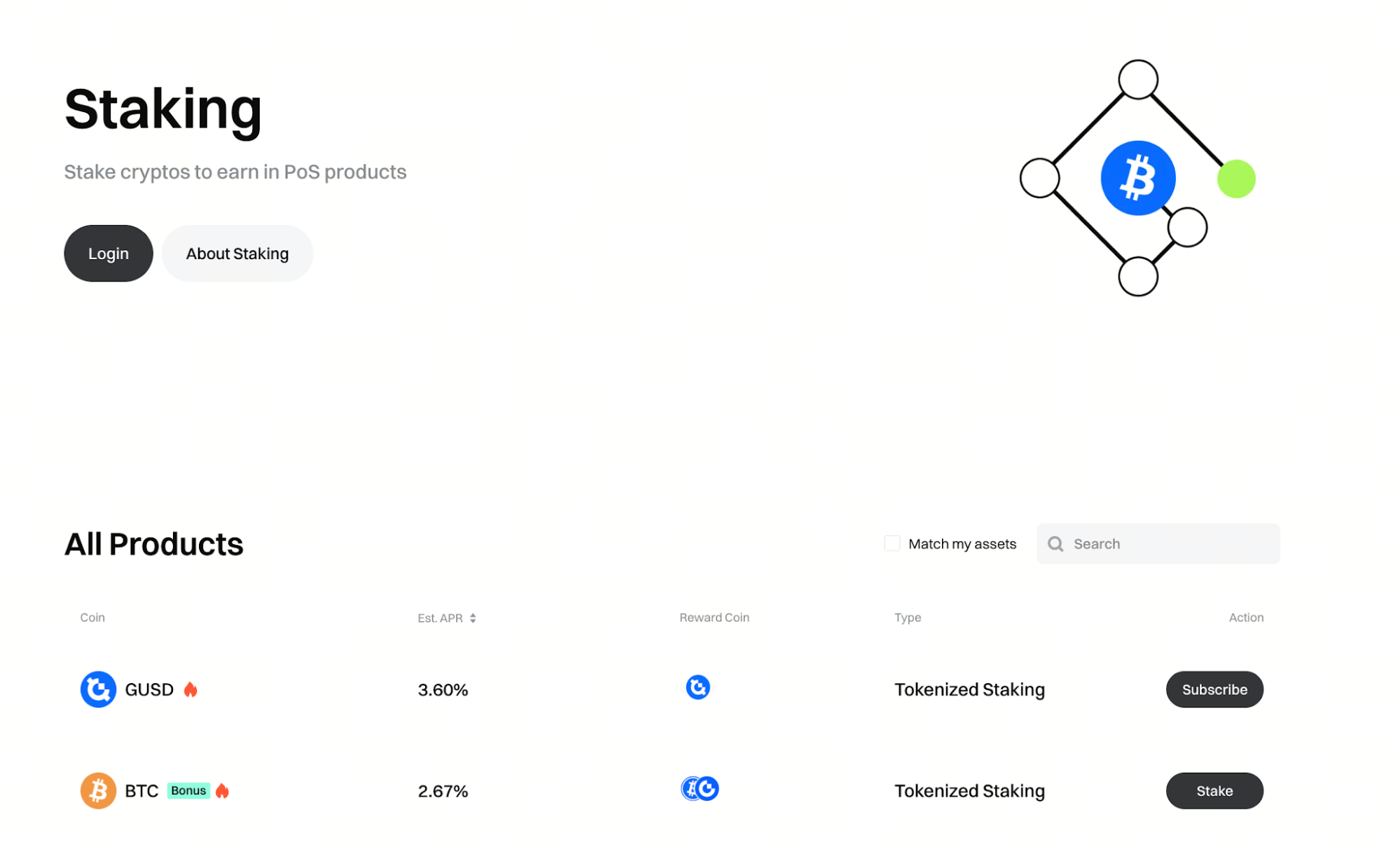
Gate Staking is a suite of products that brings together crypto staking and on-chain yield opportunities. Users can select supported assets such as BTC, ETH, SOL, and GT and participate in the corresponding products to earn rewards based on different blockchain networks or underlying mechanisms, without having to operate validator nodes or handle complex on-chain processes themselves.
Staking is commonly associated with Proof of Stake (PoS) networks. Users stake native tokens to participate in network validation or governance and receive protocol rewards in return. However, Gate Staking now covers a broader range of products. In addition to traditional PoS assets, it includes Tokenized Staking, Locked Staking, and products such as BTC Staking that rely on different underlying yield mechanisms.
As a result, not every product on Gate Staking should be understood as traditional PoS staking. Reward sources, reward assets, tokenization mechanisms, liquidity, and redemption rules can vary significantly between products. Rather than looking only at APR, users should also understand how each product works.
Key Takeaways
Gate Staking brings together multiple crypto staking and on-chain yield products.
The current product page includes assets such as BTC, ETH, SOL, GT, GUSD, USD1, and USDT, although supported assets may change over time.
Gate Staking includes not only traditional PoS staking but also Tokenized Staking and Locked Staking products.
PoS staking rewards generally come from network validation and protocol incentives, while other products may use different on-chain or underlying yield strategies.
Tokenized Staking represents staking positions in tokenized form, and the representative token and reward mechanism can vary by asset.
Estimated APRs can change dynamically based on factors such as underlying staking principal and rewards and should not be treated as fixed returns.
Reward start times, distribution methods, and redemption periods vary by product. Some PoS products may begin distributing rewards on D+1 or D+n.
Staking involves asset-price, liquidity, protocol, and blockchain-related risks, and APR alone does not determine the final investment return.
What Is Gate Staking?
Gate Staking is a suite of products that helps users access crypto staking and on-chain yield opportunities. After selecting a supported crypto asset and completing the staking process, users can earn rewards according to the rules of the corresponding product without having to deploy validator infrastructure or manage complex on-chain staking operations themselves.
For PoS assets such as ETH and SOL, the basic staking model involves committing tokens to the network’s staking mechanism. Staked assets can support network consensus, validation, or governance, while participants may receive staking rewards generated under the network’s protocol rules.
Gate provides a unified interface for accessing these opportunities. Users can compare supported assets, estimated APRs, reward assets, and product types before choosing a product that fits their asset allocation and liquidity needs.
However, Gate Staking is no longer limited to conventional PoS staking. The platform also offers products involving assets such as BTC, GUSD, and USDT, meaning that reward sources need to be understood on a product-by-product basis rather than being universally described as PoS validation rewards.
How Does Gate Staking Work?
From a user perspective, the basic Gate Staking process involves selecting a supported crypto asset, holding the required asset, participating in the relevant staking product, and then earning rewards and redeeming assets according to the product rules.
For native PoS assets, the underlying mechanism is generally connected to blockchain staking. Assets participate in network consensus or validation, the network generates rewards according to its protocol, and those rewards are then distributed based on the applicable product mechanism.
Tokenized Staking works differently by representing a staking position through another token or certificate. This structure can allow the value of the staked position and its accumulated rewards to be represented in tokenized form and, in some cases, used in additional scenarios.
Locked Staking generally operates according to a defined product period and redemption rules. Although these products are all available through Gate Staking, their underlying reward sources, liquidity characteristics, and exit mechanisms are not necessarily the same.
Which Assets Does Gate Staking Support?
Gate Staking supports multiple crypto assets, although the available product list can change with blockchain conditions, market developments, and product updates.
At the time of writing, the Gate Staking page includes products for GUSD, BTC, ETH, SOL, USD1, GT, and USDT. GUSD, BTC, ETH, SOL, and GT are currently categorized as Tokenized Staking products, while USD1 and USDT are shown under Locked Staking.
For example, the current page shows an estimated APR of approximately 2.67% for BTC, 3.98% for ETH, 7.27% for SOL, and 0.89% for GT. GUSD is shown at approximately 3.60%, while USD1 is displayed at 8.08% and USDT at 2.35%–4.18%. These figures are snapshots of current product data rather than guaranteed future rates.
Users should therefore check the Gate Staking page for the latest supported assets, estimated APRs, reward assets, product types, and participation requirements before staking.
Where Do Gate Staking Rewards Come From?
The source of Gate Staking rewards depends on the specific asset and underlying product mechanism. Not every product generates rewards in the same way.
For PoS assets such as ETH and SOL, rewards are generally related to the blockchain’s staking mechanism. Staked assets contribute to network consensus or validation, and the underlying protocol generates staking rewards according to its own rules.
For Tokenized Staking products, the yield generated by the underlying assets also needs to be reflected through the corresponding tokenization mechanism. Depending on the product, rewards may be represented through token distributions, changes in the value of a representative asset, exchange-rate adjustments, or another defined mechanism.
BTC is an important exception to conventional PoS staking. Bitcoin uses Proof of Work (PoW), not Proof of Stake, so it does not have native validator staking like Ethereum or Solana. Although BTC is available through Gate Staking, its underlying yield mechanism is therefore different from native PoS staking.
This is why comparing Gate Staking products based only on APR can be misleading. Users should also understand whether the underlying rewards come from PoS network incentives, on-chain protocols, or another yield mechanism.
What Is Tokenized Staking?
Tokenized Staking can be understood as representing a staking position in tokenized form. After a user commits a supported crypto asset, the staking position may be represented by another token or certificate, allowing the user to hold the corresponding staking exposure in a different form.
Gate currently categorizes products including GUSD, BTC, ETH, SOL, and GT as Tokenized Staking. However, the category does not mean that every asset uses exactly the same representative token, reward calculation, or redemption mechanism.
BTC provides a useful example. Gate BTC Staking uses GTBTC to represent a yield-bearing BTC position. As underlying rewards accumulate, they can be reflected in the conversion value between GTBTC and BTC. This differs from a model in which users simply receive an additional amount of BTC every day.
For other Tokenized Staking products, users should similarly check the representative asset, minting or conversion mechanism, reward accumulation method, and redemption rules instead of assuming that one product’s mechanism applies to all others.
What Is the Difference Between Tokenized Staking and Locked Staking?
Gate Staking currently includes both Tokenized Staking and Locked Staking. The main differences are generally found in how the staking position is represented and how liquidity is managed.
Tokenized Staking typically represents a staking position through a token or certificate. Depending on the product, the representative asset may also have additional trading, collateral, or DeFi use cases.
Locked Staking places more emphasis on committing assets according to a defined product structure. Holding periods, redemption timing, and reward calculations generally follow the rules of the specific locked product.
Category
Tokenized Staking
Locked Staking
Core mechanism
Represents the staking position in tokenized form
Locks assets according to product rules
Position representation
May issue a representative token or certificate
Usually remains as a locked product position
Liquidity
Depends on the representative asset and product rules
Usually subject to lock-up or redemption conditions
Reward mechanism
May be reflected through rewards or changes in conversion value
Calculated according to the specific locked product
Product categories and rules can change as Gate Staking evolves, so users should always review the latest terms of the specific product before participating.
How Should You Understand Gate Staking APR?
APR, or Annual Percentage Rate, provides a reference annualized yield for a staking product. It can help users compare products, but it should not be interpreted as a fixed rate that will necessarily remain unchanged for the next year.
The estimated APR for Gate Staking products can change dynamically based on factors such as underlying staking principal, network rewards, product incentives, and other applicable conditions.
For example, the product page currently shows estimated APRs of approximately 2.67% for BTC, 3.98% for ETH, and 7.27% for SOL. If network rewards, total staking participation, product incentives, or other underlying conditions change, these rates may also change.
APR also represents only one part of the overall return. If a user earns a 5% return in tokens but the market price of the underlying asset falls by 20%, the total portfolio value measured in USDT or fiat currency can still decline. APR should therefore be considered alongside asset-price risk, liquidity, and the underlying product mechanism.
When Are Gate Staking Rewards Distributed?
The start time and distribution schedule for Gate Staking rewards can vary between products. There is no single reward schedule that applies to every supported asset.
For PoS staking, different blockchains have different validator cycles, reward settlement mechanisms, and unstaking rules. As a result, rewards may not begin immediately after a user completes the staking process.
Depending on the product and underlying blockchain mechanism, some PoS staking rewards may begin on D+1, while others may take until D+n before the first distribution occurs.
Tokenized Staking also requires users to consider how rewards are represented. Some products may not distribute an additional reward token to the account every day. Instead, yield may accumulate through changes in the conversion value of the representative token or another product-specific mechanism.
How to Participate in Gate Staking
Users first need to hold the crypto asset supported by the product they want to use. The required asset can be prepared in the Gate account through deposits, trading, or other supported methods.
Users can then visit the Gate Staking page to review available assets, estimated APR, reward coins, and product types before choosing a product. The product interface provides the relevant information needed to compare available staking options.
Before staking, users should review the minimum participation amount, estimated APR, reward asset, yield mechanism, and redemption rules. For Tokenized Staking products, it is also important to check whether a representative token will be issued and how its conversion mechanism works.
After staking, users can monitor their position and rewards according to the product mechanism. When they want to exit, they can redeem through the corresponding product page. Redemption timing and settlement periods may vary depending on the asset and underlying mechanism.
What Is the Difference Between Gate Staking and Soft Staking?
Gate Staking and Soft Staking can both allow users to earn additional rewards from existing crypto holdings, but their participation models and underlying mechanisms differ.
Gate Staking generally requires users to actively select and participate in a specific staking product. Rewards are linked to the corresponding blockchain network, Tokenized Staking mechanism, or another underlying yield model. Some products may also issue tokens representing the staking position.
Soft Staking places greater emphasis on holding assets while maintaining flexibility. After enabling the relevant feature, eligible balances in designated accounts can be used to calculate rewards without requiring users to subscribe each amount to a specific staking product in the same way.
Users interested in participating in a specific asset’s staking or tokenized staking mechanism may therefore consider Gate Staking, while users who prioritize maintaining greater flexibility over eligible account balances may also compare Soft Staking and other Gate Earn products.
What Are the Risks of Gate Staking?
The first consideration is asset-price risk. Staking rewards are generally denominated in crypto assets or related positions. Even if the number of tokens held increases, a significant decline in the underlying asset’s market price can reduce the total value of the position when measured in USDT or fiat currency.
Liquidity is another important factor. Some products may involve lock-up periods, unstaking periods, or redemption waiting times. If market conditions change rapidly during this period, users may not be able to immediately sell or redeploy all of their assets.
Tokenized Staking introduces additional considerations related to representative tokens and conversion mechanisms. A representative asset can be affected by market liquidity, redemption rules, and the operation of the underlying protocol, and its secondary-market price may differ from its theoretical redemption value.
Staking and other on-chain yield mechanisms can also involve blockchain network, validator, smart contract, and underlying protocol risks. Risk reviews and reserve transparency can help users evaluate these products, but they do not eliminate all market or on-chain risks.
Summary
Gate Staking brings together multiple crypto staking and on-chain yield opportunities. Users can select supported assets and participate in the corresponding staking products through Gate without having to operate validator nodes or manage complex on-chain processes themselves.
Gate Staking is no longer limited to traditional PoS staking. It also includes Tokenized Staking and Locked Staking products, with the current product page covering assets such as GUSD, BTC, ETH, SOL, USD1, GT, and USDT.
The most important differences between products involve the source of underlying rewards, whether the staking position is tokenized, how APR changes, and how redemption works. BTC and other non-PoS assets, in particular, should not be explained using the same native staking model as PoS assets such as ETH and SOL.
When evaluating a Gate Staking product, users should therefore look beyond the headline APR and understand the underlying mechanism, reward structure, liquidity, and redemption conditions. The latest information on the specific product page should always be checked before participating.
FAQ
What is Gate Staking?
Gate Staking is a suite of crypto staking and on-chain yield products that allows users to participate with supported assets and earn rewards according to the mechanism of each product.
Which assets does Gate Staking support?
Gate Staking currently includes products for assets such as GUSD, BTC, ETH, SOL, USD1, GT, and USDT. The available asset list may change as products are added or updated.
Is Gate Staking APR fixed?
Gate Staking estimated APR is not fixed. It can change based on underlying staking principal, reward levels, network conditions, and the mechanism of the specific product.
Can BTC be used in Gate Staking?
Yes. BTC is available through Gate Staking, but Bitcoin uses PoW rather than PoS, so the underlying mechanism for BTC Staking differs from native PoS staking for assets such as ETH and SOL.
Can Gate Staking assets be redeemed?
Gate Staking products support redemption according to their respective rules. Redemption timing, settlement periods, and restrictions can vary between Tokenized Staking, Locked Staking, and individual assets.
Does Gate Staking guarantee returns?
No. Gate Staking does not guarantee fixed returns. Estimated APR can change, while users may also face crypto price volatility, liquidity constraints, protocol risks, and other blockchain-related risks.
Author: Max
Reviewer(s): Carlton
Disclaimer
* The information is not intended to be and does not constitute financial advice or any other recommendation of any sort offered or endorsed by Gate.
* This article may not be reproduced, transmitted or copied without referencing Gate. Contravention is an infringement of Copyright Act and may be subject to legal action.
This article provides a detailed introduction to the Solana (SOL) staking mechanism, including the purpose of staking, the process, sources of rewards, and how validators earn profits. Staking not only provides rewards for users but also enhances the security and decentralization of the network.
Gate.com has launched a new independent trading section - the Pilot Section. By focusing on finding popular on-chain projects, it cleverly combines the advantages of spot trading and on-chain trading. Not only does it help users participate in on-chain launches without the need for a Web3 wallet, but it also provides users with unparalleled token liquidity, significantly reducing trading slippage and enabling easy buying and selling.
A funding rate arbitrage quantitative fund is a specialized investment tool designed for the cryptocurrency market, aiming to generate stable, market-neutral returns through perpetual contracts’ funding rate mechanism. The fund’s core strategy involves simultaneously holding both spot and hedged perpetual contract positions, which utilizes market fluctuations' hedging effect to focus returns on funding rate payments. This approach is ideal for investors seeking consistent returns with lower risk tolerance. In comparison to traditional financial products, funding rate arbitrage funds offer greater return potential. The use of quantitative models enhances decision-making, ensuring efficient and precise capital allocation.
According to data from DefiLlama, the current BTC yield farming market size exceeds US$10 billion. More and more participants are joining the BTC yield farming track. This article will review several well-known BTC staking protocols.
PACT is a credit infrastructure designed for the global debt market, aiming to connect stablecoin capital with borrowing institutions so that funds can move more efficiently across regions. Unlike traditional financial systems that rely on banks and intermediaries, PACT builds an open credit network through on-chain credit structures and stablecoin liquidity pools, lowering financing barriers and improving capital allocation efficiency.