As the blockchain industry gradually moves toward large scale adoption, traditional single chain structures have begun to face performance bottlenecks. Network congestion, rising Gas costs, and declining transaction confirmation efficiency have become long standing issues across many public blockchain ecosystems. Against this backdrop, “sharding” has gradually become an important scaling direction for Layer1 public blockchains, and MultiversX is one of the earlier networks to adopt adaptive state sharding at scale.
From the perspective of digital assets and Web3 infrastructure, MultiversX’s value lies not only in increasing TPS, but also in its attempt to build a horizontally scalable on chain execution architecture. Through Adaptive State Sharding, Secure Proof of Stake (SPoS), and cross shard communication mechanisms, MultiversX splits network computation, state storage, and transaction processing across multiple shards, creating a more efficient Layer1 operating system.
The Relationship Between MultiversX (EGLD) and Sharded Public Blockchains
In blockchain architecture, “sharding” usually refers to splitting network data, transaction processing, and state storage into multiple independent areas. This allows different nodes to process different tasks at the same time, without requiring every node to synchronize all data.
In a traditional single chain structure, every node needs to verify all transactions, store the full state, and execute all smart contracts. This model provides strong consistency, but it also limits scalability. As the number of users increases, network throughput often cannot grow at the same pace.
MultiversX ’s Adaptive State Sharding is a more complete form of “state level sharding.” It splits not only transactions, but also account state and network structure.
Unlike designs that only parallelize transaction processing, MultiversX’s sharding system covers:
-
Network Sharding
-
Transaction Sharding
-
State Sharding
This structure means different shards can process their own accounts and state data separately, reducing the synchronization burden across the whole network.
When discussing MultiversX’s sharding structure, it is also often compared with “modular blockchain scaling” or “Rollup scaling solutions,” because all of these approaches aim to solve blockchain performance limitations. Their underlying implementation methods, however, are clearly different.
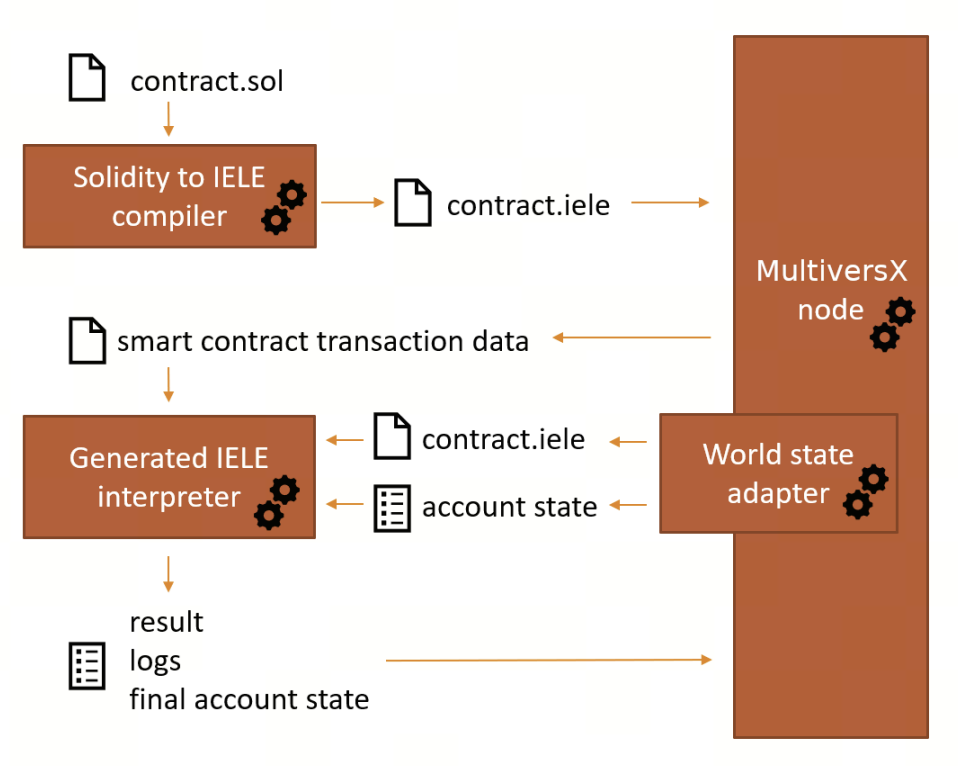
Source: multiversx.com
How an On Chain EGLD Transaction Begins
When a user initiates an EGLD transfer or smart contract call, the wallet first signs the transaction with the private key and generates a transaction message containing details such as the sender address, recipient address, nonce, Gas limit, and transaction data. Once signed, the transaction is broadcast to nodes in the MultiversX network and formally enters the on chain processing flow.
After the transaction enters the network, MultiversX automatically determines which shard it belongs to based on the account address. Because the network uses an Adaptive State Sharding architecture, the sender account and recipient account may be located in different shards. The system first determines whether the transaction can be executed within the same shard. If it involves different shards, it enters the cross shard communication process.
Next, Validator nodes in the current shard verify the validity of the transaction. This includes checking whether the signature is correct, whether the account balance is sufficient, whether the nonce matches, and whether the Gas settings meet the requirements. Once the transaction passes validation, it is added to the block candidate set and waits to be packaged and confirmed.
During block production, MultiversX’s Secure Proof of Stake (SPoS) mechanism quickly selects a block proposer, and a committee of nodes completes validation and confirmation. After the new block is produced, the transaction state is officially written on chain. If the transaction involves multiple shards, the Metachain also coordinates state synchronization across the relevant shards to ensure network wide data consistency.
How Adaptive State Sharding Works
Adaptive State Sharding is one of the most important parts of MultiversX’s underlying architecture. Its defining feature is that the network can dynamically adjust its shard structure according to network load, rather than maintaining a fixed number of static shards over time. This design is mainly intended to improve network throughput and resource utilization efficiency.
Traditional sharded networks often face problems such as uneven shard load, complex state synchronization, and congestion in certain shards. In some systems, even if transaction processing is split, nodes still need to maintain network wide state data, which means overall scalability remains limited. MultiversX attempts to reduce network pressure further through state sharding.
When network transaction volume increases, the system can dynamically add more shards and reassign nodes and state data. When network load declines, some shards can be merged again. This dynamic scaling mechanism can automatically adjust the resource structure according to real time network demand, improving overall execution efficiency.
Unlike many public blockchains that only support transaction sharding, each MultiversX shard maintains only its own state data. Nodes do not need to synchronize account information from the entire network. This structure can reduce storage pressure, lower synchronization costs, and decrease the hardware requirements for running nodes, while improving the overall scalability of the network.
MultiversX Validators and the Secure Proof of Stake (SPoS) Consensus Mechanism
MultiversX’s consensus mechanism is called Secure Proof of Stake (SPoS). It is an optimized version of traditional Proof of Stake, with the core goal of shortening block confirmation time, reducing node communication complexity, and improving overall block production efficiency. Compared with traditional PoS networks, SPoS places more emphasis on fast node selection and high performance execution.
In the MultiversX network, Validators are the validation nodes responsible for maintaining network operations. These nodes usually need to stake EGLD to participate in the consensus process. Their main responsibilities include validating transactions, producing blocks, synchronizing state data, and maintaining network security. A Validator’s operating status directly affects network stability and transaction confirmation efficiency.
One important feature of SPoS is the rapid generation of random node committees. In traditional PoS networks, the process of forming a node committee may involve more communication and waiting time. SPoS uses random selection and a node scoring system to complete committee formation quickly, thereby reducing consensus latency. A Validator’s historical performance also affects its score, including uptime, validation success rate, and whether it has any record of malicious behavior.
To further improve performance, SPoS minimizes communication rounds and repeated validation among nodes as much as possible, so its block confirmation speed is usually fast. This structure is also why MultiversX is often classified as a high performance PoS public blockchain and compared with networks such as Solana, Avalanche, and Ethereum PoS. Even so, they still differ significantly in execution architecture and scaling approach.
How MultiversX Enables Cross Shard Transaction Communication and State Synchronization
Cross shard transactions have always been one of the most complex technical challenges for sharded public blockchains. Different shards maintain independent states, account data may be located in different areas, and the transaction confirmation process requires multiple shards to coordinate. Without an effective coordination mechanism, the network may experience state inconsistency or transaction conflicts.
To solve this problem, MultiversX introduces the Metachain structure. The Metachain does not execute ordinary transactions itself. Instead, it is mainly responsible for coordinating communication and state synchronization between different shards. It aggregates block headers from each shard and maintains final consistency across the whole network, so it can be understood as the coordination layer of the entire sharding system.
When a transaction involves different shards, the system first deducts the balance in the shard where the sender account is located and generates a cross shard message or receipt. The Metachain then confirms the state and coordinates message delivery. After the shard where the recipient account is located receives the confirmation information, it completes the final balance update. This structure allows different shards to maintain a unified ledger state.
The importance of the cross shard synchronization mechanism is that it helps prevent double spending, state delays, and transaction failures. If multiple shards cannot synchronize data in time, the consistency of the entire network is affected. Therefore, cross shard communication is one of the most central and technically complex parts of any sharded public blockchain.
The Role of EGLD in the MultiversX Network
EGLD is the native asset of the MultiversX network. It is used not only for ordinary value transfer, but also for several core functions in network operation. As the base asset of the ecosystem, EGLD is directly connected to network security, resource consumption, and ecosystem interaction.
During network operation, users need to pay EGLD as Gas when making transfers, calling smart contracts, or performing NFT operations. This mechanism helps limit malicious spam transactions and establishes a cost model for network resource allocation, which means EGLD is also part of the on chain computing resource system.
Beyond payments, EGLD is closely tied to the network security mechanism. Validators usually need to stake EGLD to participate in the Secure Proof of Stake (SPoS) consensus process, so the scale of EGLD staking affects the network’s validation capacity and security. Some block rewards and network incentives are also distributed in EGLD, forming an on chain economic cycle.
At the ecosystem level, EGLD can also be used as a payment asset, an interaction medium for DeFi protocols, and a base token in certain governance activities. Therefore, EGLD is not merely a trading token. It is also a resource asset, staking asset, and ecosystem interaction asset within the MultiversX network.
MultiversX’s high performance capabilities mainly come from its Adaptive State Sharding architecture and multi shard parallel execution mechanism. Compared with traditional single chain structures, a multi shard system can process more transactions at the same time, making it easier for network throughput to scale as the number of shards increases.
Because each shard maintains only its own state data, nodes do not need to synchronize account information from the whole network. This can reduce storage requirements, shorten synchronization time, and lower the hardware costs of running nodes. The structure helps improve overall network scalability while reducing operational pressure on some nodes.
Another feature of Adaptive State Sharding is dynamic scalability. When network load rises, the system can increase the number of shards and reassign nodes. When transaction volume declines, some shards can be merged again. Compared with a fixed shard structure, this approach can adjust resource utilization more flexibly.
However, sharding architecture also introduces additional complexity. Cross shard transactions are usually more complex than single chain transactions, and multiple shards still need state synchronization and coordination. In addition, developers deploying applications also need to consider cross shard calls and state management. So while sharding can improve scalability, it is not a cost free scaling solution.
How MultiversX’s Scaling Path Differs from Ethereum, Solana, and Other Public Blockchains
MultiversX, Ethereum, and Solana all aim to solve blockchain scalability, but they use different technical paths. Their tradeoffs in performance, decentralization, and execution structure also differ clearly.
Ethereum currently leans more toward a Rollup and Layer2 scaling path. Its core idea is to let the main chain handle security while moving large amounts of execution work to Layer2 networks. This model is a typical modular scaling structure, focused on reducing main chain load and improving scalability across the broader ecosystem.
| Network |
Core Scaling Method |
Sharded |
Execution Structure |
Scaling Direction |
| MultiversX |
Adaptive State Sharding |
Yes |
Multi shard parallel execution |
Horizontal scaling |
| Ethereum |
Rollup + Layer2 |
Partly planned |
Modular |
Layer2 scaling |
| Solana |
High performance single chain |
No |
Single state parallel execution |
Hardware scaling |
Solana follows a high performance single chain path, increasing throughput through high frequency block production, parallel execution, and higher hardware requirements. Unlike MultiversX, Solana does not use a sharded structure. Instead, it relies on high performance execution on a single chain to improve network efficiency.
MultiversX’s path is a native Layer1 sharding architecture. Its core approach is to split network, transaction, and state data across multiple dynamic shards through Adaptive State Sharding, enabling horizontal scalability. From an industry perspective, there is currently no single best scaling solution. Different public blockchains represent different tradeoffs in performance, decentralization balance, and network design philosophy.
Conclusion
MultiversX (EGLD) is a high performance Layer1 public blockchain centered on Adaptive State Sharding. Its goal is to improve network throughput and scalability while preserving the decentralized structure of blockchain.
By splitting network, transaction, and state data across multiple dynamic shards, MultiversX builds a horizontally scalable architecture and combines it with Secure Proof of Stake (SPoS) to improve transaction confirmation efficiency. In addition, the Metachain coordinates cross shard communication and state synchronization, helping ensure consistency across the whole network.
Compared with Ethereum’s Rollup path and Solana’s high performance single chain path, MultiversX places greater emphasis on native Layer1 sharding. While this structure can improve parallel processing capacity, it also introduces new technical challenges such as cross shard coordination and development complexity.
FAQs
What Is MultiversX (EGLD)?
MultiversX is a Layer1 blockchain network that uses Adaptive State Sharding, mainly to improve transaction processing capacity and network scalability. EGLD is its native token.
How Is Adaptive State Sharding Different from Ordinary Sharding?
Ordinary sharding usually splits only transaction processing, while Adaptive State Sharding splits network, transaction, and state data at the same time, and supports dynamic adjustment of shard numbers.
How Is SPoS Different from Traditional PoS?
SPoS, or Secure Proof of Stake, is an optimized mechanism built on PoS. It focuses on faster node committee selection and lower communication costs.
How Does MultiversX Handle Cross Shard Transactions?
MultiversX uses the Metachain to coordinate state synchronization and cross shard message communication between different shards.
What Are the Main Uses of EGLD in the Network?
EGLD is mainly used to pay Gas, participate in staking, maintain network security, and support ecosystem interactions.
How Is MultiversX’s Scaling Path Different from Solana’s?
Solana uses a high performance single chain execution path, while MultiversX uses a native sharding architecture that achieves horizontal scaling through multiple shards.







