One of the clearest glimpses of x402’s future value that I've had surfaced while I was reading through this recent report from Galaxy Research.
The example that caught my attention: an agent helps a user book a trip, querying quality weather data via x402 to find optimal dates and destinations, surfacing flight and hotel options, then handing everything off to a booking workflow. Each query is a micropayment. Each data source gets paid. The agent stitches it all together into a decision.
What stuck with me is how x402 pairs well with data aggregation and curation. Someone takes fragmented sources, bundles them into something proprietary, that’s more useful than any single provider, and sells access via x402. The curator eats the integration cost once. Callers pay per query. Everyone wins (if the volume is there, but we’ll touch on that at the end).
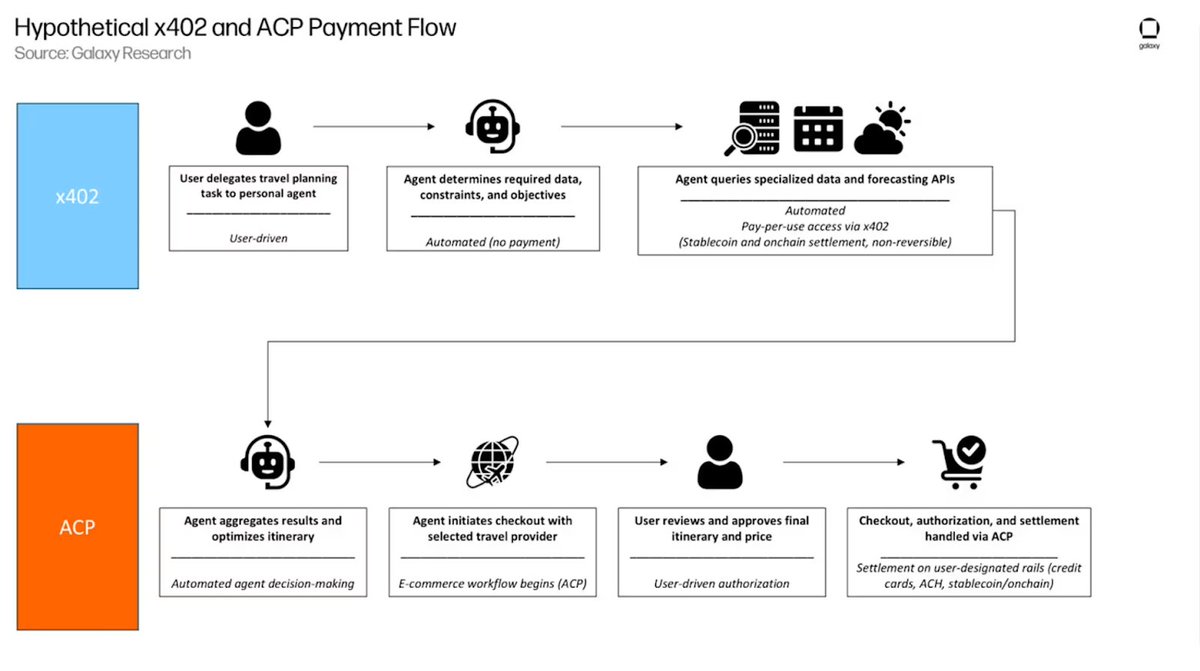 via Galaxy Research
Until services like these become commonplace, I'm still going to consider x402 to be a bit early. If you’re a developer who’s looking to build with x402 but are struggling to come up with ideas, here are a few theoretical products that I would race to use if they were available!
Skills Endpoint
Skills are carefully assembled instructions built by humans for AI agents to execute specific tasks.
Right now, most skills marketplaces use flat-fee pricing: $5, $15, $20 for permanent access. That model creates misaligned incentives. Occasional users overpay, power users underpay, and skill creators are unable to capture value proportional to usage. A genuinely useful skill, like a genuinely useful consultant (if there is such a thing), should be able to command more than a one-time $15 fee.
x402 offers an alternative. Skill creators can expose their work via an x402 endpoint and price it however makes sense: pay-per-call for one-off usage, monthly subscriptions for regular users (a feature available thanks to x402’s V2), or both. The payment rail supports either model. A skill that's called thousands of times per month generates recurring revenue for its creator. A skill that's rarely used doesn't require buyers to commit upfront.
Niche Crypto News Aggregation Bundles
Crypto news is scattered across Twitter, Telegram groups, podcasts, RSS feeds, and Substacks. If you want to track a particular ecosystem, the problem grows. Tracking everything happening in Sui or Starknet means monitoring a dozen sources and checking them daily.
Ecosystem-specific x402 feeds could solve this. Someone aggregates Twitter profiles via API, articles via websites’ RSS feeds, and Telegrams into a curated stream for a single ecosystem. An agent queries it: "What's happened in Starknet in the past 24 hours?" and gets a structured response. No more flipping between tabs and applications.
Aggregated Ecosystem Data
Developer activity is notoriously hard to gauge.
Electric Capital's annual report, and now ongoing dashboard, is a great open-source resource, but it has limitations. For example, I just went to look at top ecosystems by developer growth over the past year and got PancakeSwap, Monad, and Aleo. Sure, that's because I filtered for only one metric – but it also reflects a broader problem: developer activity data in crypto is fragmented enough that no single source gives you the full picture. This is true for
An x402 feed that aggregates Electric Capital data, GitHub activity, Artemis metrics, and protocol-specific sources into a quality-weighted developer activity stream would fill a real gap. An agent queries: "What's the developer momentum in Solana over the past quarter?" and gets something more useful than raw commit counts.
One idea I'd use personally: a service that offers a clean way to trace a thesis introduced in a podcast or newsletter back to its origin and measure how it aged.
Citron does something like this for equities, publishing scorecards of their calls for that year at its end and how they performed. But for most newsletters and podcasts, if you want to know whether a particular outlet's calls have actually made money over time, you're doing that research manually.
An x402 service that benchmarks media outlets on their predictions would fill this gap. Feed it a newsletter or podcast, and it traces every call, timestamps it, tracks subsequent price movement, and scores the outlet's track record. An agent queries: "How have X’s asset calls performed over the past year?" and gets a validated answer.
Security and Audit Tracker
Protocols understandably don't advertise when they've been hacked. And news cycles move so fast that if you weren't online the day an exploit happened, you probably missed it entirely. By the time you're looking for yield, the incident that should be top of mind is buried under weeks of headlines.
Security reviews aren't much better. Audit reports are scattered across auditor websites, protocol docs, and GitHub repos. Reviewing a protocol's audit history is harder than it should be.
An x402 feed that aggregates this information into a single queryable endpoint which you pay an extra few cents for before deciding on a yield opportunity would be great, particularly when operating through an agentic interface.
Can This Actually Work?
Two questions hang over everything I've outlined: Can the economics sustain the people building these feeds? And can they do it legally?
On the economics, history isn't encouraging. Per-item payment models have struggled since the early internet. The cognitive overhead of deciding whether something is worth paying for often outweighs the payment itself. That's why the internet moved toward subscriptions. Predictable bills, no decision fatigue, lower churn.
But agents change the equation. You fund a wallet, the agent spends on your behalf, you replenish when it runs low. That's already how API credits work. The question shifts from "is this worth a few cents?" to "can the endpoint provider cover their costs at scale?" That depends on volume.
On legality, x402 handles payment and metering. It doesn't change the data rights story upstream. If you're working with authorized APIs, public data, or first-party X402 endpoints, this is straightforward product work. If you're relying on scraping or ToS gray zones, durability and scale can be capped. The moment the upstream provider would object if they noticed, you're in fragile territory.
x402 V2 introduced dynamic payment routing, which enables revenue sharing. Curators can route a share of payments back to original data providers, aligning incentives and turning potential ToS conflicts into partnerships, though it does cut into margins.
Whether the economics and legalities both work at scale remains to be seen. But if they do, these are the feeds I'd pay for.
Disclaimer:
-
This article is reprinted from []. All copyrights belong to the original author [**]. If there are objections to this reprint, please contact the Gate Learn team, and they will handle it promptly.
-
Liability Disclaimer: The views and opinions expressed in this article are solely those of the author and do not constitute any investment advice.
-
Translations of the article into other languages are done by the Gate Learn team. Unless mentioned, copying, distributing, or plagiarizing the translated articles is prohibited.







