As blockchain ecosystems evolve from single networks into multi-chain environments, the way staked assets are used has also changed. Traditional staking primarily serves to secure networks and generate base-level rewards. However, with the growth of DeFi, users have begun seeking more efficient ways to utilize their assets.
In this context, restaking has emerged as a crucial bridge between staked assets and multi-protocol yield opportunities. By integrating restaking into its yield aggregation system, StakeStone not only expands sources of returns but also plays an important role in capital allocation and yield optimization across multi-chain DeFi ecosystems.
The Logic and Limitations of Traditional Native Staking
Traditional staking is a core function of Proof of Stake (PoS) systems. Its fundamental logic is simple: users lock assets in a blockchain network to participate in block validation or consensus, earning rewards such as block issuance or transaction fees.
This model is straightforward and offers relatively stable returns, but it comes with clear limitations. On the one hand, staked assets typically lack flexibility during the lock-up period. Although liquid staking (LSD) partially addresses this issue, the sources of yield remain limited. On the other hand, assets are tied to a single blockchain network, which restricts their overall utilization efficiency.
The Technical Definition and Value of Restaking
Restaking is a mechanism that allows already staked assets to be used again in other protocols or services. At its core is the concept of asset reuse. Under this model, the same asset can both secure its original blockchain and provide security or support to additional services, generating extra rewards.

From a value perspective, restaking delivers improvements in three key areas. First, it expands the yield dimension, enabling assets to earn from multiple sources. Second, it enhances capital efficiency by significantly increasing asset utilization. Third, it strengthens ecosystem connectivity, fostering synergy between different protocols.
Key Features of StakeStone’s Restaking Mechanism
StakeStone’s approach to restaking goes beyond simply integrating external protocols. Instead, it relies on unified management through a yield aggregation system and strategy layer.
Its key features include automated execution, multi-strategy allocation, and cross-chain support. Users do not need to manually participate in restaking; the protocol automatically allocates assets based on predefined strategies. By combining multiple yield sources, StakeStone enables layered returns. In addition, its cross-chain capability allows restaking to extend beyond a single network into a broader multi-chain environment.
Why StakeStone Introduces Restaking
The primary motivation for introducing restaking in StakeStone is to improve asset efficiency and yield potential.
Without restaking, assets can only earn base staking rewards. With restaking, they can participate in additional protocols or services, expanding their sources of returns. At the same time, the mechanism allows StakeStone to optimize yields across different ecosystems, strengthening its role as a yield aggregation protocol.
In essence, this represents a shift from a single-layer yield model to a multi-layered one.
How StakeStone’s Restaking Mechanism Works
In practice, StakeStone’s restaking process can be broken down into several key steps.
First, users deposit ETH or liquid staking assets into the protocol, where they enter a unified asset pool. The protocol then performs base staking while allocating a portion of the assets to restaking protocols to participate in additional services or validation tasks.
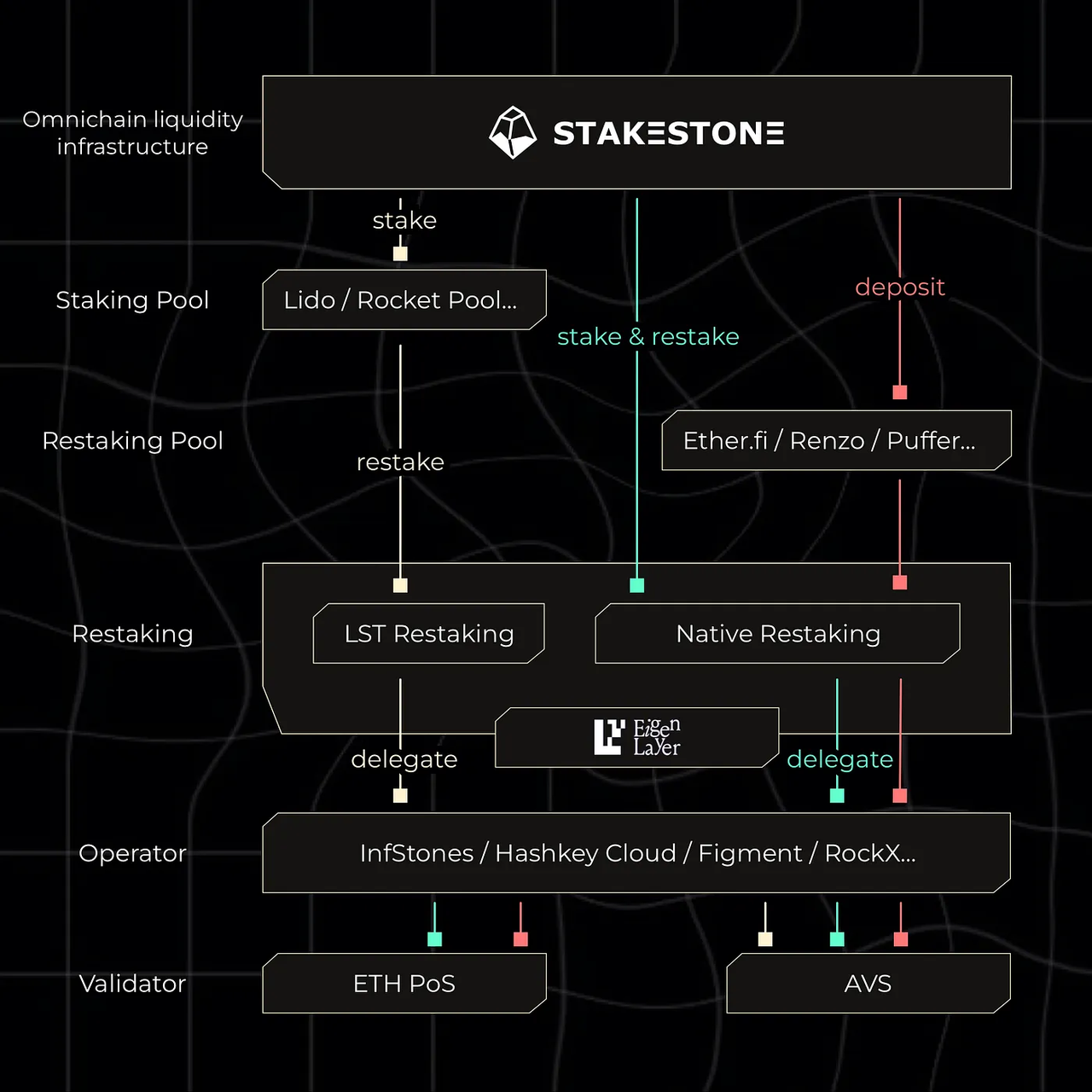
Throughout this process, users do not directly manage the assets. Instead, the strategy layer automatically handles allocation. Some funds may also be transferred across chains to capture better yield opportunities. Ultimately, all generated rewards are aggregated and reflected in the asset tokens held by users.
The Yield Logic of StakeStone Restaking
StakeStone’s yield structure consists of two main components: base staking rewards and restaking rewards.
Base rewards come from blockchain consensus mechanisms, while restaking rewards are earned by participating in additional protocols or services. These two sources are combined within the system to form a multi-layered yield structure.
The key to this model lies in composition. By stacking multiple yield sources, overall returns can be enhanced. However, this also means that returns are not fixed and depend on strategies and market conditions.
Risk Changes Introduced by Restaking of StakeStone
While restaking increases potential returns, it also introduces a more complex risk profile.
First, combining multiple protocols increases smart contract risk. A failure in any component could affect the entire system. Second, restaking may involve additional slashing mechanisms, expanding risk from a single layer to multiple layers. Furthermore, cross-chain operations may introduce risks related to bridges or communication protocols.
As a result, restaking generally carries higher risk than traditional staking, with a more intricate risk structure.
Suitable Use Cases for Restaking
Restaking is particularly suited for scenarios that require higher capital efficiency, especially in multi-chain DeFi environments.
For example, it can serve as a key tool in yield optimization strategies. Within liquid staking ecosystems, it enhances the utility of assets. In multi-protocol environments, it acts as a bridge connecting different services.
Overall, restaking is better suited to complex strategies and efficiency-driven use cases, rather than simple single-yield scenarios.
Conclusion
StakeStone’s restaking mechanism enables staked assets to be reused across multiple yield sources, significantly improving capital efficiency. It represents the evolution of blockchain yield models from single-layer staking to multi-layered structures, while also introducing more complex risks and system dependencies.
FAQs
What is the main difference between restaking and traditional staking?
Restaking allows assets to be reused for multiple sources of yield, while traditional staking generates a single stream of rewards.
Does StakeStone automatically execute restaking?
Yes, it is typically handled automatically through the protocol’s strategy layer.
Is restaking riskier?
Generally yes, as it involves multiple protocols and a more complex structure.
Are restaking yields fixed?
No, they depend on the participating protocols and strategies.
Can all assets be restaked?
Not necessarily, assets must meet the requirements supported by the protocol.