


Twelve New Projects: A Complete Look at the Privacy Projects Highlighted by Solana
Yesterday, Solana’s official X account published a thread highlighting 12 privacy-centric projects in its ecosystem. These initiatives cover encrypted computation, privacy infrastructure, payments and wallets, trading, prediction markets, and smart protection.
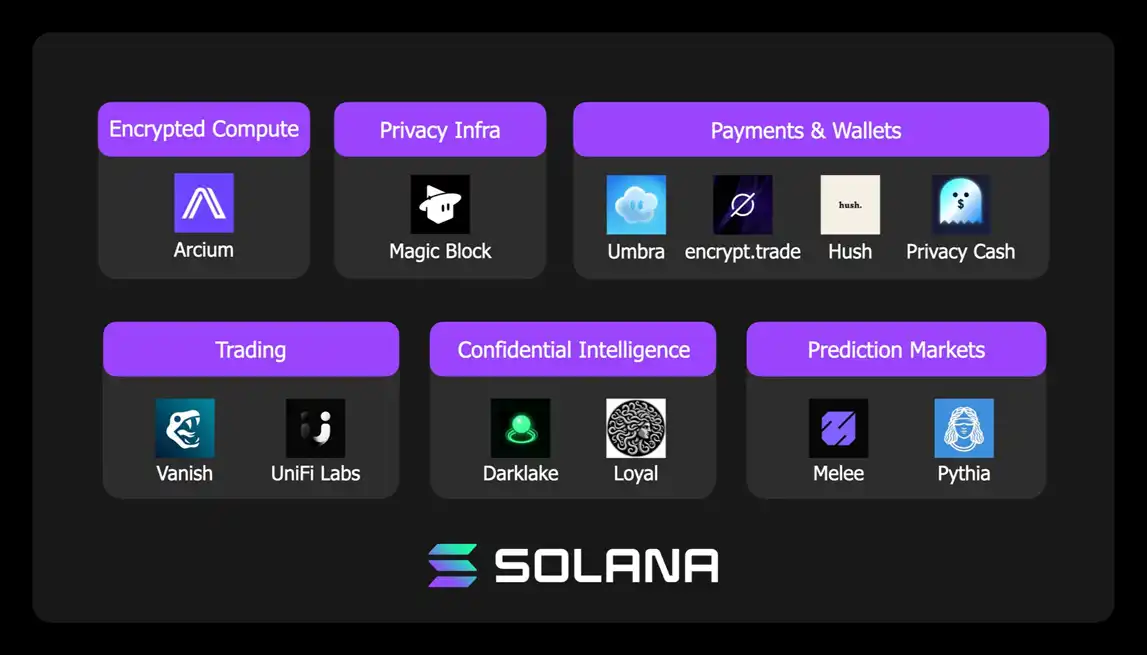
Encrypted Computation
Arcium
On March 27, Arcium—a privacy-focused computation network—announced the completion of its angel round, securing $11 million in total funding from a diverse group of investors, including community fundraising via echo. Notable participants include Jupiter co-founder Meow, MegaETH founding team member Namik, and Jupiter co-founder Siong.
Arcium originated as Elusiv, a privacy protocol on Solana, and later evolved into a comprehensive privacy computation platform. Leveraging MPC (Multi-Party Computation) and ZKP (Zero-Knowledge Proof) technologies, Arcium enables computations on encrypted data without exposing the underlying information.
Within the Arcium network, the MXE (Multi-Party Execution Environment) securely executes computation tasks. Users can customize the cryptographic protocol for each MXE instance. arxOS serves as the network’s distributed execution engine, coordinating tasks and supporting Arx nodes and clusters. Each node—akin to a CPU core—provides computing resources to carry out MXE-defined operations.
A standout feature of Arcium is its dual MPC backend protocols. The first, Cerberus, operates under a “dishonest majority” trust model with built-in cheat detection and identifiable abort mechanisms. As long as one node remains honest, privacy is preserved. The system can identify and penalize dishonest nodes, setting it apart from most protocols that require an “honest majority” (over 51% of nodes being honest).
The second protocol, Manticore, is tailored for AI applications. While its security model is less stringent than Cerberus, it is well-suited for environments with access controls, such as trusted AI training scenarios.
Umbra, another privacy-focused Solana project, utilizes the Arcium network to facilitate private on-chain transfers. Further details on Umbra will follow.
Although Arcium released its tokenomics and conducted a token sale targeting 2% of its tokens on CoinList in March, the project has not yet completed its Token Generation Event (TGE).
Privacy Infrastructure
MagicBlock
On April 25, MagicBlock, an on-chain game engine, closed a $7.5 million seed round, bringing its total funding to $10.5 million. The round was led by Faction, with Maven11, Mechanism Capital, Robot Ventures, Delphi Ventures, Equilibrium, Pivot Global, and angel investors such as Solana co-founder Toly, Helius Labs CEO Mert, and former Backpack co-founder Tristan Yver joining.
Initially positioned as a blockchain game engine, MagicBlock launched its Trusted Execution Environment (TEE)-protected scaling solution, Ephemeral Rollup, in September. According to the team, this marks the first privacy infrastructure built on Trusted Execution Environment (TEE) technology, natively supporting Solana.
Legacy privacy solutions often incur heavy cryptographic overhead, slow execution, and complex integration. MagicBlock adopts a pragmatic approach: Just-In-Time Ephemeral Rollup aggregates standard Solana transactions within Intel TDX secure enclaves, creating a hardware-verified “black box” for sensitive computations. The solution is auditable and deployable with minimal code, enabling confidential order books and dark pools, regulatory-compliant DeFi protocols with integrated privacy controls, secure and auditable payment channels, and privacy-protected consumer apps and games.
In essence, MagicBlock provides infrastructure for building on-chain privacy features and applications. Its key advantages include high speed, developer-friendly integration for Solana, and robust access controls. However, as a backend solution with limited direct impact on retail users, its future token issuance remains uncertain.
Payments and Wallets
Umbra
From October 6-8, Umbra held an Initial Coin Offering (ICO) on MetaDAO, aiming for a minimum raise of $750,000. The campaign attracted approximately $155 million, surpassing the target by 20,659%.

As previously mentioned, Umbra enables private transfers on Solana via the Arcium network. It obscures on-chain fund flows and offers an opt-in audit feature, allowing users to disclose transaction history to third parties for compliance or audit purposes.
Umbra’s anonymity layer is built on a “shielded pool,” a smart contract that holds a large mix of tokens from many users. The shielded pool acts as a public vault; once tokens are deposited and mixed, it is impossible to determine individual ownership through computation. As the pool grows, privacy protection for each user increases.
Depositors send their tokens to the shielded pool. The protocol encrypts deposit details, such as amount and recipient Umbra address. On-chain, only the sender’s Solana address is visible; the final destination remains hidden.
Recipients generate zero-knowledge proofs, which the Umbra contract verifies before transferring funds to the recipient’s Umbra address. Gas fees are deducted directly from the withdrawal, eliminating the need for recipients to fund their Umbra address with SOL, ensuring complete privacy.
encrypt.trade
encrypt.trade is a privacy DeFi platform on Solana supporting private transfers and swaps. It won the Colosseum hackathon and is backed by Alliance.
Users must first wrap their tokens for swaps. The tokens are encrypted using the ElGamal algorithm, and only the wrapped asset type is visible on-chain; the encrypted data resides off-chain.
The wrapped tokens serve as on-chain “pointers,” allowing apps like Jupiter to identify the asset type. Actual transaction amounts and directions are computed in a secure TEE environment. After computation, data is re-encrypted and updated on-chain, with corresponding actions executed by the relevant app algorithm.
This approach means swaps via encrypt.trade do not broadcast transaction data on-chain like traditional DEXs. Only the state changes of wrapped assets are visible; transaction amounts, counterparties, and even the existence of a transaction remain hidden.
Hush
Hush has not yet launched. According to its official Twitter, it is a privacy-first Solana wallet offering SOL obfuscation, one-time addresses, and private transactions. It also supports dApp wallet creation and integrated ZEC bridging.
Privacy Cash
The current version supports only private SOL transfers. Future updates will add private SPL token transfers and swaps.
Depositors send SOL to a privacy pool, generating a “credential” added to a Merkle tree. Recipients use zero-knowledge proofs to withdraw funds to any address.
Trading
Vanish
Vanish is another Colosseum hackathon winner, receiving a $1 million pre-seed round led by Colosseum, with Solana Ventures and Pivot Global participating.
Vanish uses smart trade routing to maintain transaction privacy via protected liquidity sources. Technical documentation is limited. The project emphasizes compliant privacy and anti-money laundering protections for users.
UniFi Labs
UniFi Labs has not yet launched and is focused on privacy perpetual contracts.
Smart Protection
Darklake
Darklake has ambitious goals and describes itself as a “zero-knowledge proof privacy layer.” Rather than building a full privacy system or blockchain, it applies zero-knowledge proofs to create practical privacy applications on Solana.
The live feature is the blind slippage pool (zk-AMM). This adds a cryptographic commitment layer to automated market makers (AMMs), making slippage data invisible to searchers but verifiable post-trade. After a user submits a swap, the system generates a hash and a unique encrypted value, submitting both with transaction info. Darklake’s proof generator creates a Groth16 proof confirming results meet or exceed the slippage range. If valid, the transaction settles; otherwise, it is canceled and funds are refunded.
Future plans include privacy perpetual contracts and token launches. Solana classifies this as smart protection likely due to its comprehensive feature set and integration of Arcium’s technology for multi-party privacy state coordination after transactions.
Loyal
Loyal completed an Initial Coin Offering (ICO) on MetaDAO, raising approximately $75.9 million, oversubscribed by 15,180% and far surpassing its minimum target of $500,000.
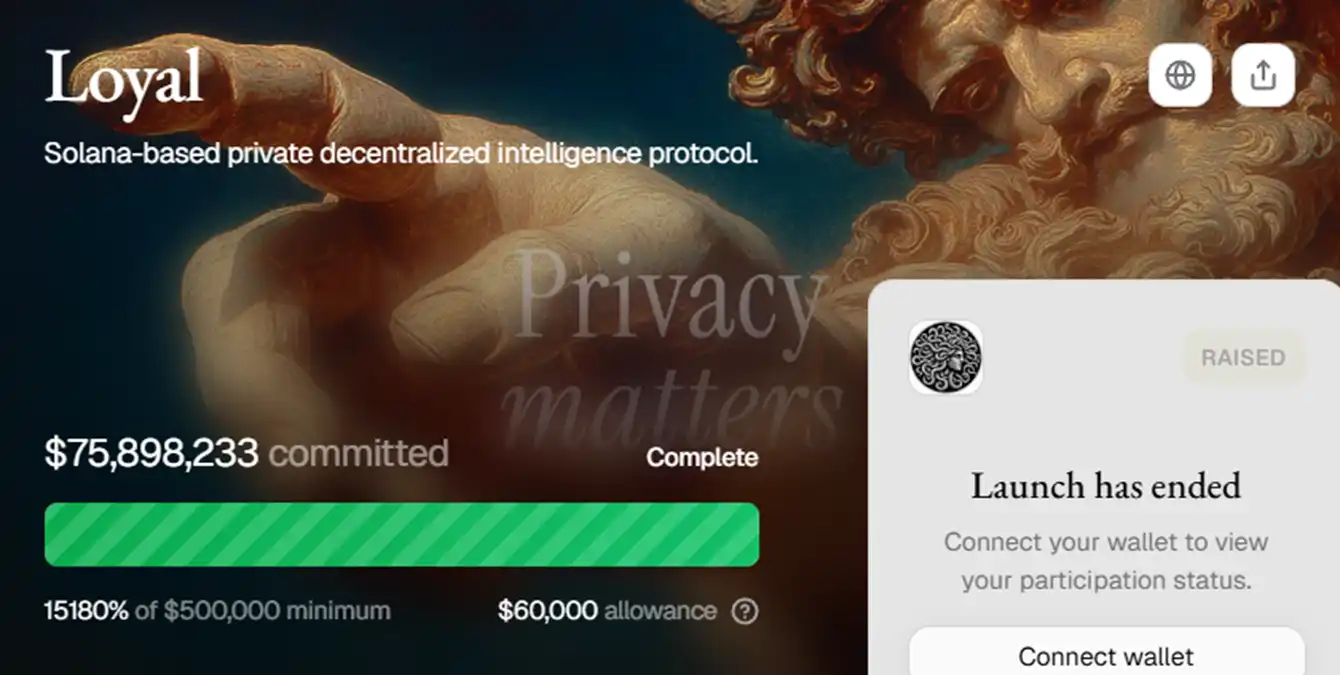
Loyal is an open-source, decentralized, censorship-resistant, and auditable smart protocol powered by MagicBlock and Arcium. The project aims to build an on-chain AI that safeguards user data privacy, starting with crypto transaction processing and evolving toward assisting daily life and work—similar to current AI offerings.
Prediction Markets
Melee and Pythia
Both projects leverage Arcium’s technology. On the technical side, both implement encrypted order books for prediction markets, creating dark pool effects. It remains to be seen whether this will become necessary as prediction markets mature.
Statement:
- This article is reprinted from [BlockBeats]. Copyright belongs to the original author [Cookie]. If you have any objections to the reprint, please contact the Gate Learn team for prompt resolution in accordance with established procedures.
- Disclaimer: The views and opinions expressed in this article are solely those of the author and do not constitute investment advice.
- The Gate Learn team translates other language versions of this article. Reproduction, dissemination, or plagiarism of the translated article is prohibited unless Gate is credited.
Share
Content


Related Articles

The Future of Cross-Chain Bridges: Full-Chain Interoperability Becomes Inevitable, Liquidity Bridges Will Decline

Solana Need L2s And Appchains?

Sui: How are users leveraging its speed, security, & scalability?

Navigating the Zero Knowledge Landscape

What is Tronscan and How Can You Use it in 2025?
