Balancer Labs, the team behind the decentralized finance protocol Balancer, is shutting down after mounting financial pressure and a $116 million hack in November, with executives proposing continuation of the protocol under a leaner, more cost-effective structure.
“After careful consideration, I have decided to wind down Balancer Labs. This is not a decision I take lightly,” one of Balancer Protocol’s founders, Fernando Martinelli, said on Monday, adding that Balancer Labs has become a “liability rather than an asset to the protocol,” as it has been operating without revenue.
Balancer Labs CEO Marcus Hardt added that it was spending too much to attract liquidity relative to the revenue the protocol is making, a strategy that came at the cost of diluting Balancer (BAL) token holders.
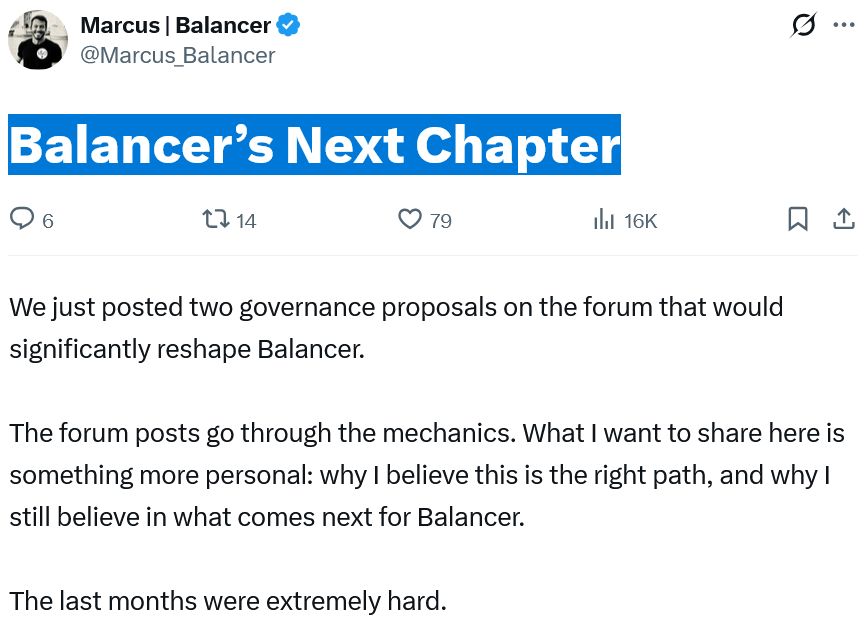
_Source: _Marcus Hardt
Balancer was one of the more notable DeFi protocols during the 2020–2021 bull market, reaching a peak of $3.3 billion in total value locked (TVL) in November 2021.
However, that figure fell to $800 million by October 2025, with the hack leading to another $500 million TVL drop over the next two weeks. Balancer’s TVL has since fallen to $158 million, showing how challenging it is for DeFi protocols to recover from large-scale hacks.
Martinelli said the November exploit “created real and ongoing legal exposure” and that maintaining a corporate entity that carries the liability of past security incidents wasn’t sustainable.
Balancer Labs executives outline restructuring plan
Moving forward, Hardt and Martinelli are pushing for Balancer’s future to be managed by the Balancer Foundation and the protocol’s decentralized autonomous organization.
Martinelli advocated for Balancer to adopt a more “lean continuation path,” which involves cutting BAL emissions to zero, restructuring fees to enable Balancer’s DAO to capture more revenue, reducing the team as much as possible and targeting lower operating costs.
“Balancer still has real value to build from here. If we can make this transition work, we have a real chance to build a stronger and more sustainable protocol on the other side of it,” Hardt said.
Balancer DAO members have been asked to vote on two proposals reflecting possible changes in Balancer’s operational restructuring and BAL’s tokenomics.
**Related: **__OP_NET launches Bitcoin DeFi push without bridges or wrapped BTC
Despite the tokenomics issues, Martinelli noted that Balancer is “still generating real revenue” at over $1 million across the past three months:
“That’s not nothing — that’s a functioning protocol buried under a broken tokenomics model and an overweight cost structure,” he said.
“The problem isn’t that Balancer doesn’t work. The problem is that the economics around Balancer aren’t working. Those are fixable.”
**Magazine: **__Are DeFi devs liable for the illegal activity of others on their platforms?
Cointelegraph is committed to independent, transparent journalism. This news article is produced in accordance with Cointelegraph’s Editorial Policy and aims to provide accurate and timely information. Readers are encouraged to verify information independently. Read our Editorial Policy https://cointelegraph.com/editorial-policy
- #DAO
- #Hacks
- #DeFi
- #DEX
- #Tokenomics
- #Industry
Disclaimer: The information on this page may come from third parties and does not represent the views or opinions of Gate. The content displayed on this page is for reference only and does not constitute any financial, investment, or legal advice. Gate does not guarantee the accuracy or completeness of the information and shall not be liable for any losses arising from the use of this information. Virtual asset investments carry high risks and are subject to significant price volatility. You may lose all of your invested principal. Please fully understand the relevant risks and make prudent decisions based on your own financial situation and risk tolerance. For details, please refer to
Disclaimer.
Related Articles
Chan Ho-lim: The Securities and Futures Commission of Hong Kong is researching rules for tokenized secondary markets, with the aim to announce details in the first half of 2026
Hong Kong officials announced that they are studying the rules for the secondary market of tokenized products, and plan to release details in the first half of 2026. The Hong Kong Monetary Authority has issued the first batch of two stablecoin licenses, driving the development of digital assets, while Hong Kong is also actively expanding the use of tokenized money market funds and green bonds. In addition, the flow of funds between Hong Kong and the Middle East has been increasing as well.
MarketWhisper18m ago
IRS tax refund delays trigger a HYTOPIA shutdown crisis—platform goes offline for 1 to 3 months
The metaverse platform HYTOPIA decided to pause the operation of its infrastructure because a large IRS tax refund has not yet been received. The platform plans to be offline for 1 to 3 months. A dispute over unpaid invoices between the platform and HY Foundation has also led to delays in the delivery of some tokens. HYTOPIA promises to handle this matter transparently and asks the community to be patient and wait.
MarketWhisper24m ago
Pi Network Core Team: The ecosystem already has over 18 million identity-verified users
Pi Network’s official announcement says there are currently more than 18 million users who have completed KYC, emphasizing that verified users matter more in transactions than other unverified accounts. The core team believes identity verification is crucial to transaction trust, and therefore has built a mainnet ecosystem with full KYC verification to ensure identities are verifiable, reduce spam, and improve overall credibility.
MarketWhisper1h ago
Curve Finance Suspends LayerZero Bridging as a Precaution, Limits CRV and crvUSD Bridge Access
Curve Finance has been attacked over LayerZero infrastructure related to rsETH, and has temporarily suspended cross-chain functionality to prevent risk, impacting CRV cross-chain bridging and the fast bridging of crvUSD. Founder Egorov said the incident demonstrates the risk of “non-isolated lending,” and proposed a fully isolated mode as an alternative. Kelp DAO also suffered losses of about $292 million due to the attack, affecting lending activity on the Aave platform.
MarketWhisper1h ago
AAVE (Aave) down 6.53% in 24 hours
Gate News message, April 20, according to Gate market data. As of the time of writing, AAVE (Aave) is trading at $92.32. Over the past 24 hours, it is down 6.53%, with a high of $99.17 and a low of $88.71. The 24-hour trading volume is $16.9544 million. The current market cap is approximately $140.1 million.
Aave is an open-source decentralized lending protocol that provides deposit and borrowing services for users. The deposit interest rates for depositors and the loan interest rates for borrowers are calculated algorithmically based on the platform’s borrowing amount and deposit amount. The platform also uses Chainlink oracles to ensure fairness in the collateral price.
AAVE’s recent important news:
1️⃣ **Kelp DAO cross-chain bridge hacked, triggering a liquidity crisis**
The hacker exploited a LayerZero cross-chain bridge vulnerability to steal rsETH worth $291 million, and then used the illegally obtained rsETH to provide collateral and borrow on Aave, causing the utilization rate of Aave’s core lending pool to reach 100%. The incident triggered a chain reaction: Aave’s net withdrawals totaled $6.2 billion, and total deposits fell from $45.8 billion to $35.7 billion. This event directly hit market confidence and is the main reason for the recent decline.
2️⃣ **Multiple institutions and whales panic-selling**
After the incident, multiple whale addresses sold AAVE heavily on-chain, including the "smaugvision" address selling 20,015 tokens, the 0xFC5 address selling 20,000 tokens, and the 0xA2E address selling 19,665 tokens—totaling nearly 60,000 tokens. The well-known whale "ThisWillMakeYouLoveAgain" even cut losses and stopped the loss by selling 29,400 AAVE for $2.73 million, with losses exceeding $6 million. Large-scale selling further intensified downward pressure on the market.
3️⃣ **DAO governance approves a large financing plan to support long-term development**
The Aave DAO passed the first grant proposal under the Aave Will Win framework with 75% support. Aave Labs will receive $25 million in stablecoins and 75,000 AAVE (about $6.8 million) unlocked linearly over four years. Founder Stani clearly laid out the strategic direction: all product revenues will flow back to the DAO treasury, with the goal of expanding the protocol’s scale from $40 billion to the trillion-level. This financing plan provides a solid foundation for the protocol’s long-term development, but in the short term the market still needs to absorb the impact of the hacker incident.
4️⃣ **Smart money addresses build positions against the trend**
On-chain data shows that over the past seven days, approximately $2.9 million worth of AAVE has flowed out of exchanges. Smart money addresses are accumulating AAVE, with their holdings increasing to 359,880 tokens. The top 100 traders saw a net inflow of $2.18 million, and the leading profit-taking wallets maintained their positions without moving, suggesting that institutional investors are optimistic about Aave’s long-term prospects and providing some support for the current price.
This information is not investment advice. Please note the risk of market volatility when investing.
GateNews1h ago
World ID 4.0 Launches with Tinder and Zoom Integration, Reaches 18M Verified Users
Tools for Humanity launched World ID 4.0, enhancing its biometric verification system with key rotation and tiered options. With 18 million users, it integrates with Tinder and Zoom. The company supports expansion through funding, despite a 97% decline in WLD token value.
GateNews3h ago


