DeFi Protocol Balancer Loses $128 Million in Hack, Announces Shutdown Due to Lack of Revenue and Legal Risks. Future Operations to Be Maintained by DAO, Token Issuance Ceased, Founders to Exit, Highlighting Challenges of Old Models.
Balancer Has No Income After Hack, Gradually Ceasing Operations
Decentralized Finance (DeFi) protocol Balancer announced earlier today (3/24) that it is gradually shutting down. Since the $128 million vulnerability exploit in November 2025, the platform has faced ongoing legal risks.
As Balancer no longer has sustainable revenue, its developer, Balancer Labs, has chosen to wind down operations. In the future, the protocol will continue to operate through a decentralized autonomous organization (DAO), foundation, and service providers, with core team members expected to transition to a new operational entity after governance approval.
Balancer Restructuring Plan Revealed, Founders to Step Down
Co-founder Fernando Martinelli outlined the restructuring plan, including ceasing issuance of Balancer tokens (BAL), gradually phasing out the veBAL governance model, and restructuring fee mechanisms to allow the DAO treasury to receive 100% of protocol fees, while reducing V3 protocol share to 25%.
Other measures include implementing BAL token buybacks to provide liquidity exits for holders, focusing development on core products such as reCLAMM, liquidity guiding pools, stablecoins, and liquidity staking pools, as well as cross-chain weighted pools.
A formal proposal outlining tokenomics restructuring and operational changes will be released separately by the core team.
Martinelli also revealed that he will no longer have an official relationship with the protocol in the future, but emphasized his continued belief in Balancer’s underlying technology and the remaining team.
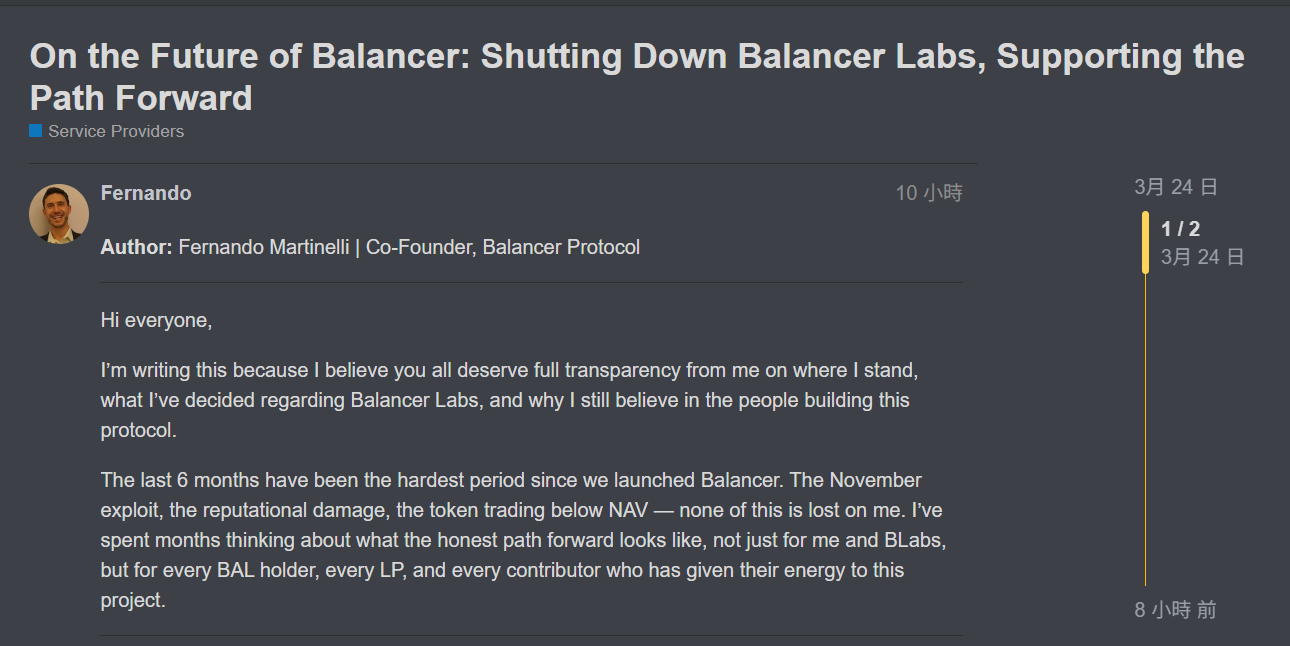
Image Source: Statement by Balancer Co-founder Fernando Martinelli: Balancer Has No Income After Hack, Announces Gradual Shutdown
Recap of the Balancer Hacker Incident: Rounding Function Vulnerability Caused the Damage
Looking back at last year’s Balancer hack, attackers exploited a logical flaw in the smart contract’s upscale rounding function, combined with BatchSwap batch transactions and flash loan mechanisms, to perform multiple complex operations within a single transaction, repeatedly draining assets from the liquidity pools.
The Balancer attack affected multiple blockchains, including Ethereum, Base, Avalanche, Arbitrum, Optimism, Polygon, Gnosis, Berachain, and Sonic, serving as a stark reminder that even in trust-minimized architectures, hot wallets and liquidity pools remain prime targets for hackers.
Although Balancer’s transparent handling of the incident and cross-chain cooperation received praise, the attack highlighted long-standing structural issues in DeFi. While complex composable designs accelerate innovation, they also expand attack surfaces.
The rounding error was a minor mathematical oversight, yet it triggered a chain reaction across cross-chain liquidity pools, revealing the industry’s ongoing lack of unified auditing standards and risk firewalls.
- Related article: Balancer Hacker Incident Report Released! How a Single Vulnerability Crippled the Entire DeFi Industry?
Balancer Governance and Security as Future Challenges
Zeus Research analyst Dominick John pointed out that Balancer exposed a structural failure, describing the protocol as having succumbed to a broken model characterized by token emission disappearance, weakened governance, and shallow value capture.
He believes that streamlining operations might be the right move, but this is only a patch for the later stages, and added that the old DeFi model driven by token rewards is being phased out.
Senior analyst Ryan Yoon of Tiger Research told Decrypt that shutting down the company may also be a way for Balancer to quickly escape legal risks, and the next challenge will be whether the reduced team can truly fix governance issues.
Yoon emphasized that the team must maintain governance consistency, ensure security integrity, and keep the treasury stable to promote protocol development.
Further Reading:
Stream Losses, xUSD Depegging Domino Effect: Over a Dozen DeFi Platforms at Risk, Exposure Near $300 Million
Disclaimer: The information on this page may come from third parties and does not represent the views or opinions of Gate. The content displayed on this page is for reference only and does not constitute any financial, investment, or legal advice. Gate does not guarantee the accuracy or completeness of the information and shall not be liable for any losses arising from the use of this information. Virtual asset investments carry high risks and are subject to significant price volatility. You may lose all of your invested principal. Please fully understand the relevant risks and make prudent decisions based on your own financial situation and risk tolerance. For details, please refer to
Disclaimer.
Related Articles
Pi Network Distributes 26.5M PI to 1M KYC Validators
Pi Network has taken another step forward in building its ecosystem. The project recently distributed 26.5 million PI tokens to more than 1 million KYC validators.
These rewards were given to users who helped verify identities on the network. This process is important. Because it ensures that
Coinfomania1m ago
Aave Faces a Major Trust Crisis: Service Providers Exit En Masse, with “Technology, Governance, and Risk Control” Fully Failing
Author: Jae, PANews
Compared with the external pressure of a bear market, Aave has instead seen a “black swan” emerge internally first.
Aave, which has long occupied the throne of lending agreements, is now facing the most severe ecosystem shake-up since its founding. There has been no hacker attack, no code vulnerabilities—only power gone out of control and conflicting interests.
From BGD Labs, a technical cornerstone, decisively leaving, to a public break between governance pioneer ACI (Aave Chan Initiative), and then to Chaos Labs, the risk-management steward, announcing that it is parting ways— a major “service provider retreat” is unfolding.
The depth of this game goes far beyond a mere cooperation dispute; it has triggered
区块客42m ago
Hyperliquid introduces a priority fee mechanism on mainnet; the order priority fee cap is reduced to 8 bps
Hyperliquid founder Jeff announced on Discord that the priority fee mechanism has been live on the mainnet in Alpha mode, including two types: Gossip and Order. Users can pay with HYPE tokens; the order priority fee cap has been reduced from 20 bps to 8 bps. Currently, it only applies to IOC orders for HIP-3 assets.
GateNews2h ago
Byreal launches an on-chain AI trading assistant, RealClaw, supporting third-party skill extensions
Byreal launched an on-chain AI trading assistant, RealClaw, on April 13. The tool is built on the OpenClaw framework, supports third-party skill extensions, and allows users to customize their trading strategies. It is currently in the Alpha testing stage and is only available to invited users.
GateNews2h ago
Aave governance civil war ends: The AWW proposal overwhelmingly passes “all-product revenue to the DAO,” and $AAVE becomes the sole core asset
Aave founder Stani Kulechov announced that the “Aave Will Win” proposal has passed, consolidating all application product revenues into the DAO, and positioning $AAVE as the single core asset. The goal is to expand the agreement’s scale to $1 trillion. This proposal ended Aave’s governance crisis, establishing new revenue streams and governance principles aimed at strengthening community trust and value.
動區BlockTempo2h ago
Zcash core development team ZODL releases strategic roadmap, focusing on post-quantum security and user base expansion
Zcash’s core development team, ZODL, has released the latest strategic roadmap, focusing on post-quantum security, scalability, and user experience, and moving into the Zcash IV phase. The new version is now live, improving user experience and advancing key development. Meanwhile, ZODL is actively involved in industry cooperation, but due to regulatory issues it has temporarily taken down the Russian app store.
GateNews4h ago


