A group of Ethereum developers has launched a resource hub focused on protecting the blockchain from future quantum computing threats and securing the billions of dollars worth of value the network secures.
The “Post-Quantum Ethereum” website, launched on Tuesday by members of the Ethereum Foundation, says the organization’s new Post-Quantum team is planning to implement quantum solutions into Ethereum at the protocol level by 2029, with solutions targeting the execution layer to follow.
While the Post-Quantum team said no imminent quantum threat exists for cryptography-secured blockchains, early action is necessary due to the complexity involved:
“Migrating a decentralized, global protocol takes years of coordination, engineering, and formal verification,” the team said. “The work must begin well before the threat arrives.”
_Source: _Ethereum Foundation
Concerns that quantum computers could eventually break blockchain cryptography have fueled industry-wide fear around private keys and wallet security, prompting broader debate over how the sector should prepare as the technology develops.
Most industry analysts acknowledge that quantum computing poses some level of threat to crypto. Galaxy Digital analyst Will Owens has said only crypto wallets with exposed public keys are vulnerable, while others, such as Capriole Investments’ Charles Edwards, have said all coins are at risk.
Post-Quantum team building SNARK-based signatures
Many crypto developers are focused on how quantum-safe solutions can be implemented into cryptographic signatures to fight off potential attacks.
However, some solutions are more computationally intensive and could potentially impact blockchain performance by increasing bandwidth and storage.
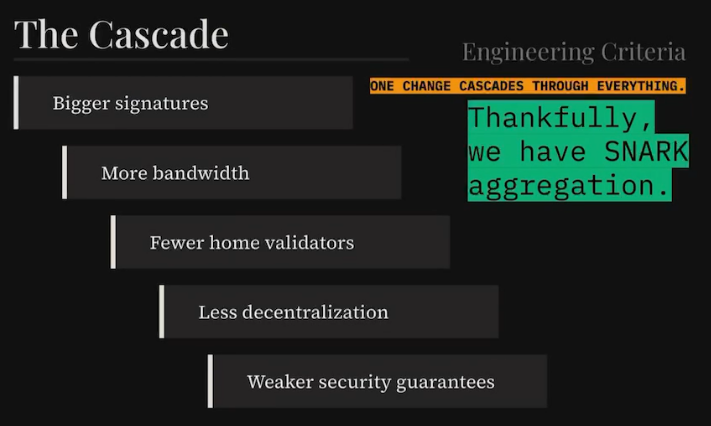
_Quantum-proof signatures can cause other problems, impacting network performance. Source: _Post-Quantum Ethereum
The Post-Quantum team is integrating SNARK, or Zero-Knowledge Succinct Non-Interactive Argument of Knowledge technology, in an effort to prevent the Ethereum network from experiencing these issues.
**Related: **__Quantum fears aren’t behind Bitcoin’s 46% drop, says developer
Quantum solutions will be implemented into Ethereum’s consensus, execution and data layers, the team said.
The Post-Quantum team said it would prioritize protecting standard Ethereum wallets as it believes that’s where the largest pool of value is, followed by high-value operational wallets tied to crypto exchanges, bridges and custody solutions.
It said that one of the biggest challenges will be to deploy these solutions without disrupting the network.
“Choosing a post-quantum algorithm is only part of the challenge. The harder parts include safely upgrading hundreds of millions of accounts, preventing the migration from introducing new bugs, avoiding new attack surfaces, maintaining performance, and coordinating ecosystem-wide adoption.”
**Magazine: **__Bitcoin faces 6 massive challenges to become quantum secure
Cointelegraph is committed to independent, transparent journalism. This news article is produced in accordance with Cointelegraph’s Editorial Policy and aims to provide accurate and timely information. Readers are encouraged to verify information independently. Read our Editorial Policy https://cointelegraph.com/editorial-policy
- #Security
- #Ethereum
- #Data
- #Quantum Computing
- #Industry
Disclaimer: The information on this page may come from third parties and does not represent the views or opinions of Gate. The content displayed on this page is for reference only and does not constitute any financial, investment, or legal advice. Gate does not guarantee the accuracy or completeness of the information and shall not be liable for any losses arising from the use of this information. Virtual asset investments carry high risks and are subject to significant price volatility. You may lose all of your invested principal. Please fully understand the relevant risks and make prudent decisions based on your own financial situation and risk tolerance. For details, please refer to
Disclaimer.
Related Articles
ether.fi's Liquid ETH Vault Now Accepts aWETH Deposits for Aave Users
Gate News message, April 23 — ether.fi announced that its Liquid ETH vault now accepts aWETH deposits, providing an exit option for users facing liquidity constraints on Aave.
The Liquid ETH vault does not hold WETH exposure to Aave, according to the
GateNews23m ago
Newly Created Address Withdraws 4,000 ETH Worth $9.59M from Major CEX
Gate News message, April 23 — According to Onchain Lens, a newly created address (0x66e...5b6b) withdrew 4,000 ETH, valued at approximately $9.59 million, from a major CEX.
The tokens were transferred to the address earlier
GateNews31m ago
Ethereum Futures Open Interest Surges 7.29% to $32.96B in 24 Hours
Gate News message, April 22 — According to Coinglass data, Ethereum's global futures open interest increased 7.29% over the past 24 hours, reaching a total of $32.96 billion.
Among major exchanges, open interest is distributed as follows: a leading exchange holds $7.67 billion, another major
GateNews6h ago
ETH Liquidation Levels: $1.445B in Short Liquidations at $2,492; $1.334B in Long Liquidations at $2,257
Gate News message, April 23 — According to Coinglass data, if ETH breaks above $2,492, cumulative short liquidations across major centralized exchanges would reach $1.445 billion. Conversely, if ETH falls below $2,257, cumulative long liquidations across major CEXs would reach $1.334 billion.
GateNews6h ago
Ethereum Breaks Through $2,400 as Daily Decline Holds at 0.15%
Gate News message, April 22 — Ethereum broke through the $2,400 mark today, though the cryptocurrency recorded a 0.15% decline over the 24-hour period.
GateNews7h ago
Bitcoin breaks through $78,000, and the market moves out of the extreme fear range
The crypto market is recovering, with BTC trading above $78k, up about 2% day over day. After breaking $75k, a short squeeze emerged; spot ETFs have seen consecutive net inflows, and MicroStrategy’s additional purchases have driven growth in institutional holdings. Open interest is rising, funding rates are falling, and even turning negative, suggesting potential explosive upside. Tensions on the geopolitical front have eased, and the fear index has rebounded back into a fear range—sentiment has improved, but it’s not yet a full bull market. To hold the $78k–$83k range steadily, improve liquidity, and maintain macro stability, we can enter a long-term bull market. This article was first published by Chain News ABMedia.
ChainNewsAbmedia8h ago


