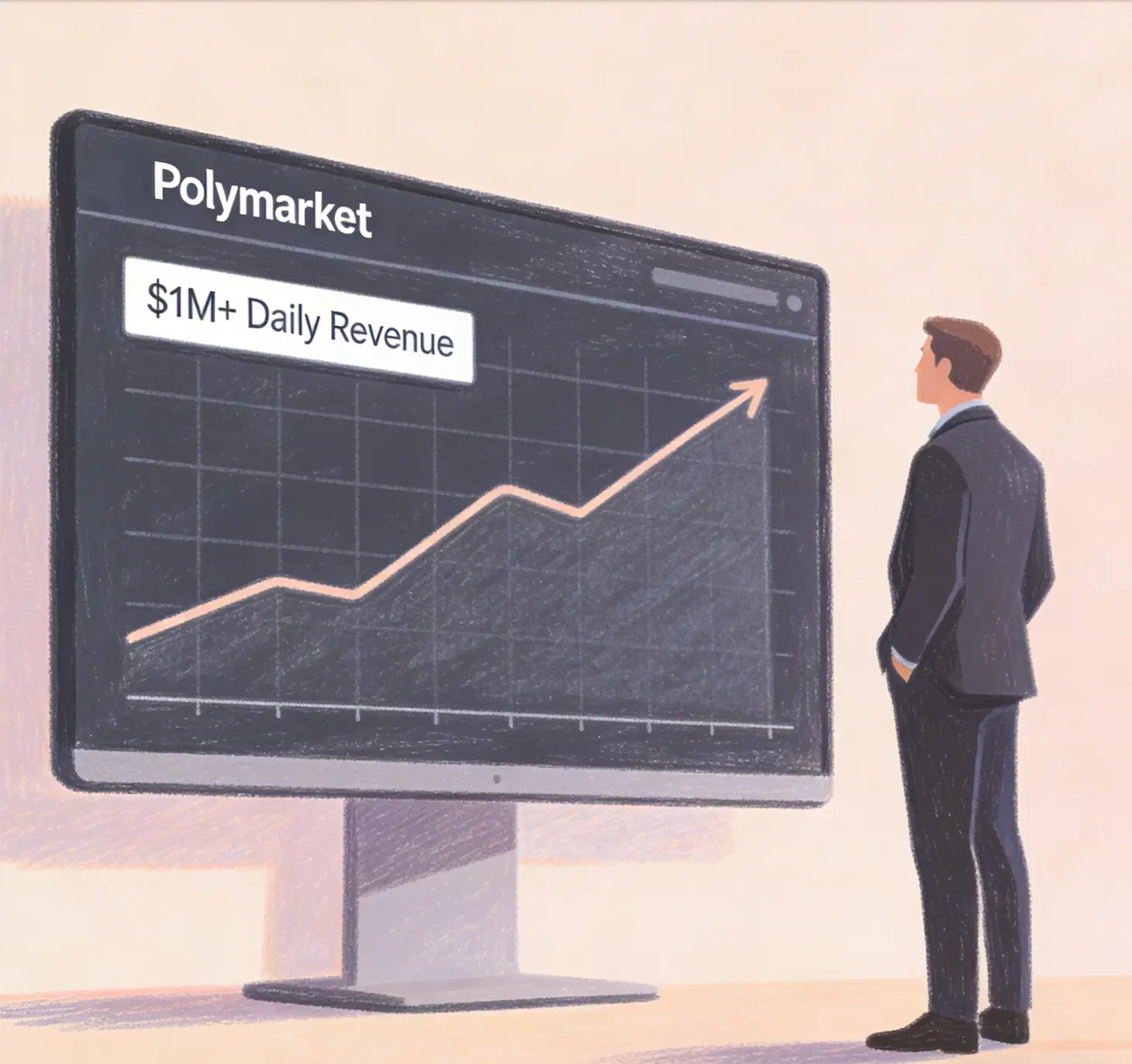
 Polymarket’s daily fee revenue reached $1.02 million on April 1, 2026, just two days after the platform expanded variable taker fees to nearly all market categories including politics, finance, economics, culture, weather, and technology.
The surge from $696,000 on March 31 comes as energy traders increasingly rely on Polymarket data to drive algorithmic trading in global Brent crude futures, raising concerns that anonymous betting could influence oil prices and that insider knowledge may be exploited.
Polymarket’s Fee Restructuring Boosts Revenue to $338 Million Annual Run Rate
Polymarket previously charged fees only on crypto and sports contracts. The updated structure applies a dynamic, probability-based model where fees peak at 50% probability of an outcome and drop near extremes. Crypto markets carry the steepest rate at 1.80%, while sports remain the lowest at 0.75%. Makers pay no fees and instead receive daily USDC rebates of 20% to 25% of collected fees, depending on the category. Geopolitics and world events remain entirely fee-free.
On-chain analyst DefiOasis noted that April 1 fees reached $927,000 on Dune Analytics, translating to an annualized run rate of approximately $338 million. DefiLlama data placed the figure even higher at $1.07 million. The rapid monetization follows Polymarket’s transition from subsidized growth to sustainable revenue, joining rival Kalshi which reportedly achieved a $1.5 billion annualized run rate.
Competition Intensifies as Binance Wallet Integrates Predict Fun
The fee shift arrives as prediction markets draw new entrants. Binance Wallet began beta-testing an in-app prediction feature through Predict Fun (Predict.fun), a BNB Smart Chain protocol that saw $7.68 million in net inflows on a single day after the integration. Predict Fun’s open interest rebounded to $23 million, according to DefiOasis.
Monthly prediction market volume industrywide now exceeds $20 billion. Polymarket’s ability to sustain above $1 million in daily fees will depend on trading volume resilience as takers adjust to the new cost structure.
Oil Traders Adopt Polymarket Data for Algorithmic Trading
Energy traders say Polymarket has become a key data source for algorithms determining multimillion-dollar trades in the global Brent crude futures market. One energy trader stated that Polymarket has been the best predictor of oil market direction since the US-Israel war with Iran triggered a global oil crisis, making it an essential part of trading algorithms.
Ajay Parmar, head of oil trading at market intelligence agency ICIS, said the betting platform is having an increased impact on many markets and that this will increasingly become the case going forward. Tim Skirrow, head of derivatives at Energy Aspects, confirmed the adoption, stating that any and all data is up for consideration in modern markets if it has alpha.
Goldman Sachs has included analysis of prediction-market data in the oil market research it shares with investors and clients. The Intercontinental Exchange (ICE), which owns the New York Stock Exchange and is the most important exchange for Brent crude futures trading, has launched a trading tool providing a data feed of Polymarket’s prediction markets to help traders consume crowdsourced probability assessments as market signals.
Insider Trading Concerns and Market Influence Risks
Energy traders have raised concerns that anonymous Polymarket users may be using insider knowledge to place bets, with some noting very large bets occurring minutes before major announcements. The growing influence of Polymarket on oil pricing means betting by a relatively small number of anonymous users could play an outsized role in influencing the oil market, where far larger financial windfalls are possible.
In some instances, a small number of Polymarket users made substantial bets in the run-up to the US-Israel war in Iran, and in the weeks that followed, that experts say appears to show signs of insider knowledge. This data is used to inform algorithmic trading systems that previously focused on news organizations and social media. In some cases, these bets appear to have triggered high volume in oil futures markets, causing sharp price fluctuations.
ICE launched its Polymarket data tool just weeks before the Iran war began. The exchange agreed to invest $2 billion in Polymarket in October 2025, valuing the platform at approximately $9 billion, and has since injected an additional $600 million.
However, not all commodity traders are convinced. A trading analyst at a leading energy company stated that Polymarket has made bad calls during the crisis and that while hedge funds may be interested, their firm does not use it for decision-making.
FAQ
How much daily fee revenue is Polymarket generating after its fee overhaul?
Polymarket’s daily fee revenue reached $1.02 million on April 1, 2026, following the March 30 expansion of variable taker fees to nearly all market categories. The annualized revenue run rate based on that figure is approximately $338 million.
How are oil traders using Polymarket data?
Energy traders are incorporating Polymarket data into algorithms that trade Brent crude futures. The Intercontinental Exchange (ICE) offers a Polymarket data feed as a trading tool, and Goldman Sachs includes prediction-market analysis in its oil market research.
What concerns have been raised about Polymarket’s influence on oil markets?
Energy traders worry that anonymous users with insider knowledge could place bets that influence oil prices through algorithmic trading systems. Substantial bets placed minutes before major announcements and in the run-up to the Iran war have raised questions about potential insider trading and market manipulation.
Disclaimer: The information on this page may come from third parties and does not represent the views or opinions of Gate. The content displayed on this page is for reference only and does not constitute any financial, investment, or legal advice. Gate does not guarantee the accuracy or completeness of the information and shall not be liable for any losses arising from the use of this information. Virtual asset investments carry high risks and are subject to significant price volatility. You may lose all of your invested principal. Please fully understand the relevant risks and make prudent decisions based on your own financial situation and risk tolerance. For details, please refer to
Disclaimer.


