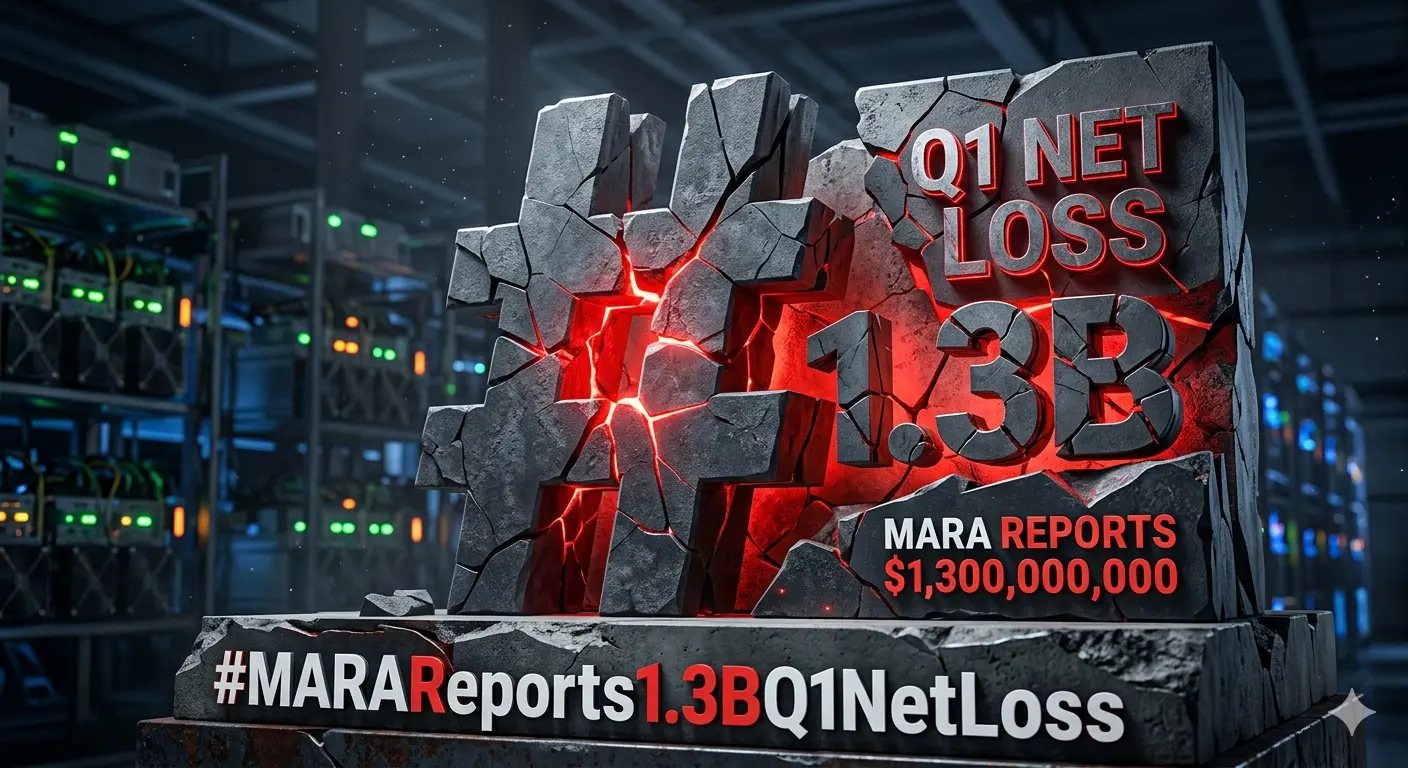

# MARAReports1.3BQ1NetLoss

50.27M

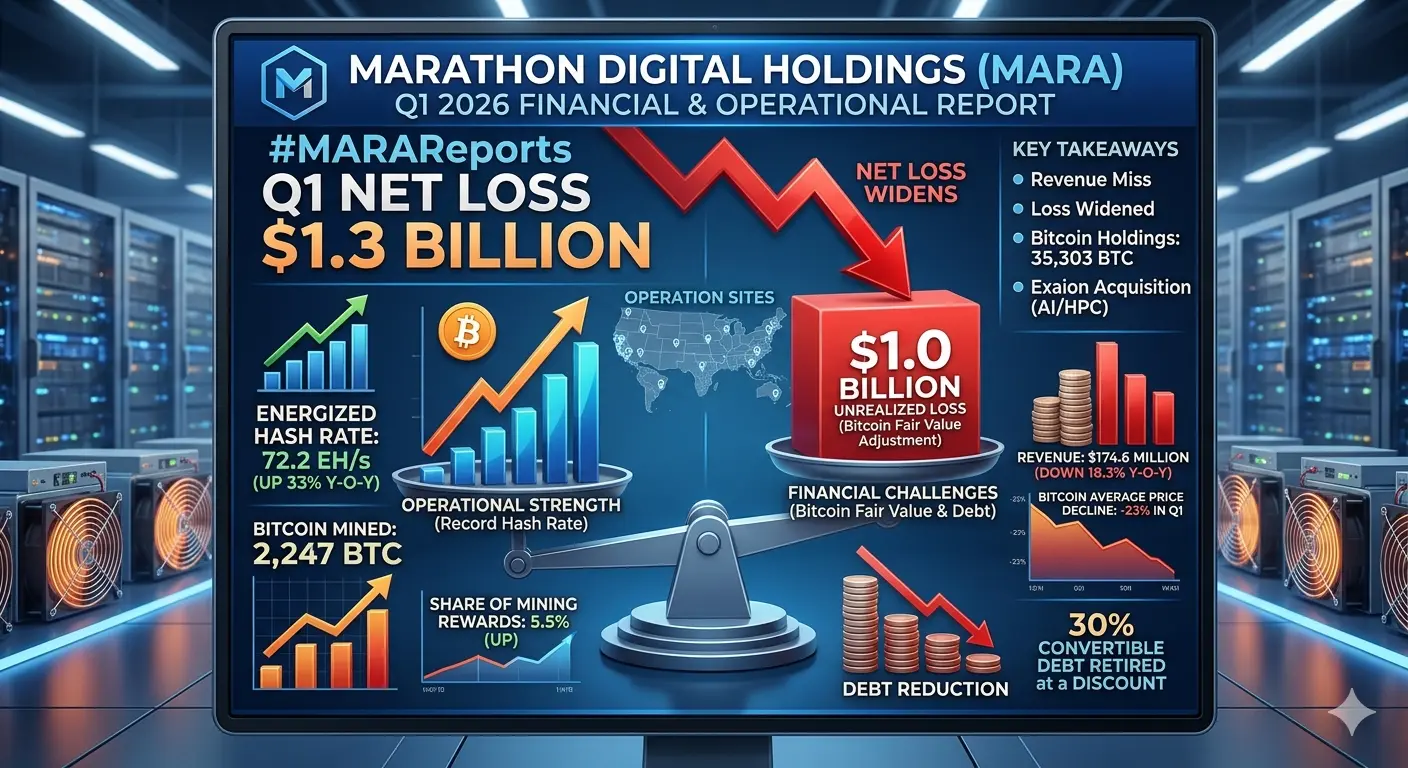
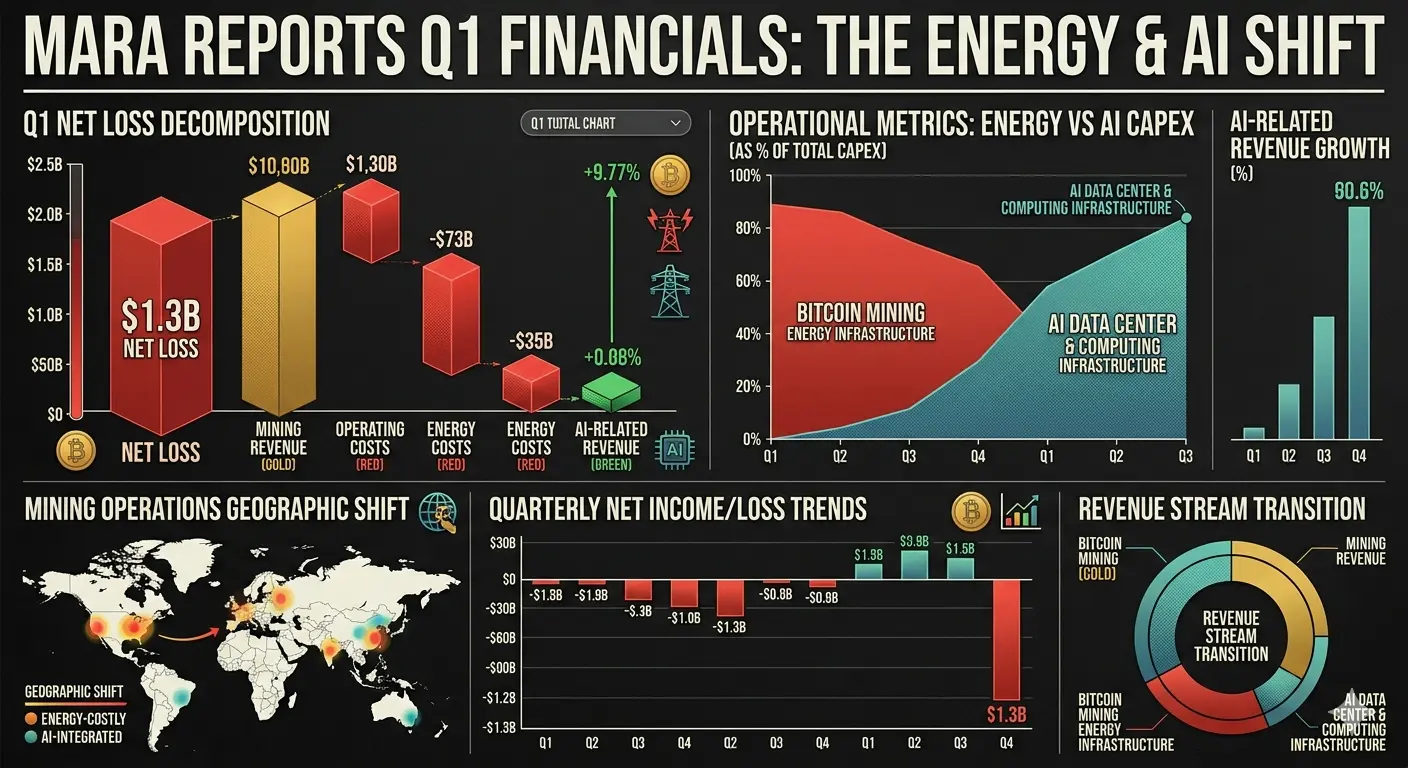
Bitcoin miner MARA reported Q1 revenue of 174.6 million US dollars with a net loss of 1.3 billion US dollars, widening from 533.4 million US dollars a year earlier. The loss was primarily driven by a 1 billion US dollar fair value reduction on digital assets as Bitcoin dropped 22 percent during the quarter. The company mined 2,247 BTC at an average cost of 76,288 US dollars but sold 20,880 BTC at a low average price of 70,137 US dollars. It currently holds 35,303 BTC worth about 2.4 billion US dollars. Notably, CEO Frederick Thiel said the company is shifting from mining to an "energy monetization" model, acquiring the Long Ridge power plant and expanding into AI data centers to hedge Bitcoin volatility with stable power plant cash flow. This is a key case study for mining industry transformation.

#GateSquareMayTradingShare BREAKING: MARA Holdings Reports $1.3 Billion Net Loss in Q1 2026 Unrealized BTC Losses Wipe Out Balance Sheet Value

One of the largest publicly traded Bitcoin mining companies just delivered a sobering quarterly report that underscores the brutal volatility of the crypto mining sector. MARA Holdings (NASDAQ: MARA) announced its Q1 2026 financial results on May 11, revealing a staggering net loss of $1.3 billion more than double the $533 million loss reported in the same quarter last year.

📊 The Numbers Behind The Damage

Revenue came in at $174.6 million, down
MARA0.62%
post-image
post-image
  • Reward
  • 1
  • Repost
  • Share
HighAmbition:
thnxx for the update good 👍
#MARAReports1.3BQ1NetLoss
MARA Holdings Q1 2026 Financial Report: A Deep Dive into the 1.3 Billion Dollar Net Loss
MARA Holdings, formerly known as Marathon Digital Holdings, has released its first quarter 2026 financial results, revealing a staggering net loss of approximately 1.3 billion dollars. This marks a dramatic escalation from the 533.2 million dollar loss recorded in Q1 2025, more than doubling the year-over-year deficit and sending shockwaves through the cryptocurrency mining sector.
Revenue Performance and Market Expectations
The company reported total revenue of 174.6 million dol
BTC-0.19%
HighAmbition
#MARAReports1.3BQ1NetLoss
MARA Holdings Q1 2026 Financial Report: A Deep Dive into the 1.3 Billion Dollar Net Loss
MARA Holdings, formerly known as Marathon Digital Holdings, has released its first quarter 2026 financial results, revealing a staggering net loss of approximately 1.3 billion dollars. This marks a dramatic escalation from the 533.2 million dollar loss recorded in Q1 2025, more than doubling the year-over-year deficit and sending shockwaves through the cryptocurrency mining sector.
Revenue Performance and Market Expectations
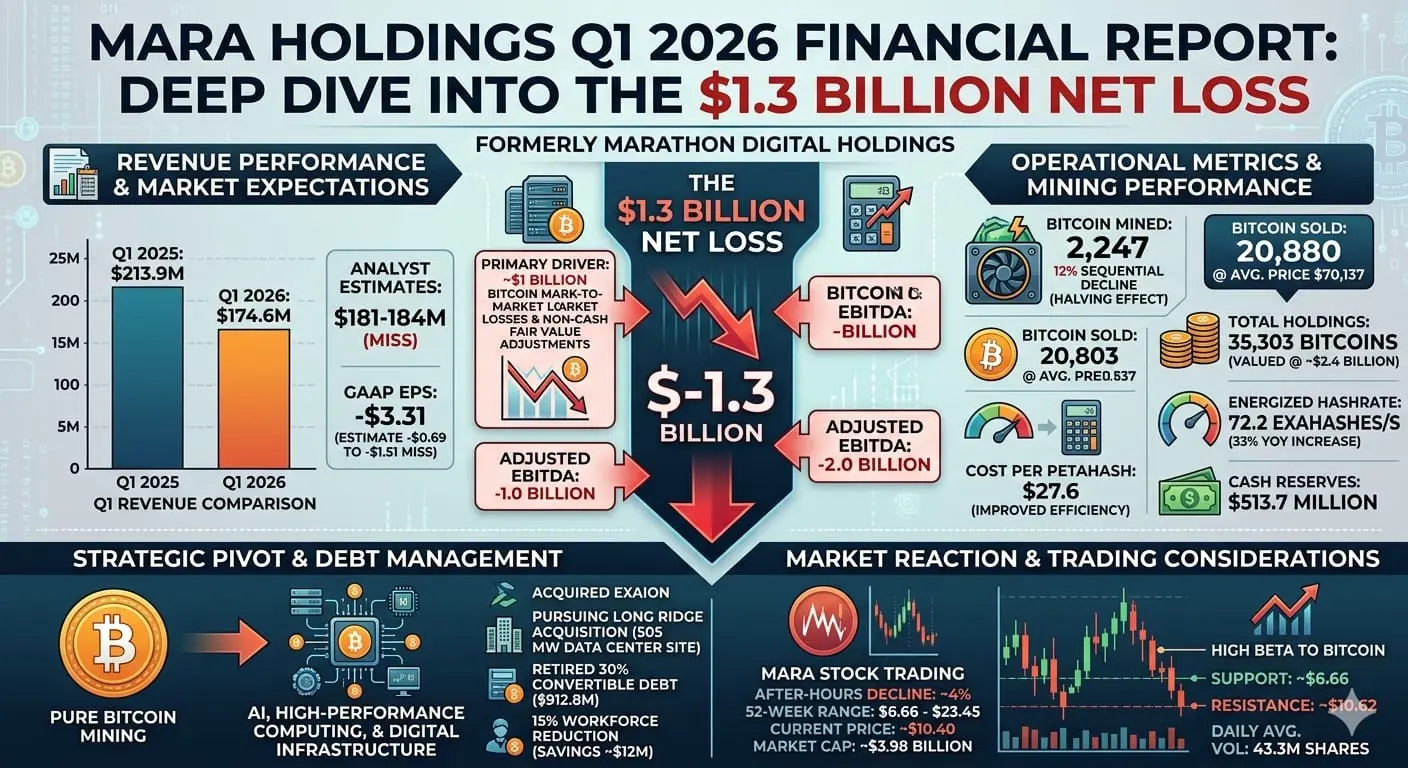
The company reported total revenue of 174.6 million dollars for Q1 2026, representing an 18 percent decline from the 213.9 million dollars generated in the same period last year. This figure fell short of analyst consensus estimates, which had projected revenue in the range of 181 to 184 million dollars. The earnings per share on a GAAP basis came in at negative 3.31 dollars, significantly missing estimates of negative 0.69 to negative 1.51 dollars.
Primary Drivers of the Massive Loss
The 1.3 billion dollar net loss was primarily driven by approximately 1 billion dollars in Bitcoin mark-to-market losses and non-cash fair value adjustments. These accounting adjustments reflect the volatility in Bitcoin prices and the company's substantial holdings. Adjusted EBITDA stood at negative 1.0 billion dollars, highlighting the severe financial pressure the company is currently experiencing.
Operational Metrics and Mining Performance
Despite the financial losses, MARA maintained strong operational capabilities. The company mined 2,247 Bitcoin during Q1 2026, though this represents a 12 percent sequential decline attributed to the Bitcoin halving event that reduced mining rewards. The company sold 20,880 Bitcoin at an average price of 70,137 dollars per coin. Current Bitcoin holdings stand at 35,303 coins, valued at approximately 2.4 billion dollars.
The energized hashrate reached 72.2 exahashes per second, marking a 33 percent year-over-year increase. The cost per petahash improved to 27.6 dollars, demonstrating operational efficiency gains. Cash reserves currently stand at 513.7 million dollars, providing some liquidity cushion amid the challenging financial environment.
Strategic Pivot and Debt Management
MARA is actively pivoting its business model from pure Bitcoin mining toward artificial intelligence, high-performance computing, and digital infrastructure. The company has acquired Exaion and is pursuing the Long Ridge acquisition, a 505 megawatt site intended for data center operations with projected yields between 9 and 15 percent.
In terms of debt management, MARA successfully retired approximately 30 percent of its convertible debt, totaling 912.8 million dollars, at a 9 percent discount. The company also implemented a 15 percent workforce reduction, generating annualized savings of approximately 12 million dollars.
Market Reaction and Trading Considerations
Following the earnings announcement, MARA stock declined approximately 4 percent in after-hours trading. The stock has experienced significant volatility over the past year, trading between a low of 6.66 dollars and a high of 23.45 dollars. Current trading price hovers around 10.40 dollars with a market capitalization of approximately 3.98 billion dollars.
Traders are closely monitoring several key factors. The company's strategic pivot toward AI and data centers represents a potential long-term value driver, though execution risks remain substantial. The significant Bitcoin holdings expose MARA to cryptocurrency price volatility, which could amplify both gains and losses in future quarters. The debt reduction efforts and cost-cutting measures demonstrate management's commitment to financial stability, but the path to profitability remains uncertain.
Risk management is paramount for traders considering positions in MARA. The stock exhibits high beta characteristics relative to Bitcoin price movements. Technical analysis suggests monitoring support levels around the 52-week low of 6.66 dollars and resistance near the 10.62 dollar recent high. Volume patterns indicate sustained institutional interest, with daily trading volume averaging 43.3 million shares.
The transformation from a pure-play Bitcoin miner to a diversified digital infrastructure company represents a fundamental business model shift. Success in this transition will largely determine whether MARA can reverse its current financial trajectory and deliver shareholder value in the coming quarters.

repost-content-media
  • Reward
  • Comment
  • Repost
  • Share
#MARAReports1.3BQ1NetLoss The crypto mining industry faced another major headline after MARA Holdings reported a massive $1.3 billion net loss for Q1 2026, sending shockwaves across the digital asset market. Despite continued expansion in mining infrastructure and aggressive Bitcoin accumulation strategies, the company struggled under the pressure of market volatility, operational expenses, and post-halving mining economics.
According to the quarterly report, the loss was largely driven by unrealized losses tied to Bitcoin price fluctuations, increased energy costs, infrastructure investments,
BTC-0.19%
ShainingMoon
#MARAReports1.3BQ1NetLoss The crypto mining industry faced another major headline after MARA Holdings reported a massive $1.3 billion net loss for Q1 2026, sending shockwaves across the digital asset market. Despite continued expansion in mining infrastructure and aggressive Bitcoin accumulation strategies, the company struggled under the pressure of market volatility, operational expenses, and post-halving mining economics.
According to the quarterly report, the loss was largely driven by unrealized losses tied to Bitcoin price fluctuations, increased energy costs, infrastructure investments, and depreciation expenses linked to mining hardware upgrades. While revenue from mining operations remained significant, it was not enough to offset the broader financial pressure facing large-scale mining firms in the current market environment.
One of the biggest challenges for miners in 2026 continues to be the impact of the Bitcoin halving event. Reduced block rewards have significantly tightened profit margins across the sector, forcing companies to optimize efficiency while competing against rising network difficulty. MARA has continued expanding its hash rate and data center operations, but scaling operations during periods of unstable crypto prices can create enormous short-term financial strain.
Investors are closely watching how institutional mining firms adapt to the changing environment. Some analysts believe this loss reflects temporary accounting pressure rather than a long-term collapse, especially because large portions of the reported losses were non-cash adjustments connected to Bitcoin valuation changes. Others argue that mining companies may need to diversify revenue streams beyond traditional BTC mining to remain competitive in the next cycle.
Despite the negative earnings report, MARA reaffirmed its long-term commitment to Bitcoin accumulation and infrastructure growth. The company continues to position itself as one of the largest publicly traded Bitcoin miners in the world, betting heavily on future BTC appreciation and broader institutional adoption of digital assets.
The market reaction has been mixed. Some traders see the report as a warning sign for the mining industry, while others consider it a potential opportunity if Bitcoin enters another bullish phase later in 2026. Historically, mining firms often experience extreme earnings volatility during transition periods following halvings, making quarterly performance highly sensitive to BTC price movements.
At the same time, the broader crypto market remains focused on institutional inflows, ETF demand, and global regulation developments. If Bitcoin maintains strong momentum in the coming months, mining companies like MARA could potentially recover faster than expected. However, continued pressure from energy prices and operational costs may remain a serious concern for the entire sector.
The Q1 report highlights a critical reality of the crypto mining business: massive rewards can come with equally massive risks. As the industry evolves, only the most efficient and financially resilient mining firms may survive the next phase of competition.
— SHAININGMOON
repost-content-media
  • Reward
  • Comment
  • Repost
  • Share
#MARAReports1.3BQ1NetLoss : What It Means for Bitcoin Mining and the Crypto Market
MARA Holdings, one of the largest publicly traded Bitcoin mining companies, recently reported a staggering $1.3 billion net loss for Q1, sending shockwaves through the crypto mining industry and investor community. The report highlights the increasing financial pressure faced by large-scale mining operations in an environment shaped by Bitcoin volatility, rising operational costs, and post-halving revenue adjustments.
This massive quarterly loss has raised important questions about the sustainability of mining p
BTC-0.19%
post-image
  • Reward
  • Comment
  • Repost
  • Share
#MARAReports1.3BQ1NetLoss
MARA Holdings Q1 2026 Financial Report: A Deep Dive into the 1.3 Billion Dollar Net Loss
MARA Holdings, formerly known as Marathon Digital Holdings, has released its first quarter 2026 financial results, revealing a staggering net loss of approximately 1.3 billion dollars. This marks a dramatic escalation from the 533.2 million dollar loss recorded in Q1 2025, more than doubling the year-over-year deficit and sending shockwaves through the cryptocurrency mining sector.
Revenue Performance and Market Expectations
The company reported total revenue of 174.6 million dol
BTC-0.19%
post-image
post-image
post-image
  • Reward
  • 12
  • Repost
  • Share
BlackRiderCryptoLord:
2026 GOGOGO 👊
View More
#MARAReports1.3BQ1NetLoss
𝐌𝐀𝐑𝐀 𝐑𝐄𝐏𝐎𝐑𝐓𝐒 𝐐𝟏 𝐍𝐄𝐓 𝐋𝐎𝐒𝐒 𝐎𝐅 $𝟏.𝟑𝐁 𝐀𝐒 𝐁𝐈𝐓𝐂𝐎𝐈𝐍 𝐌𝐈𝐍𝐈𝐍𝐆 𝐒𝐇𝐈𝐅𝐓𝐒 𝐈𝐍𝐓𝐎 𝐀𝐍 𝐄𝐍𝐄𝐑𝐆𝐘 𝐀𝐍𝐃 𝐀𝐈 𝐄𝐑𝐀
MARA’s latest Q1 financial report reflects one of the most volatile and structurally important quarters ever seen in the Bitcoin mining sector, highlighting both the fragility and transformation of large-scale mining operations in a rapidly changing macro and crypto environment. The company reported revenue of 174.6 million US dollars, but at the same time recorded a staggering net loss of 1.3 billion US dollars, a dra
BTC-0.19%
MrFlower_XingChen
#MARAReports1.3BQ1NetLoss
𝐌𝐀𝐑𝐀 𝐑𝐄𝐏𝐎𝐑𝐓𝐒 𝐐𝟏 𝐍𝐄𝐓 𝐋𝐎𝐒𝐒 𝐎𝐅 $𝟏.𝟑𝐁 𝐀𝐒 𝐁𝐈𝐓𝐂𝐎𝐈𝐍 𝐌𝐈𝐍𝐈𝐍𝐆 𝐒𝐇𝐈𝐅𝐓𝐒 𝐈𝐍𝐓𝐎 𝐀𝐍 𝐄𝐍𝐄𝐑𝐆𝐘 𝐀𝐍𝐃 𝐀𝐈 𝐄𝐑𝐀
MARA’s latest Q1 financial report reflects one of the most volatile and structurally important quarters ever seen in the Bitcoin mining sector, highlighting both the fragility and transformation of large-scale mining operations in a rapidly changing macro and crypto environment. The company reported revenue of 174.6 million US dollars, but at the same time recorded a staggering net loss of 1.3 billion US dollars, a dramatic widening compared to the 533.4 million US dollar loss in the same period last year. This divergence between operational revenue and net profitability underscores how heavily mining firms are exposed not only to mining economics but also to Bitcoin price volatility and balance sheet accounting effects.
A major contributor to the massive quarterly loss was a 1 billion US dollar fair value reduction on digital assets, driven by Bitcoin’s approximate 22 percent decline during the quarter. Because MARA holds a large amount of Bitcoin on its balance sheet, changes in BTC price directly affect reported financial performance. When Bitcoin drops, the value of holdings is marked down, creating large paper losses even if the underlying coins are not sold. This accounting structure makes mining companies extremely sensitive to macro-driven crypto cycles, especially during correction phases.
On the operational side, MARA mined 2,247 BTC during the quarter, but at an average production cost of approximately 76,288 US dollars per Bitcoin, which is notably high relative to market prices during weaker phases. This cost structure reflects increasing mining difficulty, rising energy prices in certain regions, hardware depreciation, and competition within the global hash rate network. When production cost approaches or exceeds market price, margins compress sharply, forcing miners to rely more heavily on treasury reserves or asset sales to maintain liquidity.
During the same period, MARA also sold 20,880 BTC at an average price of 70,137 US dollars, indicating active balance sheet management and liquidity strategy adjustments. The decision to sell a significant portion of holdings at prices below production cost suggests the company was managing operational expenses, debt obligations, or strategic capital allocation rather than purely holding for long-term appreciation. This type of behavior is common during volatile or bearish phases, where miners must stabilize cash flow even if it means realizing losses on Bitcoin sales.
Despite these challenges, MARA still maintains a substantial Bitcoin treasury of approximately 35,303 BTC, valued at around 2.4 billion US dollars at current market levels. This reserve remains a critical asset for the company, providing both long-term exposure to Bitcoin price upside and a liquidity buffer during periods of operational stress. However, it also introduces significant balance sheet volatility, as changes in Bitcoin price directly impact reported asset value.
-1300 + 174.6 = -1125.4
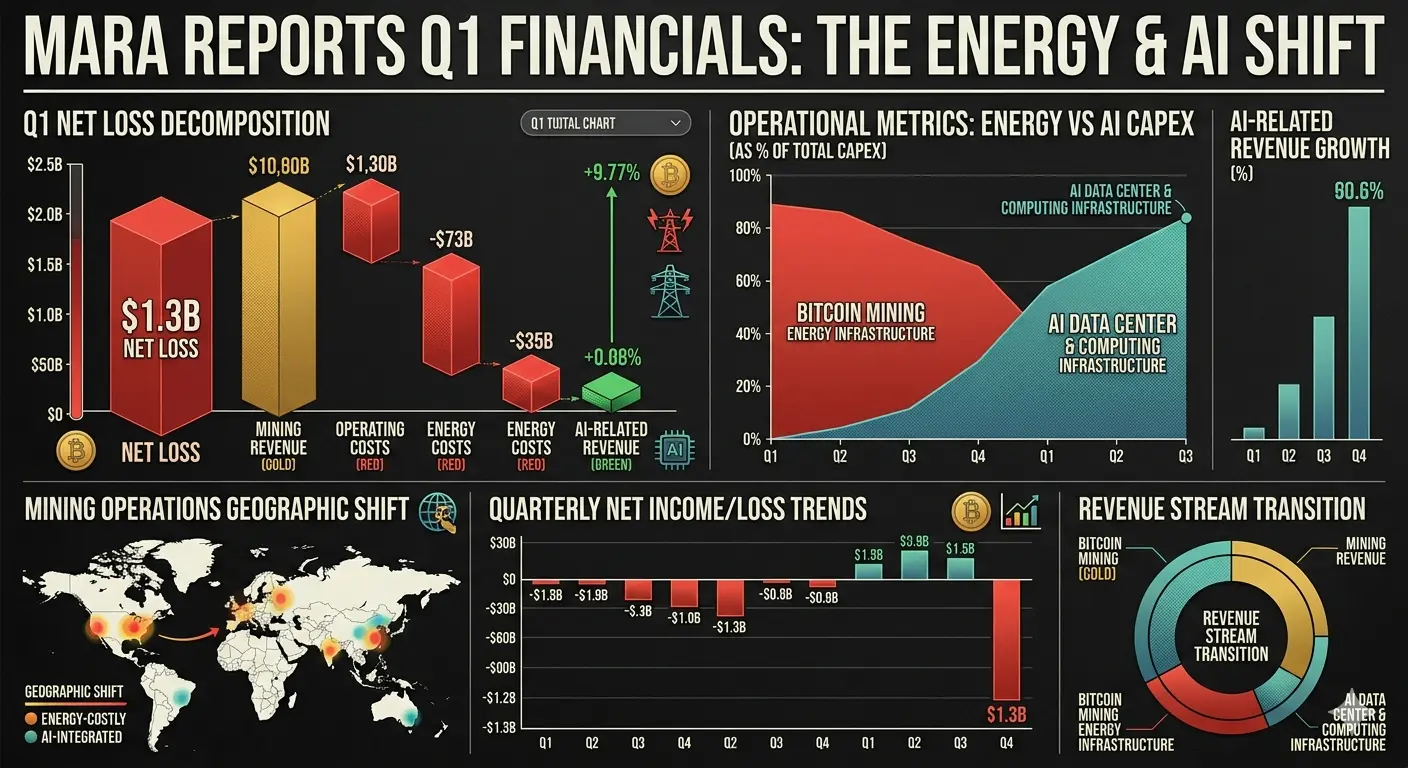
Beyond financial performance, the most important strategic signal from MARA’s report is its explicit shift toward an “energy monetization” model, as highlighted by CEO Frederick Thiel. This represents a fundamental evolution in how mining companies define their business identity. Instead of viewing themselves purely as Bitcoin production entities, companies like MARA are increasingly repositioning as energy infrastructure operators that can flexibly allocate power between crypto mining, AI computing, and industrial data services.
A key component of this transformation is MARA’s acquisition of the Long Ridge power plant, which provides direct control over energy generation and supply. By owning energy infrastructure, the company can reduce reliance on external electricity markets and potentially stabilize long-term operating costs. This move also allows MARA to treat electricity as a monetizable asset rather than just an operational expense, opening the door to diversified revenue streams.
In parallel, MARA is expanding into AI data center infrastructure, aligning itself with one of the fastest-growing sectors in global technology. Artificial intelligence workloads require massive computing power, high-density data centers, and stable energy supply—all areas where large Bitcoin mining operations already have strong infrastructure overlap. This makes mining companies natural candidates for AI infrastructure conversion or hybrid operation models.
The broader implication of this shift is that Bitcoin mining is no longer just a standalone industry. It is increasingly merging with global compute infrastructure, where energy, hardware, and data center capacity become interchangeable resources depending on market demand. This convergence is being driven by two major forces: Bitcoin’s cyclical volatility and the explosive growth in AI compute demand.
From a financial perspective, MARA’s results also highlight how mining companies operate in a high-leverage environment. Small changes in Bitcoin price can lead to outsized impacts on profitability due to fixed operational costs and large asset holdings. When Bitcoin declines, revenue drops while asset impairments increase simultaneously, creating a double pressure effect on earnings.
Another important dimension is the structural challenge of mining cost inflation. As Bitcoin network difficulty rises over time and block rewards continue to halve, miners must continuously upgrade hardware, secure cheaper energy, or improve efficiency just to maintain profitability. Companies that fail to adapt risk falling into unprofitable territory during extended market downturns.
MARA’s pivot toward energy infrastructure and AI computing is therefore not just a growth strategy—it is a defensive survival strategy. By diversifying revenue away from Bitcoin price dependency, the company aims to stabilize cash flow and reduce exposure to crypto market cycles. This is increasingly becoming a common trend among large mining firms globally.
At the same time, holding a large Bitcoin treasury remains a double-edged sword. While it provides upside exposure during bull markets, it also introduces significant volatility in reported earnings during downturns. This forces companies like MARA to constantly balance between accumulation, liquidation, and operational funding requirements.
Overall, MARA’s Q1 report serves as a clear case study of the Bitcoin mining industry’s transformation phase. The sector is evolving from pure hash-rate competition into a broader energy and compute infrastructure ecosystem that includes AI data centers, power plant ownership, and hybrid digital-physical asset monetization.
This transition marks a major structural shift in how mining companies operate, moving them closer to traditional energy and technology infrastructure firms rather than pure crypto-native entities. The success of this transition will likely determine which mining companies survive and thrive in the next cycle of the digital asset economy.
#GateSquareMayTradingShare
repost-content-media
  • Reward
  • Comment
  • Repost
  • Share
#MARAReports1.3BQ1NetLoss The crypto mining industry faced another major headline after MARA Holdings reported a massive $1.3 billion net loss for Q1 2026, sending shockwaves across the digital asset market. Despite continued expansion in mining infrastructure and aggressive Bitcoin accumulation strategies, the company struggled under the pressure of market volatility, operational expenses, and post-halving mining economics.
According to the quarterly report, the loss was largely driven by unrealized losses tied to Bitcoin price fluctuations, increased energy costs, infrastructure investments,
BTC-0.19%
ShainingMoon
#MARAReports1.3BQ1NetLoss The crypto mining industry faced another major headline after MARA Holdings reported a massive $1.3 billion net loss for Q1 2026, sending shockwaves across the digital asset market. Despite continued expansion in mining infrastructure and aggressive Bitcoin accumulation strategies, the company struggled under the pressure of market volatility, operational expenses, and post-halving mining economics.
According to the quarterly report, the loss was largely driven by unrealized losses tied to Bitcoin price fluctuations, increased energy costs, infrastructure investments, and depreciation expenses linked to mining hardware upgrades. While revenue from mining operations remained significant, it was not enough to offset the broader financial pressure facing large-scale mining firms in the current market environment.
One of the biggest challenges for miners in 2026 continues to be the impact of the Bitcoin halving event. Reduced block rewards have significantly tightened profit margins across the sector, forcing companies to optimize efficiency while competing against rising network difficulty. MARA has continued expanding its hash rate and data center operations, but scaling operations during periods of unstable crypto prices can create enormous short-term financial strain.
Investors are closely watching how institutional mining firms adapt to the changing environment. Some analysts believe this loss reflects temporary accounting pressure rather than a long-term collapse, especially because large portions of the reported losses were non-cash adjustments connected to Bitcoin valuation changes. Others argue that mining companies may need to diversify revenue streams beyond traditional BTC mining to remain competitive in the next cycle.
Despite the negative earnings report, MARA reaffirmed its long-term commitment to Bitcoin accumulation and infrastructure growth. The company continues to position itself as one of the largest publicly traded Bitcoin miners in the world, betting heavily on future BTC appreciation and broader institutional adoption of digital assets.
The market reaction has been mixed. Some traders see the report as a warning sign for the mining industry, while others consider it a potential opportunity if Bitcoin enters another bullish phase later in 2026. Historically, mining firms often experience extreme earnings volatility during transition periods following halvings, making quarterly performance highly sensitive to BTC price movements.
At the same time, the broader crypto market remains focused on institutional inflows, ETF demand, and global regulation developments. If Bitcoin maintains strong momentum in the coming months, mining companies like MARA could potentially recover faster than expected. However, continued pressure from energy prices and operational costs may remain a serious concern for the entire sector.
The Q1 report highlights a critical reality of the crypto mining business: massive rewards can come with equally massive risks. As the industry evolves, only the most efficient and financially resilient mining firms may survive the next phase of competition.
— SHAININGMOON
repost-content-media
  • Reward
  • Comment
  • Repost
  • Share
#MARAReports1.3BQ1NetLoss #MARAReports1.3BQ1NetLoss – A Deep Dive into the Financial Shock and What It Signals for the Crypto Mining Sector
The latest financial disclosure surrounding MARA has sent a strong ripple through the crypto and stock trading communities. Reporting a staggering $1.3 billion net loss in Q1, the company has once again highlighted the extreme volatility and structural risks tied to large-scale Bitcoin mining operations in a rapidly shifting macroeconomic environment. This result is not just a number on a balance sheet—it reflects deeper pressures affecting the entire digi
BTC-0.19%
post-image
post-image
post-image
  • Reward
  • 10
  • Repost
  • Share
Vortex_King:
2026 GOGOGO 👊
View More
#MARAReports1.3BQ1NetLoss
𝐌𝐀𝐑𝐀 𝐑𝐄𝐏𝐎𝐑𝐓𝐒 𝐐𝟏 𝐍𝐄𝐓 𝐋𝐎𝐒𝐒 𝐎𝐅 $𝟏.𝟑𝐁 𝐀𝐒 𝐁𝐈𝐓𝐂𝐎𝐈𝐍 𝐌𝐈𝐍𝐈𝐍𝐆 𝐒𝐇𝐈𝐅𝐓𝐒 𝐈𝐍𝐓𝐎 𝐀𝐍 𝐄𝐍𝐄𝐑𝐆𝐘 𝐀𝐍𝐃 𝐀𝐈 𝐄𝐑𝐀
MARA’s latest Q1 financial report reflects one of the most volatile and structurally important quarters ever seen in the Bitcoin mining sector, highlighting both the fragility and transformation of large-scale mining operations in a rapidly changing macro and crypto environment. The company reported revenue of 174.6 million US dollars, but at the same time recorded a staggering net loss of 1.3 billion US dollars, a dra
BTC-0.19%
post-image
post-image
  • Reward
  • 25
  • Repost
  • Share
Vortex_King:
LFG 🔥
View More
#MARAReports1.3BQ1NetLoss The crypto mining industry faced another major headline after MARA Holdings reported a massive $1.3 billion net loss for Q1 2026, sending shockwaves across the digital asset market. Despite continued expansion in mining infrastructure and aggressive Bitcoin accumulation strategies, the company struggled under the pressure of market volatility, operational expenses, and post-halving mining economics.
According to the quarterly report, the loss was largely driven by unrealized losses tied to Bitcoin price fluctuations, increased energy costs, infrastructure investments,
BTC-0.19%
post-image
post-image
  • Reward
  • 13
  • Repost
  • Share
discovery:
To The Moon 🌕
View More
Load More