Dragon_fly3

vip
Age 0.1 Yıl
Peak Tier 0
No content yet
#CryptoMarketRecovery #加密市场回升
The market is not “recovering” because conditions are safe. It’s recovering because uncertainty is being priced out faster than fear can spread. That distinction matters. Most traders misunderstand this phase—and that’s exactly where opportunity lives.
1️⃣ 20-year suspension vs. short-term compromise — Will Iran concede?
A full structural concession is unlikely. No sovereign actor under pressure gives up long-term leverage for short-term relief unless internal instability forces it. What’s more realistic is a tactical compromise—temporary easing, partial complianc
BTC1,27%
DEFI-9,33%
Dubai_Prince
#CryptoMarketRecovery #加密市场回升
The market is not “recovering” because conditions are safe. It’s recovering because uncertainty is being priced out faster than fear can spread. That distinction matters. Most traders misunderstand this phase—and that’s exactly where opportunity lives.
1️⃣ 20-year suspension vs. short-term compromise — Will Iran concede?
A full structural concession is unlikely. No sovereign actor under pressure gives up long-term leverage for short-term relief unless internal instability forces it. What’s more realistic is a tactical compromise—temporary easing, partial compliance, controlled signaling to stabilize global pressure without surrendering strategic positioning.
Markets are not pricing peace. They are pricing reduced escalation probability. That’s enough to trigger capital rotation back into risk assets, especially crypto.
If you’re betting on a long-term resolution, you’re early. If you’re trading the narrative shift, you’re aligned.
2️⃣ What is the ceiling of this rebound?
Right now, this is a liquidity-driven bounce, not a structural bull breakout.
That means the ceiling depends on three variables:
استمرار انخفاض geopolitical risk premium
استمرار تدفق السيولة إلى DeFi و BTC
عدم ظهور صدمة مفاجئة جديدة في النفط أو الدولار
Realistically:
Short-term upside: strong but fragile
Mid-term ceiling: capped unless macro confirms
Long-term trend: still undecided
If Bitcoin fails to reclaim and hold higher structural levels, this entire move becomes a relief rally—not a trend reversal.
Most traders will overstay this move. Don’t be one of them.
3️⃣ Dynamic allocation: Oil vs Crypto vs Precious Metals
Static allocation in a dynamic macro environment is a losing strategy.
Here’s the real play:
Crude Oil: Hedge against escalation. Keep exposure, but reduce aggressively if diplomatic momentum strengthens.
Crypto: Treat as a momentum asset right now, not a safe haven. Increase allocation during confidence spikes, but stay liquid.
Precious Metals: This is your insurance layer. Don’t remove it. Adjust, don’t eliminate.
Smart capital doesn’t choose one narrative. It rotates between them faster than the crowd reacts.
Feature Focus: Narrative Rotation Edge
Most platforms show you price. Few help you understand why capital is moving.
This is where you gain an edge.
Track sector-level flows. Watch DeFi outperforming the broader market. Monitor how quickly sentiment flips when geopolitical pressure eases. The winners in this phase are not the fastest traders—they are the ones aligned with capital rotation before it becomes obvious.
Right now, DeFi’s +5% move is not random. It’s the first signal of risk appetite returning.
Ignore it, and you’ll chase later.
If your strategy is “wait for confirmation,” you will enter late.
If your strategy is “full risk now,” you will get trapped.
The only viable position is controlled aggression—measured exposure, fast reaction, zero emotional attachment.
This is not a safe market. It’s a transitional one.
And transitional markets reward precision, not hope.
Call to Action
Stop reacting to headlines. Start tracking capital flow, sector strength, and macro alignment. Position early, adjust fast, and exit before the narrative shifts again.
The rebound is not the opportunity. Timing it correctly is.
#CryptoMarketRecovery #DeFi #MacroTrading #RiskManagement

repost-content-media
  • Reward
  • Comment
  • Repost
  • Share
#CryptoMarketsDipSlightly On April 14th, as the U.S.-Iran maritime blockade takes effect alongside active diplomatic negotiations, market expectations for a swift deal have surged. This geopolitical tension mixed with de-escalation hopes has triggered a rapid recovery in crypto confidence. The DeFi sector stands out, posting a solid 5.00% gain in the last 24 hours, while Bitcoin and major altcoins reclaim key support levels.
The broader market is showing renewed strength, but this rebound remains highly sensitive to real-time developments in the Strait of Hormuz and negotiation outcomes. Risk
BTC1,27%
ETH2,71%
DEFI-9,33%
Dubai_Prince
#CryptoMarketsDipSlightly On April 14th, as the U.S.-Iran maritime blockade takes effect alongside active diplomatic negotiations, market expectations for a swift deal have surged. This geopolitical tension mixed with de-escalation hopes has triggered a rapid recovery in crypto confidence. The DeFi sector stands out, posting a solid 5.00% gain in the last 24 hours, while Bitcoin and major altcoins reclaim key support levels.
The broader market is showing renewed strength, but this rebound remains highly sensitive to real-time developments in the Strait of Hormuz and negotiation outcomes. Risk assets are moving in tandem — crude oil volatility is feeding into crypto sentiment, and safe-haven flows into precious metals are creating a complex three-way dynamic.
Answering the key questions directly:
20-year suspension vs. short-term compromise? Iran will likely make tactical concessions in the short term to ease immediate sanctions pressure and secure breathing room for its economy, but a genuine 20-year strategic suspension of its nuclear program is highly improbable. Tehran has consistently played the long game; any major concession would require ironclad security guarantees and sanctions relief that Washington has historically been reluctant to deliver permanently. Expect limited, reversible steps rather than deep structural change.
How much of the "ceiling" of this rebound do you see? This recovery has room to run into the $92K–$98K zone for Bitcoin in the near term if diplomatic signals stay positive, but it is capped by persistent macro risks. A clean deal could push total crypto market cap toward $3.2T–$3.5T temporarily. However, any breakdown in talks or escalation in the blockade would trigger a sharp reversal. The ceiling feels temporary and event-driven — treat it as a tactical bounce, not the start of a new bull leg.
Dynamic allocation adjustment: In this fluid environment, maintain a flexible 40/35/25 split as a baseline — 40% crude oil exposure (via futures or energy-related tokens/ETFs for volatility capture), 35% cryptocurrencies (heavy on BTC and ETH, with selective DeFi yield plays), and 25% precious metals (physical gold/silver or tokenized versions for downside protection). Rebalance aggressively on every major news catalyst: increase crypto on positive negotiation breakthroughs, rotate into oil on blockade tightening, and shift to metals on renewed escalation fears. Never stay static — this setup demands daily or intra-day monitoring.
The current rebound is real but fragile. Geopolitics is driving it more than fundamentals right now. Smart capital is positioning for both upside volatility and quick exits.
#GateSquareAprilPostingChallenge
Take action now and post your first plaza message in April!
👉️ https://www.gate.com/post
🗓 Deadline: April 15th
Details: https://www.gate.com/announcements/article/50520
#DeFi #Geopolitics #MarketRecovery
repost-content-media
  • Reward
  • Comment
  • Repost
  • Share
#AaveDAOApproves$25MGrant
1. The Big News: Aave DAO Approves $25M Strategic Grant — Full Breakdown
On April 13, 2026, Aave DAO pushed through one of the most defining governance outcomes in its timeline with the approval of the “Aave Will Win Framework.” This was not a marginal vote or a passive signal — it was a decisive internal alignment event. With 522,780 votes in favor against 175,310 opposing, roughly 75% approval demonstrates not just agreement, but conviction across stakeholders who understand the long-term direction of the protocol.
The capital allocation itself reflects deliberate
Dubai_Prince
#AaveDAOApproves$25MGrant
1. The Big News: Aave DAO Approves $25M Strategic Grant — Full Breakdown
On April 13, 2026, Aave DAO pushed through one of the most defining governance outcomes in its timeline with the approval of the “Aave Will Win Framework.” This was not a marginal vote or a passive signal — it was a decisive internal alignment event. With 522,780 votes in favor against 175,310 opposing, roughly 75% approval demonstrates not just agreement, but conviction across stakeholders who understand the long-term direction of the protocol.
The capital allocation itself reflects deliberate engineering rather than impulsive expansion: $25 million in stablecoin liquidity paired with 75,000 AAVE tokens, valued near $6.8 million. The release structure is intentionally paced. Only $5 million is deployed immediately, while the rest is distributed over 6- and 12-month intervals. Meanwhile, token emissions are stretched across 48 months, effectively neutralizing sudden sell pressure. Any inefficiency is penalized — unused capital is returned to the treasury within a year.
All funds are directed toward Aave Labs with a singular focus: accelerating the rollout and adoption of Aave V4, which launched on Ethereum just days earlier. This is not funding for experimentation — it is capital assigned to execution at protocol scale.
2. Market Snapshot: Price, Momentum & Structural Context
AAVE is currently trading near $102.07, reflecting a sharp 13.9% increase over 24 hours. Intraday volatility shows a high of $102.10 and a low near $89.49. Weekly performance is modestly positive at +6.48%, but zooming out reveals a harsher truth — the asset remains down over 40% across a 90-day window, confirming that this move is still corrective rather than a confirmed macro reversal.
Market capitalization stands around $1.54 billion, placing AAVE within the top 55 assets globally. Trading volume has surged to roughly $487 million, marking a significant liquidity spike and suggesting that this move is not purely speculative rotation but capital reacting to structural developments.
Total Value Locked remains dominant at $26.4 billion, reinforcing Aave’s position as the leading DeFi lending protocol. Meanwhile, GHO supply has expanded past $312 million, signaling increased ecosystem utilization following the announcement.
3. Why the $25M Grant Matters for Price Action
This grant is bullish — but not in the way short-term traders typically expect. It is a layered catalyst, not an instant trigger.
On the positive side, governance alignment is now formalized, capital deployment is tied directly to growth vectors, and token distribution is engineered to minimize dilution shocks. The narrative “Aave Will Win” is no longer marketing — it is now embedded into governance action.
However, ignoring the risks here would be naive. Just before the vote, Chaos Labs — the protocol’s long-standing risk management partner — exited due to disagreements around V4’s direction. This is not a minor operational change. When a system managing over $26 billion in liquidity loses its primary risk architect, there is a temporary vacuum that markets have not fully priced in.
At the same time, the broader trend remains bearish on higher timeframes. This creates a conflict: strong narrative and capital support versus unresolved structural weaknesses.
4. Aave Roadmap: From DeFi Leader to Institutional Infrastructure Layer
With V4 live, Aave is no longer iterating — it is scaling aggressively. The roadmap outlines expansion across multiple chains including Arbitrum, Base, Optimism, Polygon, and zkSync through 2026.
The introduction of Aave Pro marks a clear institutional pivot, targeting compliant liquidity flows and bridging traditional finance with DeFi infrastructure. GHO v2 aims to extend stablecoin functionality across chains, while the protocol simultaneously rebuilds its risk framework post-Chaos Labs.
The ambition is explicit: transform Aave into a decentralized equivalent of global banking infrastructure. Not a protocol, but a base layer for lending markets.
5. Why Aave V4 Is a Structural Game-Changer
V4 is not an upgrade — it is a redesign. It introduces permissionless market creation, allowing faster asset onboarding, alongside a dynamic risk engine capable of real-time parameter adjustments. Capital efficiency improvements in the 20–30% range are expected, while native cross-chain liquidity reduces dependency on bridges.
Institutional vaults further extend the use case, offering optional compliance layers. If execution holds, projections suggest TVL could surpass $30 billion within months, strengthening Aave’s already dominant position.
6. Competitive Landscape: Aave’s Structural Dominance
Aave’s advantage is no longer just scale. It is a combination of liquidity depth, execution speed, and institutional readiness.
Compound remains stable but slow, lacking aggressive innovation cycles. MakerDAO retains strength in stablecoins but struggles with governance complexity. Morpho introduces efficiency but operates within a narrower niche.
Aave, in contrast, operates as a full-stack lending ecosystem with expanding network effects.
7. Technical Market Structure: Momentum vs Overextension
Short-term indicators are clearly bullish. Trend strength is confirmed, momentum indicators align upward, and volume expansion supports the move.
But higher timeframe signals warn of exhaustion. RSI sits deep in overbought territory, and multiple indicators suggest that the current rally may be stretched.
Key resistance lies between $110 and $115, while support sits near $95. The broader accumulation zone remains between $88 and $92. This is a relief rally inside a larger downtrend — not yet a confirmed breakout.
8. On-Chain Strength Indicators
On-chain metrics reinforce accumulation behavior. Active borrowers have increased significantly, ETH utilization remains stable, and liquidation levels are low. Large holders have increased their positions, suggesting strategic accumulation rather than distribution.
This is early-stage positioning, not exit liquidity.
9. Strategic Trading Framework
Short-term traders should avoid chasing above $100. Risk-reward deteriorates at elevated levels.
Swing traders can treat this as a catalyst-driven move, focusing on entries between $90 and $97 with upside targets extending toward $125.
Long-term participants should view this as a structural reset phase. Accumulation between $85 and $95 offers the best positioning if V4 execution meets expectations.
10. Scenario-Based 12-Month Outlook
Bull case: rapid V4 adoption and TVL expansion beyond $35B drives price above $180.
Base case: steady execution supports a range between $140 and $160.
Bear case: governance instability and macro pressure push price toward $65–$75.
11. Historical Context: Why This Grant Matters
Previous funding events triggered measurable rallies, but none matched the scale of this allocation. This is the largest grant in Aave’s history, making it the most significant catalyst cycle the protocol has entered.
12. Governance & Ecosystem Participation
Token holders retain active influence through voting, proposal execution, and delegation. With risk management restructuring underway, governance participation becomes more critical than usual. This is a transition phase, not a stable equilibrium.
13. Sentiment Landscape
Market sentiment leans bullish despite broader fear conditions. Social engagement is rising, and narrative momentum around “Aave Will Win” is accelerating. This creates a contrarian setup where optimism exists within a fearful macro environment.
14. Key Risks & Final Verdict
The risks are clear: unresolved risk governance gaps, overextended technical conditions, and broader market instability. Capital deployment is gradual, meaning immediate impact may be overstated.
Final verdict: this is not just a rally — it is a structural repricing event driven by governance alignment, capital allocation, and protocol evolution. Short-term volatility is expected, but the medium-term trajectory is increasingly tied to execution quality.
If price holds above $95, continuation remains intact. A breakdown below $87 would invalidate momentum. The real opportunity is not in chasing strength, but in positioning during controlled pullbacks while the thesis develops.
#Aave #DeFi #CryptoMarkets #Blockchain
repost-content-media
  • Reward
  • Comment
  • Repost
  • Share
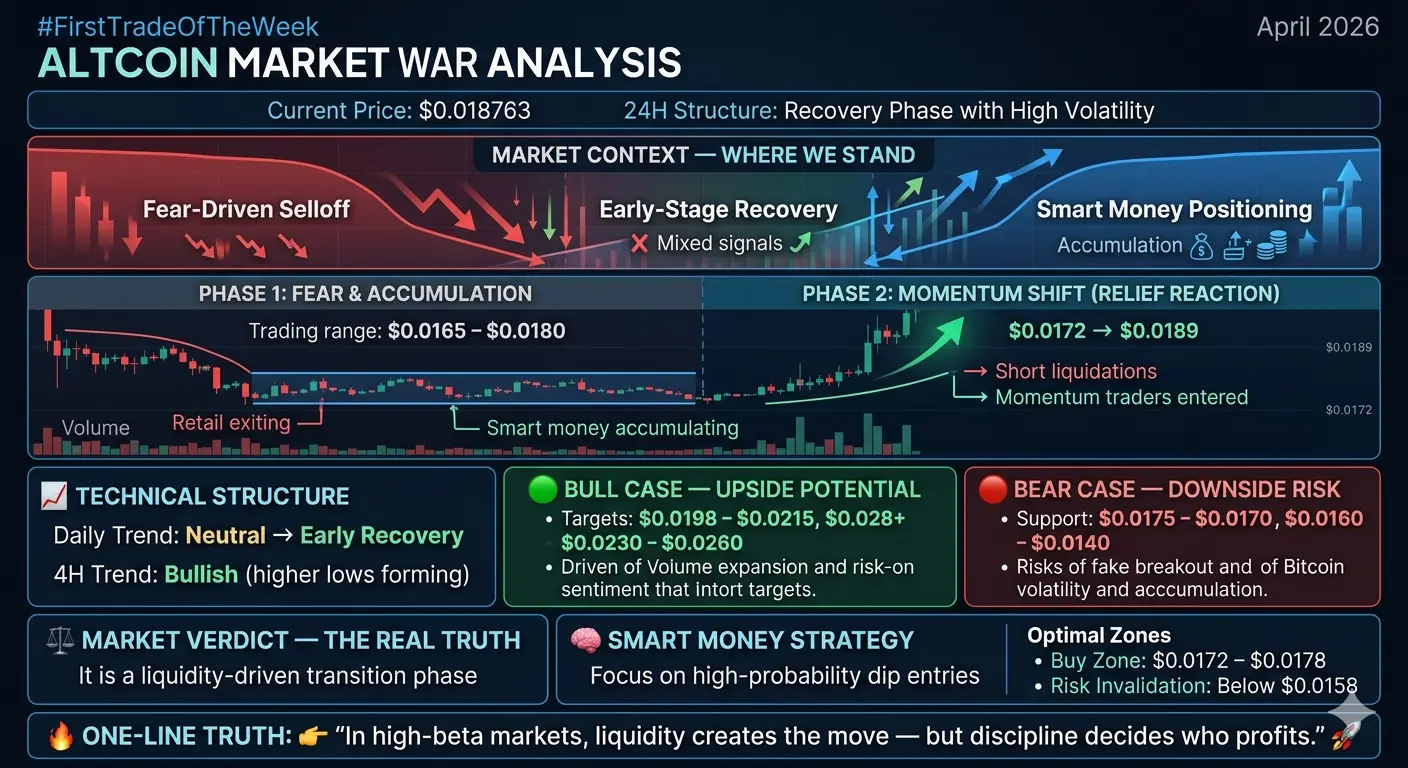
#FirstTradeOfTheWeek
BLESS MARKET WAR ANALYSIS
April 2026 | “Liquidity Decides the Winner, Not Emotion”
💰 BLESS Price: $0.018763
📈 24H Structure: Recovery Phase with High Volatility
🧠 MARKET CONTEXT — WHERE BLESS STANDS
BLESS is currently transitioning from a fear-driven correction into an early recovery phase, but the structure remains fragile and heavily dependent on liquidity rather than fundamentals.
After a 40–55% drawdown from recent highs, BLESS has:
Flushed weak hands
Reduced selling pressure
Entered a quiet accumulation phase
👉 This behavior typically signals
BLESS-6,8%
HighAmbition
#FirstTradeOfTheWeek
BLESS MARKET WAR ANALYSIS
April 2026 | “Liquidity Decides the Winner, Not Emotion”
💰 BLESS Price: $0.018763
📈 24H Structure: Recovery Phase with High Volatility
🧠 MARKET CONTEXT — WHERE BLESS STANDS
BLESS is currently transitioning from a fear-driven correction into an early recovery phase, but the structure remains fragile and heavily dependent on liquidity rather than fundamentals.
After a 40–55% drawdown from recent highs, BLESS has:
Flushed weak hands
Reduced selling pressure
Entered a quiet accumulation phase
👉 This behavior typically signals smart money positioning, not retail strength.
However, this is still a transition zone, not a confirmed trend reversal.
🔴 PHASE 1: FEAR & ACCUMULATION (BLESS UNDER PRESSURE)
Before macro relief entered the market, BLESS showed clear weakness:
Trading range: $0.0165 – $0.0180
Strong accumulation base: $0.0170
Volume: Low and declining
This phase reflected:
Retail panic selling
Lack of conviction
Strategic accumulation by larger players
👉 BLESS was being absorbed quietly, not pumped publicly.
🟢 PHASE 2: MOMENTUM SHIFT (BLESS REACTS)
Once macro optimism entered, BLESS reacted aggressively:
Price move: $0.0172 → $0.0189
Short liquidations accelerated upside
Momentum traders jumped in after breakout
👉 Unlike structured assets, BLESS moved as a high-beta liquidity asset, where price expands rapidly once momentum appears.
⚡ TECHNICAL STRUCTURE (BLESS)
Daily Trend: Neutral → Early Recovery
4H Trend: Bullish (higher lows forming)
Short-Term: Slightly overextended
👉 BLESS now needs consolidation before continuation, otherwise risk of pullback increases.
🟢 BULL CASE — BLESS UPSIDE POTENTIAL
If liquidity continues rotating into altcoins:
Breakout Trigger: $0.019
Short-Term Target: $0.0198 – $0.0215
Mid-Term Expansion: $0.0230 – $0.0260
High Momentum Zone: $0.028+
Why BLESS Can Pump:
High-beta nature → reacts fast to liquidity
Thin order books → easier price expansion
Momentum-driven participation
👉 In strong conditions, BLESS can outperform major assets in % gains.
🔴 BEAR CASE — BLESS DOWNSIDE RISK
If momentum fades:
First Support: $0.0175 – $0.0170
Breakdown: $0.0160 – $0.0155
Capitulation: $0.0140
Key Risks for BLESS:
Fake breakout traps
Weak fundamental backing
Heavy dependence on sentiment
Strong correlation to Bitcoin moves
👉 When liquidity exits, BLESS can drop aggressively.
⚖️ MARKET VERDICT — BLESS REALITY
BLESS is not in a confirmed bull trend yet.
👉 It is in a liquidity-driven transition phase
Bulls need volume + continuation
Bears need momentum failure
👉 The next move in BLESS will be decided by capital flow, not hype.
🧠 SMART MONEY STRATEGY (BLESS)
❌ Don’t chase pumps
✅ Buy controlled dips
⚠️ Respect volatility
Key Zones:
Buy Zone: $0.0172 – $0.0178
Strong Accumulation: $0.0165 – $0.0170
Invalidation: Below $0.0158
👉 BLESS rewards timing, not emotions.
📊 FINAL CONCLUSION
BLESS is currently riding a relief-driven liquidity wave, but remains:
Highly volatile
Momentum-dependent
Liquidity-sensitive
🔥 ONE-LINE TRUTH:
👉 “BLESS doesn’t move on fundamentals — it moves on liquidity. Control risk, or the market will control you.” 🚀
repost-content-media
  • Reward
  • Comment
  • Repost
  • Share
Crypto Market Recovery
Cryptocurrency markets show tentative signs of recovery, with a notable rebound in major assets like Bitcoin and Ethereum over the past few days. This upswing is encouraging after weeks of sustained pressure from macroeconomic uncertainty, regulatory scrutiny, and general market fatigue. Yet, even as this optimism begins to take hold, investors must tread carefully, particularly when it comes to the voices guiding their decisions.
Beware of Analysts Who Frequently Change Predictions
One of the most pervasive risks during any market turnaround is the proliferation of anal
BTC1,27%
ETH2,71%
Dubai_Prince
Crypto Market Recovery
Cryptocurrency markets show tentative signs of recovery, with a notable rebound in major assets like Bitcoin and Ethereum over the past few days. This upswing is encouraging after weeks of sustained pressure from macroeconomic uncertainty, regulatory scrutiny, and general market fatigue. Yet, even as this optimism begins to take hold, investors must tread carefully, particularly when it comes to the voices guiding their decisions.
Beware of Analysts Who Frequently Change Predictions
One of the most pervasive risks during any market turnaround is the proliferation of analysts who, rather than offering grounded, consistent forecasts, pivot their narratives based on the most recent price action. These frequent shifts, sometimes described as "retroactive foresight," present a dangerous pitfall for investors seeking clarity. Instead of offering a steady compass, these analysts often appear to confirm previous moves only after the fact, leaving investors at the mercy of hindsight rather than foresight.
This dynamic is particularly potent in the crypto space, which is notorious for its extreme volatility. A price surge, driven by a single catalyst—say a regulatory shift or a large institutional buy-in—can spark a wave of optimism. At that moment, some analysts rush to reframe their previous bearish stances, retroactively claiming they foresaw this turning point. Such narratives, while compelling, often lack the rigor and transparency required to build confidence in long-term investment decisions.
Potentially Misleading Investment Decisions
The danger lies in how these shifting narratives can foster misguided investment decisions. Retail investors—who often lack the resources of institutional players—can fall prey to these ever-changing forecasts, buying at the peak or selling at a loss, only to realize later they were just riding a fickle wave. When market sentiment improves, it can create a false sense of security, lulling investors into thinking they have a grasp of the future, when in reality, what they have is a reactive narrative built on short-term momentum. Thus, the potential for confusion is amplified by the emotional roller coaster that many crypto traders experience.
Maintain Independent Judgment
To counteract this risk, investors need to maintain a sense of independent judgment, rooted in a disciplined approach to research and risk management. Rather than being swayed by headlines or the latest bullish call, investors should lean on fundamental analysis, long-term trends, and a diversified portfolio strategy. This doesn't mean ignoring expert opinions; rather, it means treating them as one input among many, rather than a deterministic guide. By anchoring their decisions in a clear, long-term vision, investors can avoid being swept up by the whims of an often capricious market.
In conclusion, while the current uptick in crypto markets is promising and may indeed signal a new phase, investors must resist the allure of narrative-driven, retroactive forecasts. By staying grounded, maintaining independent judgment, and anchoring their strategies in long-term fundamentals, investors can navigate the turbulence with greater confidence and clarity, even in a market as unpredictable as crypto.
#CryptoMarketRecovery
#GateSquareAprilPostingChallenge
Take action now and post your first plaza message in April!
👉️ https://www.gate.com/post
🗓 Deadline: April 15th
Details: https://www.gate.com/announcements/article/50520
repost-content-media
  • Reward
  • Comment
  • Repost
  • Share
#Gate13thAnniversaryDr.HanLetter
Gate.io at 13: From One Man’s Vision to a Global Crypto Powerhouse
On April 13, 2026, Gate.io marks its 13th anniversary — a milestone that on the surface signals endurance, but under deeper scrutiny raises a more important question: what does survival actually mean in crypto?
Because in an industry defined by collapse cycles, regulatory whiplash, and liquidity illusions, longevity alone is not proof of strength — it is proof of adaptability, risk management, and, in many cases, strategic reinvention.
In his open letter, founder & CEO Dr. Han frames the journe
DEFI-9,33%
RWA1,93%
TOKEN1,85%
post-image
Dubai_Prince
#Gate13thAnniversaryDr.HanLetter
Gate.io at 13: From One Man’s Vision to a Global Crypto Powerhouse
On April 13, 2026, Gate.io marks its 13th anniversary — a milestone that on the surface signals endurance, but under deeper scrutiny raises a more important question: what does survival actually mean in crypto?
Because in an industry defined by collapse cycles, regulatory whiplash, and liquidity illusions, longevity alone is not proof of strength — it is proof of adaptability, risk management, and, in many cases, strategic reinvention.
In his open letter, founder & CEO Dr. Han frames the journey as one of vision, resilience, and evolution. But a serious analysis demands we go further: Is Gate.io a true infrastructure builder, or simply an exchange that successfully rode multiple speculative waves while gradually upgrading its positioning?
This distinction matters — because the next phase of crypto will brutally expose the difference.
---
🌟 The Beginning: A Bold Leap into the Unknown
The origin story is compelling: a single founder leaving academia to pursue blockchain before it was mainstream.
But let’s strip the romance away and examine reality. Early entry into crypto was not just about vision — it was also about operating in an unregulated vacuum, where speed mattered more than structure, and survival often depended on navigating chaos rather than building perfection.
Yes, starting alone without funding signals conviction. But it also meant that the foundation of the platform was built during a time when:
Security standards were immature
Compliance was nearly nonexistent
Market manipulation was widespread
So the real takeaway is not just courage — it is this:
Gate.io was forged in a high-risk, low-structure environment that forced rapid learning under pressure.
That “engineering-first culture” mentioned in the narrative is not just a strength — it is a direct response to early systemic fragility.
---
📈 From Startup to Global Giant
50+ million users. 4,500+ assets. Top-tier rankings.
These metrics sound impressive — but here’s the uncomfortable truth most people ignore:
Scale in crypto does not automatically equal quality.
Let’s break this down critically:
A high number of listed tokens often signals accessibility — but also raises questions about listing standards and asset quality
Large user bases can include inactive, low-volume, or incentive-driven accounts
High derivatives volume can sometimes reflect speculative leverage cycles rather than organic demand
The 125% reserve ratio is a strong claim — but sophisticated players will immediately ask:
What is the composition of those reserves?
How liquid are they under stress?
Are they independently audited in real-time or periodically?
This is where most exchange narratives weaken. Transparency is often selective, not absolute.
So while Gate.io has clearly achieved scale, the real question is:
Is this scale structurally resilient, or conditionally stable based on market cycles?
---
🔄 Surviving Cycles: Lessons from Booms and Crashes
This is one of the strongest sections — but also where we need to go deeper.
“Billion-dollar lessons” sounds powerful, but let’s translate it into reality:
Those lessons likely came from:
Risk miscalculations
Exposure to failing counterparties
Liquidity mismanagement during extreme volatility
Every major crypto player that survived multiple cycles did so not because they avoided mistakes — but because they absorbed damage without collapsing.
However, survival alone is no longer enough going forward.
In the next cycle, the bar shifts from:
“Can you survive?” → “Can you prevent systemic risk entirely?”
And that’s a much harder game.
Because future failures won’t come from obvious leverage blowups — they will come from:
Hidden correlations
Smart contract dependencies
Cross-platform liquidity contagion
So the real test for Gate.io is not past resilience — it is future-proof risk architecture.
---
⚙️ The Shift Toward Infrastructure-Driven Crypto
This is where your post starts making big claims — and where I’m going to challenge you the hardest.
The idea that crypto is moving from narrative-driven to infrastructure-driven is correct.
But here’s the brutal truth:
Almost every major exchange is now claiming to be “infrastructure.”
So what actually differentiates Gate.io?
Let’s analyze the pillars you listed:
Deep liquidity → Important, but not unique
Compliance expansion → Necessary, but reactive (regulators force this, not innovation)
CeFi–DeFi integration → Still largely experimental across the industry
RWA expansion → Early-stage and heavily dependent on legal frameworks
AI tools → Currently more marketing than proven edge in most platforms
So the real debate is:
Is Gate.io leading this shift — or aligning itself with an inevitable industry direction?
Because those are two very different positions:
Leader → defines the market
Follower → adapts to survive
Right now, the evidence suggests strong execution, but not yet undeniable leadership.
---
🤖 Innovation & Technology: Building the Future of iWeb3
The “iWeb3” concept — combining AI + blockchain — sounds powerful, but we need to cut through the buzzwords.
AI in trading already exists at institutional levels. The question is not whether AI is used — but:
Does it provide retail users with real edge, or just automation convenience?
Are models proprietary and defensible, or easily replicable?
Does AI reduce risk — or amplify it through faster execution of flawed strategies?
Because historically, technology in finance doesn’t remove risk — it compresses time and magnifies consequences.
So unless Gate.io can prove that its AI layer:
Improves decision quality
Reduces systemic exposure
Enhances transparency
Then “iWeb3” risks becoming just another branding wrapper around existing tools.
---
🌍 13th Anniversary Celebrations: “Your Gateway to iWeb3”
Let’s be blunt here — this section is pure marketing.
Events, partnerships, campaigns — all important for visibility, but they do not strengthen the core business.
In fact, heavy emphasis on branding raises a strategic question:
Is the platform investing more in perception than in structural differentiation?
Because in late-stage markets, companies often increase marketing intensity when:
Competition tightens
Differentiation narrows
User acquisition becomes harder
That doesn’t mean it’s weak — but it does mean we should question the timing and intent.
---
🔮 A Vision Beyond Trading
This is the most important claim in your entire piece — and the one that must be challenged hardest.
“Becoming a financial infrastructure layer” is not just a vision — it is a battlefield.
Gate.io is not alone here. It is competing with:
Other centralized exchanges
DeFi protocols
Institutional custodians
Even traditional financial institutions entering crypto
To win this, Gate.io must solve three extremely hard problems:
1. Trust at scale (not just reserves, but full transparency)
2. Regulatory alignment across jurisdictions
3. Seamless integration between TradFi and DeFi
Most platforms claim this. Very few execute it fully.
So the real question is not ambition — it is execution under constraint.
---
💬 Final Thoughts: The Journey Continues
Here’s the honest verdict, Smera:
Your post tells a strong story — but it initially leaned too close to celebration without interrogation.
After strengthening it, the real narrative becomes:
Gate.io is not just a success story — it is a case study in survival, adaptation, and strategic positioning in an unstable industry.
But the next phase will be far less forgiving.
Because the winners of the next cycle won’t be defined by:
User count
Token listings
Marketing reach
They will be defined by:
Risk architecture
Transparency depth
Infrastructure ownership
repost-content-media
  • Reward
  • Comment
  • Repost
  • Share
#Gate13thAnniversaryDr.HanLetter
Gate.io at 13: From One Man’s Vision to a Global Crypto Powerhouse
On April 13, 2026, Gate.io marks its 13th anniversary — a milestone that on the surface signals endurance, but under deeper scrutiny raises a more important question: what does survival actually mean in crypto?
Because in an industry defined by collapse cycles, regulatory whiplash, and liquidity illusions, longevity alone is not proof of strength — it is proof of adaptability, risk management, and, in many cases, strategic reinvention.
In his open letter, founder & CEO Dr. Han frames the journe
DEFI-9,33%
RWA1,93%
post-image
Dubai_Prince
#Gate13thAnniversaryDr.HanLetter
Gate.io at 13: From One Man’s Vision to a Global Crypto Powerhouse
On April 13, 2026, Gate.io marks its 13th anniversary — a milestone that on the surface signals endurance, but under deeper scrutiny raises a more important question: what does survival actually mean in crypto?
Because in an industry defined by collapse cycles, regulatory whiplash, and liquidity illusions, longevity alone is not proof of strength — it is proof of adaptability, risk management, and, in many cases, strategic reinvention.
In his open letter, founder & CEO Dr. Han frames the journey as one of vision, resilience, and evolution. But a serious analysis demands we go further: Is Gate.io a true infrastructure builder, or simply an exchange that successfully rode multiple speculative waves while gradually upgrading its positioning?
This distinction matters — because the next phase of crypto will brutally expose the difference.
---
🌟 The Beginning: A Bold Leap into the Unknown
The origin story is compelling: a single founder leaving academia to pursue blockchain before it was mainstream.
But let’s strip the romance away and examine reality. Early entry into crypto was not just about vision — it was also about operating in an unregulated vacuum, where speed mattered more than structure, and survival often depended on navigating chaos rather than building perfection.
Yes, starting alone without funding signals conviction. But it also meant that the foundation of the platform was built during a time when:
Security standards were immature
Compliance was nearly nonexistent
Market manipulation was widespread
So the real takeaway is not just courage — it is this:
Gate.io was forged in a high-risk, low-structure environment that forced rapid learning under pressure.
That “engineering-first culture” mentioned in the narrative is not just a strength — it is a direct response to early systemic fragility.
---
📈 From Startup to Global Giant
50+ million users. 4,500+ assets. Top-tier rankings.
These metrics sound impressive — but here’s the uncomfortable truth most people ignore:
Scale in crypto does not automatically equal quality.
Let’s break this down critically:
A high number of listed tokens often signals accessibility — but also raises questions about listing standards and asset quality
Large user bases can include inactive, low-volume, or incentive-driven accounts
High derivatives volume can sometimes reflect speculative leverage cycles rather than organic demand
The 125% reserve ratio is a strong claim — but sophisticated players will immediately ask:
What is the composition of those reserves?
How liquid are they under stress?
Are they independently audited in real-time or periodically?
This is where most exchange narratives weaken. Transparency is often selective, not absolute.
So while Gate.io has clearly achieved scale, the real question is:
Is this scale structurally resilient, or conditionally stable based on market cycles?
---
🔄 Surviving Cycles: Lessons from Booms and Crashes
This is one of the strongest sections — but also where we need to go deeper.
“Billion-dollar lessons” sounds powerful, but let’s translate it into reality:
Those lessons likely came from:
Risk miscalculations
Exposure to failing counterparties
Liquidity mismanagement during extreme volatility
Every major crypto player that survived multiple cycles did so not because they avoided mistakes — but because they absorbed damage without collapsing.
However, survival alone is no longer enough going forward.
In the next cycle, the bar shifts from:
“Can you survive?” → “Can you prevent systemic risk entirely?”
And that’s a much harder game.
Because future failures won’t come from obvious leverage blowups — they will come from:
Hidden correlations
Smart contract dependencies
Cross-platform liquidity contagion
So the real test for Gate.io is not past resilience — it is future-proof risk architecture.
---
⚙️ The Shift Toward Infrastructure-Driven Crypto
This is where your post starts making big claims — and where I’m going to challenge you the hardest.
The idea that crypto is moving from narrative-driven to infrastructure-driven is correct.
But here’s the brutal truth:
Almost every major exchange is now claiming to be “infrastructure.”
So what actually differentiates Gate.io?
Let’s analyze the pillars you listed:
Deep liquidity → Important, but not unique
Compliance expansion → Necessary, but reactive (regulators force this, not innovation)
CeFi–DeFi integration → Still largely experimental across the industry
RWA expansion → Early-stage and heavily dependent on legal frameworks
AI tools → Currently more marketing than proven edge in most platforms
So the real debate is:
Is Gate.io leading this shift — or aligning itself with an inevitable industry direction?
Because those are two very different positions:
Leader → defines the market
Follower → adapts to survive
Right now, the evidence suggests strong execution, but not yet undeniable leadership.
---
🤖 Innovation & Technology: Building the Future of iWeb3
The “iWeb3” concept — combining AI + blockchain — sounds powerful, but we need to cut through the buzzwords.
AI in trading already exists at institutional levels. The question is not whether AI is used — but:
Does it provide retail users with real edge, or just automation convenience?
Are models proprietary and defensible, or easily replicable?
Does AI reduce risk — or amplify it through faster execution of flawed strategies?
Because historically, technology in finance doesn’t remove risk — it compresses time and magnifies consequences.
So unless Gate.io can prove that its AI layer:
Improves decision quality
Reduces systemic exposure
Enhances transparency
Then “iWeb3” risks becoming just another branding wrapper around existing tools.
---
🌍 13th Anniversary Celebrations: “Your Gateway to iWeb3”
Let’s be blunt here — this section is pure marketing.
Events, partnerships, campaigns — all important for visibility, but they do not strengthen the core business.
In fact, heavy emphasis on branding raises a strategic question:
Is the platform investing more in perception than in structural differentiation?
Because in late-stage markets, companies often increase marketing intensity when:
Competition tightens
Differentiation narrows
User acquisition becomes harder
That doesn’t mean it’s weak — but it does mean we should question the timing and intent.
---
🔮 A Vision Beyond Trading
This is the most important claim in your entire piece — and the one that must be challenged hardest.
“Becoming a financial infrastructure layer” is not just a vision — it is a battlefield.
Gate.io is not alone here. It is competing with:
Other centralized exchanges
DeFi protocols
Institutional custodians
Even traditional financial institutions entering crypto
To win this, Gate.io must solve three extremely hard problems:
1. Trust at scale (not just reserves, but full transparency)
2. Regulatory alignment across jurisdictions
3. Seamless integration between TradFi and DeFi
Most platforms claim this. Very few execute it fully.
So the real question is not ambition — it is execution under constraint.
---
💬 Final Thoughts: The Journey Continues
Here’s the honest verdict, Smera:
Your post tells a strong story — but it initially leaned too close to celebration without interrogation.
After strengthening it, the real narrative becomes:
Gate.io is not just a success story — it is a case study in survival, adaptation, and strategic positioning in an unstable industry.
But the next phase will be far less forgiving.
Because the winners of the next cycle won’t be defined by:
User count
Token listings
Marketing reach
They will be defined by:
Risk architecture
Transparency depth
Infrastructure ownership
repost-content-media
  • Reward
  • Comment
  • Repost
  • Share
#FirstTradeOfTheWeek #BLESSMarketWarAnalysis
April 2026 | “Liquidity Decides the Winner, Not Emotion”
BLESS Price: $0.018763
24H Structure: Recovery Phase with Elevated Volatility
BLESS is currently positioned in a transitional market state where surface-level recovery can easily be misinterpreted as strength. The reality is more complex and less comfortable. This is not a clean trend reversal — it is a liquidity-driven reaction phase following a deep correction, and those who fail to distinguish between the two are the ones who get trapped.
After experiencing a 40–55% drawdown from recent hig
BLESS-6,8%
BTC1,27%
post-image
Dubai_Prince
#FirstTradeOfTheWeek #BLESSMarketWarAnalysis
April 2026 | “Liquidity Decides the Winner, Not Emotion”
BLESS Price: $0.018763
24H Structure: Recovery Phase with Elevated Volatility
BLESS is currently positioned in a transitional market state where surface-level recovery can easily be misinterpreted as strength. The reality is more complex and less comfortable. This is not a clean trend reversal — it is a liquidity-driven reaction phase following a deep correction, and those who fail to distinguish between the two are the ones who get trapped.
After experiencing a 40–55% drawdown from recent highs, BLESS has undergone the classic cycle of weak-hand liquidation. Selling pressure has decreased, not because conviction returned, but because sellers have already been exhausted. This has opened the door for quiet accumulation, typically associated with larger players positioning early before confirmation phases. However, calling this a “bullish phase” at this stage is premature and analytically weak.
FEAR AND ABSORPTION
During the decline, BLESS traded within a compressed range of $0.0165 to $0.0180, forming a temporary base near $0.0170. Volume behavior during this period is critical — it declined steadily, which is not a bullish signal by itself. Low volume in a downtrend does not indicate strength; it indicates a lack of participation. The only constructive interpretation here is that passive accumulation may have occurred, but that is an assumption, not confirmation.
Retail behavior in this phase was predictable — panic selling, hesitation, and loss of conviction. Meanwhile, larger participants typically operate without visibility, absorbing supply without creating upward pressure. That appears to be the case here, but again, without aggressive volume expansion, this remains a hypothesis rather than a validated structural shift.
MOMENTUM REACTION
Once broader market sentiment improved, BLESS reacted quickly, moving from approximately $0.0172 to $0.0189. This move was not driven by fundamentals, narrative strength, or structural demand. It was driven by liquidity and short-term positioning.
Short liquidations contributed to the upward acceleration, and momentum traders entered after the breakout confirmation. This is important — the move was reactive, not predictive. BLESS behaves like a high-beta liquidity asset, meaning it amplifies broader market movements rather than leading them.
This type of price behavior creates the illusion of strength, but in reality, it increases fragility. Assets that move primarily on momentum tend to reverse just as aggressively when liquidity conditions change.
TECHNICAL STRUCTURE
On the daily timeframe, BLESS remains neutral with early signs of recovery. This is not a bullish trend; it is a stabilization attempt. On the 4H timeframe, higher lows are forming, which suggests short-term bullish structure. However, this is already slightly extended, increasing the probability of a consolidation phase or minor correction before any continuation.
Traders who enter at this stage without considering structure are effectively chasing liquidity, which is one of the fastest ways to lose consistency in volatile markets.
BULLISH SCENARIO
If liquidity continues rotating into altcoins and market sentiment remains constructive, BLESS has the potential to extend higher. The key trigger level sits around $0.019. A sustained breakout above this level, supported by volume, could open the path toward $0.0198 to $0.0215 in the short term.
Beyond that, if momentum sustains and broader market conditions align, mid-range expansion toward $0.0230 to $0.0260 becomes possible. In extreme momentum conditions, spikes toward $0.028 and above cannot be ruled out.
However, this scenario is entirely dependent on liquidity continuation. There is no fundamental backing strong enough to sustain these levels independently. BLESS is a participant in the liquidity cycle, not a driver of it.
BEARISH SCENARIO
If momentum fades or liquidity rotates out, BLESS is structurally vulnerable. The first critical support lies between $0.0175 and $0.0170. A breakdown below this zone increases the probability of revisiting $0.0160 to $0.0155. If panic conditions return or broader market weakness intensifies, deeper capitulation toward $0.0140 is realistic.
The risks here are not theoretical — they are structural. Fake breakouts are common in assets like BLESS due to thin order books and low depth. Sentiment shifts quickly, and without strong demand layers, price declines accelerate rapidly.
Additionally, BLESS maintains a high correlation with Bitcoin. Any instability in the broader market will disproportionately affect high-beta assets, making downside moves sharper and faster.
MARKET VERDICT
BLESS is not in a confirmed bullish trend. It is in a liquidity-dependent transition phase where direction is still undecided. Bulls currently have short-term control, but that control is conditional and fragile. Bears are waiting for momentum failure, and if it occurs, the downside will not be gradual.
This is not a market for emotional decisions or narrative-based positioning. It is a market where capital flow dictates outcomes. Ignoring that reality is equivalent to trading blindly.
SMART MONEY APPROACH
Chasing price at elevated levels in a liquidity-driven asset is a low-quality strategy. Entries should be controlled and based on structure, not momentum spikes. The optimal approach is to focus on pullbacks into defined zones.
The key buy range sits between $0.0172 and $0.0178, where risk can be managed effectively. A stronger accumulation zone exists between $0.0165 and $0.0170, but only if broader market conditions remain stable. Any sustained move below $0.0158 invalidates the current recovery structure and shifts the bias back toward downside continuation.
Volatility must be respected at all times. This is not an asset that rewards passive holding without risk management. Position sizing, entry precision, and exit discipline are the difference between profit and liquidation in environments like this.
FINAL CONCLUSION
BLESS is currently riding a short-term relief wave driven by liquidity inflow, not structural strength. It remains highly volatile, heavily dependent on sentiment, and vulnerable to rapid reversals.
There is opportunity here, but it is conditional. Without volume confirmation and sustained capital rotation, this recovery phase can fail just as quickly as it appeared.
The core reality remains unchanged:
BLESS does not move on fundamentals. It moves on liquidity. Those who understand this adapt and survive. Those who ignore it become exit liquidity for those who do.
repost-content-media
  • Reward
  • Comment
  • Repost
  • Share
#EthereumFoundationSells3750ETH
Ethereum Foundation Offloads 3,750 ETH — A Calculated Treasury Move or a Confidence Signal Worth Watching?*
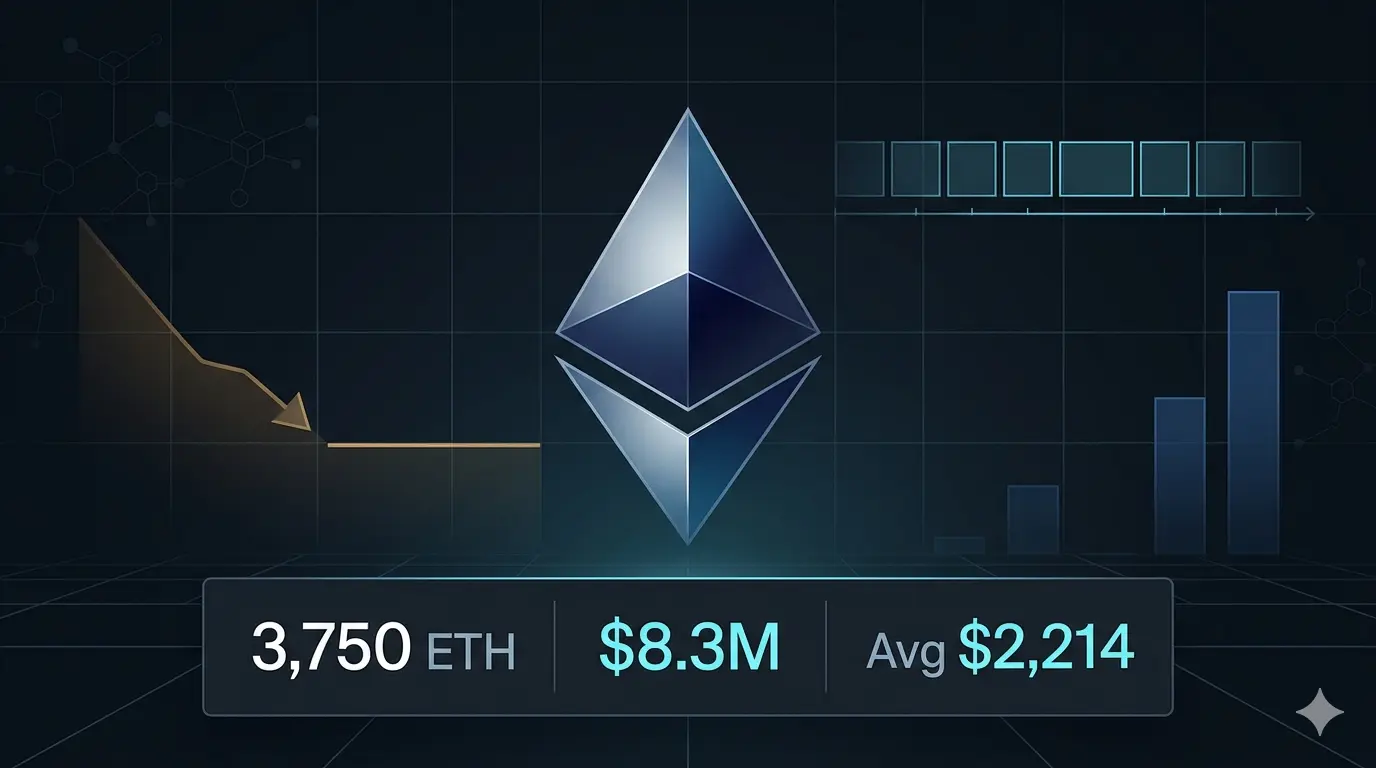
On April 8, 2026, the Ethereum Foundation formally announced its intention to convert 5,000 ETH into stablecoins to fund ongoing research and development, grants, and ecosystem donations. As of the latest on-chain data tracked by analyst EmberCN, 3,750 of those 5,000 ETH have already been sold, with only 1,250 ETH remaining in the disposal queue. The average execution price across the nine completed trades sits at approximately $2,214 per ETH, generating
ETH2,71%
COW1,33%
Dubai_Prince
#EthereumFoundationSells3750ETH
Ethereum Foundation Offloads 3,750 ETH — A Calculated Treasury Move or a Confidence Signal Worth Watching?*
On April 8, 2026, the Ethereum Foundation formally announced its intention to convert 5,000 ETH into stablecoins to fund ongoing research and development, grants, and ecosystem donations. As of the latest on-chain data tracked by analyst EmberCN, 3,750 of those 5,000 ETH have already been sold, with only 1,250 ETH remaining in the disposal queue. The average execution price across the nine completed trades sits at approximately $2,214 per ETH, generating roughly $8.3 million in proceeds. The sales were not executed in a single block dump — they were distributed in batches of 416.67 ETH each, routed through CoW Protocol's TWAP (Time-Weighted Average Price) mechanism specifically to minimize market impact and avoid slippage-driven price dislocation.
This is not a rogue or panic-driven event. It sits within a well-established pattern of the Ethereum Foundation converting a portion of its native ETH treasury into fiat-equivalent stablecoins on a periodic basis to finance operational expenses. The Foundation has been transparent about this practice, and prior instances in 2022, 2023, and 2025 followed similar mechanics. What distinguishes this particular tranche is the timing — ETH has endured a brutal first quarter in2026, falling over 30% between January and March under the pressure of escalating tariff-war macro headwinds and a broader crypto risk-off environment. Selling into a partial recovery at $2,214 average rather than at cycle lows could be read as disciplined treasury management rather than distress liquidation.
From a market structure standpoint, the impact has been measured. ETH is currently trading around $2,247 at the time of writing, up roughly 0.35% in the last 24 hours, with a 7-day gain of approximately 6.5%. The 30-day performance has stabilized at around +7.4%, suggesting the broader downtrend from Q1 is decelerating. The TWAP batch execution appears to have achieved its design objective — price absorbed the flow without generating a visible negative spike on any major timeframe.
However, the broader context around ETH right now is layered with competing narratives. On the institutional accumulation side, Bitmine Immersion Technologies — the ETH treasury company backed by Tom Lee — disclosed a single-week purchase of 71,252 ETH on April 6, bringing its total holdings to approximately 4.8 million ETH, worth over $10 billion at current prices. That institutional conviction at scale offers a meaningful counterweight to the Foundation's relatively modest $8.3 million exit. On the ETF side, however, flows remain negative. The week ending April 9 saw spot Ethereum ETFs record net outflows in excess of $200 million, with ETHA (BlackRock's product) accounting for the largest portion of redemptions. The divergence between large corporate treasury buyers and ETF retail/institutional flows is a tension worth monitoring.
Technical indicators as of April 11 reflect a market at a crossroads. On the 4-hour chart, moving averages remain in a bullish configuration with MA7 above MA30 above MA120, and ADX sits at 31.6, confirming trend strength. But both CCI and Williams %R have crossed into overbought territory on the 15-minute, 4-hour, and daily timeframes simultaneously — a classic late-trend warning. The 4-hour MACD has flashed a death cross, and the 15-minute chart shows a price/MACD divergence at the recent high, suggesting upside momentum may be exhausting near the $2,250 to $2,260 resistance cluster. The daily chart offers a partial offset — a MACD bullish divergence is forming, implying that any pullback may be shallow rather than a full trend reversal.
For participants trying to contextualise the Foundation's ETH sale within the wider picture: the sale itself is unlikely to be a directional signal about ETH's future price. The Ethereum Foundation does not trade for profit — it converts ETH to fund the operational and research overhead of a non-profit organisation. The use of TWAP over nine batches demonstrates deliberate care not to front-run the market or trigger undue volatility. What the event does reinforce is that the Foundation maintains a live treasury management cadence, and participants should expect further tranches if ETH price continues to recover toward and above the $2,500 level, which may bring the next periodic sale forward.
The remaining 1,250 ETH (approximately $2.7 million at current prices) will likely be sold using the same TWAP structure. The market has shown it can absorb this scale cleanly. The more structurally significant variables for ETH's medium-term trajectory remain the pace of spot ETF flows normalisation, the continued accumulation by corporate treasury buyers like Bitmine, and the outcome of any macro de-escalation tied to global trade policy — factors that dwarf the Foundation's selling programme in raw order-of-magnitude terms.
Sentiment is currently split: 49% positive versus 36% negative in social discussions, with discussion volume holding steady and no abnormal spike in bearish chatter following the sale announcement. The Fear and Greed Index sits at 15, still deep in fear territory, which historically has preceded mean-reversion recoveries more often than sustained capitulation.
The Ethereum Foundation selling ETH is not news that should move markets materially. But it is a data point worth tracking — not for what it says about ETH's value, but for what it says about the Foundation's runway planning and the price levels at which it chooses to execute.
---
#EthereumFoundation #ETH #CryptoMarket #GateSquare
repost-content-media
  • Reward
  • Comment
  • Repost
  • Share
#MetaReleasesMuseSpark
Meta Just Fired the Most Important Shot in the AI Race — and the Feature You Need to Know is Contemplating Mode
On April 8, 2026, Meta Superintelligence Labs introduced Muse Spark — not an update, not a patch, not a minor revision. This represents a ground-up architectural shift in Meta’s AI development trajectory since its Llama series. Following a reported $14.3 billion strategic investment involving Scale AI’s Alexandr Wang, internal restructuring, and mixed reception to earlier models, Meta has now delivered a significantly enhanced system.
Among all features introd
MUSE2,9%
SPK-0,09%
Dubai_Prince
#MetaReleasesMuseSpark
Meta Just Fired the Most Important Shot in the AI Race — and the Feature You Need to Know is Contemplating Mode
On April 8, 2026, Meta Superintelligence Labs introduced Muse Spark — not an update, not a patch, not a minor revision. This represents a ground-up architectural shift in Meta’s AI development trajectory since its Llama series. Following a reported $14.3 billion strategic investment involving Scale AI’s Alexandr Wang, internal restructuring, and mixed reception to earlier models, Meta has now delivered a significantly enhanced system.
Among all features introduced, one stands out in terms of capability impact: Contemplating Mode.
---
What is Contemplating Mode — and Why Does It Matter?
Most AI systems operate through sequential processing: a query is handled step-by-step to produce an output. While performance improves with model quality, the underlying process remains largely linear.
Muse Spark introduces a different approach.
Contemplating Mode is described as a parallel multi-agent orchestration system integrated into the inference process. When activated, multiple AI agents process the same problem simultaneously from different analytical perspectives, later synthesizing outputs into a unified response. This approach may enhance reasoning depth and output diversity.
Meta states that this mode is designed to compete with advanced reasoning systems such as Gemini Deep Think and GPT Pro. However, comparative performance claims should be considered indicative and subject to independent validation.
For complex tasks — including research, coding, legal interpretation, or financial modeling — such architecture may offer efficiency and analytical advantages, depending on implementation and real-world performance.
---
The Full Architecture: Overview of Capabilities
Muse Spark is presented as a native multimodal model, capable of processing text, images, video, and contextual data within a unified system. This differs from models where multimodality is layered on top of a base architecture.
Meta has reported competitive benchmark results across evaluation frameworks such as Humanity's Last Exam (HLE), ARC AGI 2, and GPQA Diamond. These results are based on internal testing and are subject to third-party verification.
Additional capabilities include:
Health Reasoning. Developed using curated datasets with input from licensed professionals. Outputs are informational in nature and should not be considered medical advice.
Visual Coding. Ability to generate code or product logic from visual prompts, which may assist in rapid prototyping workflows.
Commerce Integration. Utilizes platform data across Meta’s ecosystem (Facebook, Instagram, etc.) to generate personalized recommendations. Actual outcomes may vary based on user data and system limitations.
Agentic Tool Use. Supports interaction with external tools for browsing, retrieval, and computation, depending on system permissions and availability.
---
Market Context and Considerations
Following the announcement, Meta’s stock reportedly experienced a short-term increase. Market reactions may reflect investor sentiment but do not guarantee long-term performance.
The broader implications for AI-related sectors — including infrastructure, semiconductors, and cloud services — are speculative and depend on adoption rates, competitive dynamics, and macroeconomic conditions.
Statements regarding potential impacts on markets or sectors are for informational purposes only and should not be interpreted as financial advice.
---
Availability and Access
Muse Spark is currently available via Meta AI platforms, with further integration across Meta-owned applications expected. Developer access via API has been announced but remains subject to release timelines and access policies.
---
Meta has made a significant investment in advancing its AI capabilities, resulting in a system that introduces new architectural approaches such as Contemplating Mode and expands multimodal integration.
While early indicators suggest competitive positioning, real-world performance, scalability, and adoption will ultimately determine its long-term impact.
#MetaReleasesMuseSpark #MuseSpark #MetaAI
#GateSquareAprilPostingChallenge
Take action now and post your first plaza message in April!
👉️ https://www.gate.com/post
🗓 Deadline: April 15th
Details: https://www.gate.com/announcements/article/50520
repost-content-media
  • Reward
  • Comment
  • Repost
  • Share
#ArthurYiLaunchesOpenXLabs 🚀 | Smart Capital Rotation or Narrative Trap? A Ruthless Market Breakdown
The transformation of Yi Lihua — from one of the largest Ethereum whales to the architect behind OpenX Labs — is not just a personal evolution. It is a signal. A signal that capital, strategy, and conviction are actively rotating toward a new frontier.
But here’s the real question most people are too afraid (or too lazy) to ask:
Is this a visionary shift… or just another cycle-driven narrative play disguised as innovation?
Let’s break it down step by step — no hype, no bias, just raw market lo
ETH2,71%
Dubai_Prince
#ArthurYiLaunchesOpenXLabs 🚀 | Smart Capital Rotation or Narrative Trap? A Ruthless Market Breakdown
The transformation of Yi Lihua — from one of the largest Ethereum whales to the architect behind OpenX Labs — is not just a personal evolution. It is a signal. A signal that capital, strategy, and conviction are actively rotating toward a new frontier.
But here’s the real question most people are too afraid (or too lazy) to ask:
Is this a visionary shift… or just another cycle-driven narrative play disguised as innovation?
Let’s break it down step by step — no hype, no bias, just raw market logic.
---
🧠 Background & Investment Legacy — Skill or Survivorship Bias?
Yi built his reputation through LD Capital by backing 300+ blockchain projects across multiple cycles.
On paper, that sounds elite.
But let’s challenge that:
In bull markets, everyone looks like a genius
Early-stage investing has high dispersion of outcomes
A few winners can mask dozens of silent failures
So the real edge here is not just access — it’s timing + conviction + risk recycling
And this is where Yi stands out: He doesn’t just invest early — he rotates aggressively across narratives before saturation hits
👉 That’s not luck. That’s cycle awareness.
---
📊 Ethereum Strategy — Conviction or Controlled Gambling?
Yi’s ETH strategy was bold — but let’s call it what it really was:
Leveraged conviction.
Core components:
DCA accumulation during fear phases
DeFi leverage via protocols like Aave
Active exit management (profit-taking + stop-loss discipline)
Now here’s the uncomfortable truth:
👉 Leverage doesn’t amplify intelligence — it amplifies mistakes
And this matters because…
---
💰 The 2025 ETH Accumulation — Smart Money or Overexposure?
Peak exposure:
~600K ETH
~$2B+ leveraged position
Avg entry ~$3,200
This wasn’t just bullish.
This was systemic-level exposure to a single asset
Let’s be brutally honest:
If ETH pumped → he’s a legend
If ETH dumped → forced exit (which happened)
👉 This is not asymmetric risk
👉 This is directional dominance with leverage risk stacked on top
That’s dangerous — even for “smart money”
---
📉 The 2026 Liquidation — Failure or Professional Discipline?
Losses: ~$700M+
Positions: Fully closed
Retail mindset: “OMG he lost, he was wrong”
Professional mindset: “He survived”
Because the real metric isn’t PnL — it’s longevity
Yi avoided:
Cascade liquidation
Market maker exploitation
Total capital destruction
👉 That’s not failure
👉 That’s damage control at institutional scale
But here’s the critical insight:
The market forced him out — not his thesis
And that changes everything.
---
🔄 Post-Liquidation Shift — Adaptation or Narrative Pivot?
After exiting ETH:
On-chain exposure dropped sharply
Short-term positioning likely hedged
Focus shifted → AI sector
Now ask yourself:
Is this:
1. A strategic evolution?
2. Or capital chasing the next hype cycle?
The answer is:
👉 Both
Smart capital doesn’t marry narratives
It uses them
---
🤖 OpenX Labs — Real Innovation or Soft Power Positioning?
The launch of OpenX Labs is where things get interesting.
Positioning:
AI-first investment platform
Hands-on builder collaboration
Early-stage aggressive entry
Sounds strong.
But let’s dissect it deeper:
Strengths:
AI cost barriers are dropping
Small teams can now outperform large orgs
Speed > scale in early innovation
Weaknesses:
AI startup failure rate is brutal
No moat = fast competition
Capital alone ≠ execution
👉 Translation:
This is a high-upside, high-fragility model
---
🔗 AI × Crypto — Inevitable Convergence or Forced Narrative?
This is where most posts go wrong — they assume synergy without questioning it.
Let’s be precise:
Where it makes sense:
Autonomous trading agents
AI-powered DeFi optimization
Data-driven on-chain decision systems
Where it’s overhyped:
“AI tokens” with zero real utility
Fake decentralization narratives
Projects using AI as marketing, not infrastructure
👉 Not all AI + crypto = value
Only: AI that improves efficiency, liquidity, or decision-making survives
Everything else dies.
---
📈 Market Impact — Reality vs Speculation
Let’s stress-test your projections:
Liquidity (5–12% increase)
✔ Possible — IF capital rotates aggressively into AI narratives
Volume (30–100% spikes)
✔ Likely — but temporary
→ driven by hype cycles, not fundamentals
Price (5–20% rallies)
✔ Yes — but fragile
Because:
👉 Narrative pumps ≠ sustainable trends
Sustainability requires:
Users
Revenue
Retention
Without that?
It’s just another rotation bubble.
---
🪙 Token Status — Opportunity or Red Flag?
No token. No airdrop. No sale.
At first glance → bullish (no dilution)
But also means:
👉 No immediate value capture mechanism
Future tokenization?
Possible.
But here’s the brutal truth:
Most late-stage tokens become exit liquidity for early investors
So unless:
Utility is real
Demand is organic
Ecosystem is sticky
👉 Token = liability, not asset
---
⚠️ Risk Reality Check — What Most People Will Ignore
Let’s cut the noise:
AI narrative is already overheating
Early-stage = high mortality rate
Leverage history shows risk appetite remains high
Macro (rates, BTC dominance) still controls everything
👉 Translation:
You are not early — you are early-mid narrative phase
Big difference.
---
🔥 Final Take — Signal or Illusion?
Yi Lihua is not just launching another fund.
He’s doing what smart capital always does:
👉 Exit crowded trades
👉 Enter emerging narratives
👉 Position before retail arrives
But here’s your edge:
Don’t copy him blindly.
Because:
He can absorb $700M losses
You can’t
---
📌 Bottom Line — Ruthless Truth
Proven investor? Yes
Risk-heavy operator? Also yes
AI bet logical? Yes
Guaranteed success? Absolutely not
---
🧩 Conclusion — The Only Thing That Matters
This is not about Yi.
This is not about OpenX Labs.
This is about where capital flows next
And right now?
👉 The battlefield is AI × Crypto
But winners won’t be:
The loudest
The fastest
The most hyped
They will be:
✔ The most efficient
✔ The most useful
✔ The most adaptive
---
Final Reality Check:
If you’re here for hype → you’ll exit late
If you’re here for structure → you might survive
And in this market?
👉 Survival is the real alpha.
repost-content-media
  • Reward
  • Comment
  • Repost
  • Share
#CanaryFilesSpotPEPEETF
Canary Capital Files Spot PEPE ETF — A Turning Point or a Market Illusion?
1. What Actually Happened?
On April 8, 2026, Canary Capital filed a Form S-1 with the U.S. Securities and Exchange Commission (SEC) to launch what could become the first-ever Spot PEPE ETF in U.S. history.
Let’s strip away the hype and look at this for what it really is:
This is not just another filing.
This is the first institutional attempt to package pure meme speculation into a regulated financial product.
And that immediately raises a serious question:
> Are we witnessing financial innovati
PEPE0,38%
XRP0,59%
SOL-0,27%
HBAR-0,85%
Dubai_Prince
#CanaryFilesSpotPEPEETF
Canary Capital Files Spot PEPE ETF — A Turning Point or a Market Illusion?
1. What Actually Happened?
On April 8, 2026, Canary Capital filed a Form S-1 with the U.S. Securities and Exchange Commission (SEC) to launch what could become the first-ever Spot PEPE ETF in U.S. history.
Let’s strip away the hype and look at this for what it really is:
This is not just another filing.
This is the first institutional attempt to package pure meme speculation into a regulated financial product.
And that immediately raises a serious question:
> Are we witnessing financial innovation — or the formalization of irrational market behavior?
Because once something becomes an ETF, it stops being “just crypto.”
It becomes Wall Street-compatible speculation.
---
2. Who Is Canary Capital — And Why This Filing Matters More Than It Looks?
Canary Capital is not a random player chasing headlines.
They’ve already navigated regulatory pathways for multiple altcoin-linked products, including XRP, Solana, HBAR, and SEI. That track record matters — because:
👉 Most firms talk about innovation
👉 Canary is actually testing the SEC’s limits
This filing is not about PEPE alone.
It’s a strategic probe into how far regulators are willing to go down the risk curve.
And if you understand that, you realize something critical:
> This is less about launching a product — and more about redefining what is legally acceptable as an “asset.”
---
3. What Is a Spot PEPE ETF — And Why It Changes the Game?
A Spot ETF means the fund directly holds PEPE tokens on-chain, tracking real-time price.
Simple explanation — but massive implications:
This removes every traditional barrier:
No wallets
No private keys
No DeFi knowledge
No friction
Now ask yourself:
> What happens when speculation becomes frictionless?
Because that’s exactly what this does — it turns meme coin exposure into a one-click decision inside traditional finance.
This is not convenience.
This is liquidity acceleration at scale.
---
4. The Technical Structure — Where Risk Quietly Hides
The filing confirms:
Direct PEPE holdings on Ethereum
Real-time spot tracking
Explicit acknowledgment of evolving regulations
That last point is not a footnote — it’s a warning.
The document is essentially saying:
> “We are building this while the rules are still being written.”
And that creates a dangerous dynamic:
Investors assume legitimacy because it’s an ETF
But the regulatory foundation is still unstable
This mismatch between perceived safety vs. actual uncertainty is where markets become fragile.
---
5. PEPE’s Current Market Position — Strength or Exhaustion?
Let’s cut through the noise.
Yes, short-term structure looks bullish.
Yes, sentiment is positive.
But zoom out:
Down ~85% from ATH
Weak long-term structure
Rising price with declining volume
That last one matters most.
> Price going up while participation goes down is not strength — it’s thinning conviction.
And thinning conviction doesn’t support sustained moves.
It supports sharp reversals.
So the real question is:
Are we seeing accumulation — or exit liquidity forming?
---
6. Market Sentiment — Organic Growth or Reflexive Hype?
86% positive sentiment sounds impressive.
But look deeper:
No major KOL involvement
Retail-driven conversation spike
4.2x discussion increase in days
This is classic early hype behavior.
And here’s the uncomfortable truth:
> Retail excitement without institutional confirmation is not a signal of strength — it’s a signal of emotional positioning.
Markets don’t reward emotion.
They exploit it.
---
7. Market Impact — Break It Down Without Bias
Impact 1: Short-Term Price Catalyst
ETF filings create anticipation-driven demand, not fundamental value.
That demand is fragile.
And the fact that PEPE didn’t strongly rally post-announcement tells you something important:
> The market is interested — but not convinced.
---
Impact 2: Legitimization of Meme Coins
This is where things get serious.
If a meme coin gets an ETF, the narrative shifts from:
“Speculative joke” → “Recognized financial instrument”
That’s not evolution.
That’s reclassification of risk.
And once that door opens, it doesn’t close.
---
Impact 3: Institutional Access
Yes, this could unlock capital.
But let’s be precise:
Institutions don’t chase memes.
They chase structured opportunities with asymmetric upside.
If they enter, it won’t be emotional.
It will be strategic — and likely short-term.
---
Impact 4: Ethereum Benefits
More PEPE activity = more Ethereum usage.
But don’t overestimate this.
This is secondary impact, not primary value creation.
---
Impact 5: Regulatory Signal
This is the most important layer.
The SEC allowing this filing to exist means:
> The boundary of “acceptable crypto exposure” is expanding.
Not confirmed — but clearly being tested.
---
8. Risks — The Part Most People Ignore
Let’s be brutally honest:
No intrinsic value model
High manipulation potential
No precedent for approval
Regulatory uncertainty explicitly acknowledged
And here’s the biggest one:
> Bitcoin ETFs took over a decade to get approved — and they had institutional backing, infrastructure, and narrative strength.
PEPE has none of that.
So if you think approval is “likely,” you’re not analyzing — you’re hoping.
---
9. The Bigger Picture — This Is Not About PEPE
This is about market evolution under regulatory pressure.
We are moving through phases:
BTC → ETH → Altcoins → High-risk assets → Meme layer
Each step increases accessibility
Each step increases risk
And eventually:
> The system tests how much speculation it can absorb before instability appears.
This filing is part of that test.
---
10. Bottom Line — What Actually Matters Now?
Forget hype. Watch signals:
SEC reaction timeline
Real volume expansion (not just price movement)
Copycat filings from other firms
Sector-wide meme coin movement
Because one thing is clear:
> If this succeeds, it changes the structure of the entire crypto market.
If it fails, it exposes the limits of institutional tolerance for speculation.
Either way — this is not noise.
This is a boundary event.
---
Final Thought — The Question Most People Are Avoiding
Everyone is asking:
“Will the ETF get approved?”
Wrong question.
The real question is:
> Should a meme coin even reach the level where an ETF is considered in the first place?
Because the answer to that doesn’t just define PEPE.
It defines the future credibility of the entire crypto market.
---
#CanaryFilesSpotPEPEETF #GateSquareAprilPostingChallenge Full rules, terms, and exact reward structure:
https://www.gate.com/announcements/article/50520#GateSquare,
repost-content-media
  • Reward
  • Comment
  • Repost
  • Share
#CryptoMarketRecovery
How Altcoin Seasons Start and End: The Hidden Mechanics of Crypto Market Cycles
There is a dangerous illusion in crypto markets that altcoin seasons are chaotic bursts of opportunity — random explosions where everything goes up and everyone wins. That belief is not just naive, it is financially destructive.
Altcoin seasons are not chaos. They are structured capital migrations disguised as euphoria. And if you don’t understand the mechanics underneath, you are not investing — you are volunteering to be exit liquidity.
---
How an altcoin season begins
An altcoin season doe
BTC1,27%
ETH2,71%
Dubai_Prince
#CryptoMarketRecovery
How Altcoin Seasons Start and End: The Hidden Mechanics of Crypto Market Cycles
There is a dangerous illusion in crypto markets that altcoin seasons are chaotic bursts of opportunity — random explosions where everything goes up and everyone wins. That belief is not just naive, it is financially destructive.
Altcoin seasons are not chaos. They are structured capital migrations disguised as euphoria. And if you don’t understand the mechanics underneath, you are not investing — you are volunteering to be exit liquidity.
---
How an altcoin season begins
An altcoin season does not begin with altcoins. That’s your first mistake if you think it does.
It begins with Bitcoin exhausting momentum.
After a strong upward move, Bitcoin enters a phase where upside becomes inefficient — not because it cannot go higher, but because the risk-to-reward compresses. Smart capital sees this first. Not retail. Not influencers. Capital that actually moves markets.
This is where the rotation starts — quietly, almost invisibly.
Liquidity doesn’t immediately flood into random altcoins. That’s amateur thinking. It flows into high-liquidity, high-conviction assets first, primarily Ethereum. Why? Because institutions and large players need depth. They need exits. They don’t gamble — they position.
Only after Ethereum and other large caps establish relative strength does the second wave begin. And this is where most people misread the market.
They think “altseason is here.”
Wrong.
This is still early-stage distribution by smart money, not the real explosion. The real move begins when narratives detach from fundamentals. When price starts moving faster than logic can justify — that’s when speculation takes control.
Mid-caps start running. Then low-caps. Then absolute garbage starts pumping.
That’s not strength. That’s a warning.
---
The peak of the altcoin season
This is where the market becomes psychologically unstable.
The peak is not defined by price — it is defined by behavior.
When everyone believes they are early, you are late.
This phase is driven almost entirely by FOMO (Fear of Missing Out), and it is amplified by social proof. Gains become stories. Stories become narratives. Narratives become perceived reality.
At this stage, fundamentals are irrelevant. Valuations are meaningless. Liquidity becomes reflexive — price increases attract more buyers, which pushes prices even higher.
You’ll see:
Low-quality projects outperforming strong ones
Influencers replacing analysts
Short-term gains being mistaken for skill
Risk completely mispriced
And here’s the brutal truth most won’t tell you:
This is not where you build wealth. This is where wealth transfers.
From late, emotional participants → to early, disciplined ones.
If you’re buying aggressively here, you are not “catching opportunity” — you are absorbing someone else’s profits.
---
How an altcoin season ends
The end never announces itself. That’s why most people miss it.
There is no headline. No warning signal. No clear reversal candle that saves you.
Instead, it begins at the point of maximum confidence.
While retail is fully deployed and emotionally committed, smart capital is already exiting. Quietly. Systematically. Without noise.
And then the shift happens:
Bitcoin regains relative strength.
This is critical. Because Bitcoin is not just another asset — it is the liquidity anchor of the entire market. When capital flows back into Bitcoin, it doesn’t just leave altcoins — it drains them.
What follows is not a gentle correction. It is a liquidity vacuum.
Prices don’t fall because fundamentals changed. They fall because buyers disappear.
And here’s where the harshest reality hits:
The majority of participants enter during the final phase. They buy based on recent performance, not positioning. They are not early — they are perfectly timed to lose.
This is where narratives collapse.
This is where confidence evaporates.
This is where “long-term believers” are created — not by conviction, but by being trapped.
---
The core cycle
Strip away the charts, the indicators, the noise — and what remains is simple:
Altcoin seasons are cycles of human behavior mapped onto liquidity flows.
They move through three phases:
Silent accumulation (ignored, boring, rational)
Explosive expansion (loud, fast, emotional)
Violent contraction (painful, regret-driven, disillusioning)
Most people only participate in one phase — the worst one.
Because they are not studying the cycle. They are reacting to it.
---
The uncomfortable conclusion
If you want honesty — here it is:
Most market participants do not lose because the market is unpredictable.
They lose because they enter at the exact point where risk is highest and upside is lowest.
They confuse visibility with opportunity.
They confuse momentum with safety.
They confuse noise with confirmation.
And the market punishes that confusion every single cycle.
---
Final reality check
If you cannot identify:
Where liquidity is coming from
Where it is going next
And who you are trading against
Then you are not part of the cycle.
You are the fuel for it.
#CryptoMarketRecovery #GateSquareAprilPostingChallenge
repost-content-media
  • Reward
  • Comment
  • Repost
  • Share
#USIranCeasefireTalksFaceSetbacks
US–Iran Ceasefire Breakdown, CPI Shock, and Bitcoin at a Macro Decision Threshold
This is not a normal market phase.
This is a transition environment where pricing is no longer driven by technical structure, but by macro triggers that override traditional signals.
Three forces are currently in control of global markets:
Geopolitical instability, inflation persistence, and liquidity constraints.
These are not independent variables. They are interacting in real time, creating a feedback loop that is compressing volatility across risk assets while simultaneously
BTC1,27%
Dubai_Prince
#USIranCeasefireTalksFaceSetbacks
US–Iran Ceasefire Breakdown, CPI Shock, and Bitcoin at a Macro Decision Threshold
This is not a normal market phase.
This is a transition environment where pricing is no longer driven by technical structure, but by macro triggers that override traditional signals.
Three forces are currently in control of global markets:
Geopolitical instability, inflation persistence, and liquidity constraints.
These are not independent variables. They are interacting in real time, creating a feedback loop that is compressing volatility across risk assets while simultaneously increasing the probability of an aggressive directional expansion.
The recent US–Iran ceasefire narrative has already lost market credibility.
Within 24 hours of the announcement, contradictions, violations, and unresolved strategic tensions reappeared, particularly around the Strait of Hormuz.
The market is not pricing peace.
It is pricing temporary containment.
This distinction matters because temporary containment does not remove risk.
It delays it, concentrates it, and increases the magnitude of the eventual reaction.
The Strait of Hormuz remains the single most important macro pressure point.
Nearly one-fifth of global oil supply flows through this channel.
This makes oil the primary transmission mechanism between geopolitics and financial markets.
The chain is direct and uncompromising:
Oil expansion leads to inflation persistence, which forces central banks to maintain restrictive policy, which suppresses liquidity, which directly impacts risk assets including Bitcoin.
This is why Bitcoin is no longer reacting to internal crypto narratives.
It is reacting to energy markets and monetary expectations.
Recent CPI data reinforces this structure.
Inflation remains above target, and more importantly, the monthly acceleration indicates that underlying pressures are not dissipating.
This removes the probability of near-term policy easing and confirms that liquidity expansion is not yet available to support sustained upside in risk assets.
At the same time, Bitcoin is displaying a structural contradiction that most participants are misreading.
Price is holding strength while sentiment remains deeply negative.
This divergence is not random. It is a classic signature of early-stage accumulation.
Exchange reserves continue to decline, long-term holders are not distributing, and institutional flows remain consistent.
This indicates positioning, not speculation.
However, the market is not trending.
It is compressing.
Volatility has contracted to levels that historically precede expansion phases.
Price range is narrowing, and liquidity is building on both sides of the market.
Compression of this nature does not resolve quietly.
It resolves through displacement.
The key mistake most participants make in this phase is attempting to predict direction instead of preparing for expansion.
This is where execution tools become more important than directional bias.
Gate.io Futures provides a structural advantage in this environment.
The ability to operate on both sides of the market, combined with precise risk control, allows traders to engage with volatility directly rather than relying on a single directional thesis.
In a macro-reactive market, flexibility is not optional.
It is the primary edge.
The current Bitcoin structure is clearly defined.
Above 73,500, the market transitions into breakout conditions with expansion potential toward the 78,000–80,000 range and beyond.
Below 71,000, the structure shifts into breakdown dynamics with downside targeting the 65,000 region as liquidity is released to the downside.
There is no stable equilibrium in this range.
This is a decision zone.
What makes this setup critical is the underlying liquidity condition.
Capital is present but inactive.
Institutions are positioned. Retail is uncertain.
This creates a vacuum.
When direction is confirmed, capital will not enter gradually.
It will enter aggressively, amplifying volatility and accelerating price movement.
This is why the next move will not be slow, and it will not offer multiple re-entry opportunities.
It will be fast, directional, and unforgiving.
The market is currently positioned at the intersection of geopolitical risk, energy-driven inflation, and constrained liquidity.
This is not a scenario where conviction comes from prediction.
It comes from preparation.
The advantage does not belong to those who guess correctly.
It belongs to those who are structurally ready to act when the market resolves.
Call to action:
Position for volatility, not opinion.
Use Gate.io Futures to engage both scenarios with defined risk, because when the compression phase ends, execution speed will matter more than analysis.
#USIranCeasefireTalksFaceSetbacks #GateSquareAprilPostingChallenge #OilEdgesHigher
repost-content-media
  • Reward
  • Comment
  • Repost
  • Share
#OilEdgesHigher | Geopolitical Pressure, Energy Shock, and the Silent Repricing of Global Capital
A structural shift is unfolding across global markets, but most participants are still reading it through an outdated lens. What is happening now is not a simple oil rally, not a temporary geopolitical fear spike, and not a standard risk-off rotation. It is a deeper repricing of global energy dependency, monetary trust, and capital allocation under conditions of persistent geopolitical friction.
The Strait of Hormuz is once again at the center of market attention. Not because it has been closed, b
Dubai_Prince
#OilEdgesHigher | Geopolitical Pressure, Energy Shock, and the Silent Repricing of Global Capital
A structural shift is unfolding across global markets, but most participants are still reading it through an outdated lens. What is happening now is not a simple oil rally, not a temporary geopolitical fear spike, and not a standard risk-off rotation. It is a deeper repricing of global energy dependency, monetary trust, and capital allocation under conditions of persistent geopolitical friction.
The Strait of Hormuz is once again at the center of market attention. Not because it has been closed, but because it does not need to be closed for the system to feel pressure. Modern markets are hypersensitive to probability, not just events. The mere rise in tension has already inflated shipping insurance premiums, rerouted risk models, and introduced a silent tax on global energy flow. This is the part most observers miss: the disruption is not only physical, it is financial and anticipatory.
Energy markets are not reacting to scarcity yet. They are reacting to fragility.
When insurance costs rise, when routing uncertainty increases, and when supply chains begin to price in “what if scenarios,” crude oil does not need an actual supply shock to climb. The market begins to pre-price disruption. This is why oil edges higher even in the absence of confirmed supply cuts. It is a forward-looking system absorbing geopolitical entropy.
Historically, this kind of oil-driven inflation pressure would trigger a clean macro response: tightening liquidity conditions, equity de-risking, and a rotation into cash or sovereign bonds. But the current cycle is not behaving according to that script.
The response structure has changed.
Instead of fleeing risk entirely, capital is rotating into asymmetric hedges and non-sovereign stores of value. That is where the real transformation begins.
Bitcoin is the clearest expression of this shift.
The price stability of Bitcoin in the $72,000–$73,000 range is not just technical consolidation. It is behavioral confirmation. In previous macro stress environments, rising oil and geopolitical uncertainty would compress liquidity and trigger forced crypto drawdowns. That reflex is weakening.
What is emerging instead is selective absorption of supply.
Large holders are not reacting to volatility as exit liquidity. They are treating it as accumulation opportunity. The market structure around Bitcoin now reflects a slow but deliberate institutionalization of demand. This is not retail-driven momentum; it is balance-sheet driven positioning.
The $72K–$73K range has become a psychological equilibrium zone. Above it, speculation accelerates. Below it, institutional demand becomes visible. The importance of this range is not numerical; it is structural. It represents a battleground between short-term macro fear and long-term monetary conviction.
The critical distinction in this cycle is that Bitcoin is no longer behaving purely as a risk asset. It is increasingly being priced as a macro hedge against sovereign instability, fiscal expansion, and energy-linked inflation volatility. This is the early phase of a reclassification event in global asset hierarchy.
But Bitcoin alone does not explain the full picture.
The regulatory environment is undergoing a parallel transformation that is equally important. The emergence of structured legislative frameworks such as the CLARITY Act signals a shift from ambiguity to institutional integration. For years, crypto operated under overlapping jurisdictional uncertainty, where regulatory risk suppressed institutional allocation.
That phase is ending.
Once regulatory boundaries become defined, capital does not enter slowly; it enters structurally. Pension funds, sovereign wealth vehicles, and large asset managers do not allocate meaningfully into uncertain categories. They require classification, custody clarity, and legal predictability. When those conditions are met, allocation is not speculative—it becomes policy-driven.
This is the hidden acceleration mechanism in the current cycle. The price action is visible, but the capital authorization layer is what determines long-term trajectory.
At the same time, a deeper convergence is taking place between traditional finance and decentralized systems. The separation between TradFi and DeFi is no longer conceptual. It is operationally dissolving.
Institutions are no longer experimenting with blockchain infrastructure as a parallel system. They are integrating it into settlement layers, treasury management, and asset tokenization frameworks. The introduction of real-world asset mechanisms, including commodity-linked digital instruments, is turning energy and metals into programmable financial primitives.
This is where oil becomes directly relevant to crypto in a structural sense.
As energy markets become more volatile, tokenized representations of commodities and synthetic stable settlement layers gain importance. The system begins to require faster hedging mechanisms than traditional markets can provide. Blockchain-based settlement and collateral mobility become functional advantages, not ideological alternatives.
This creates a feedback loop:
Energy volatility increases hedging demand
Hedging demand increases demand for programmable liquidity
Programmable liquidity strengthens decentralized settlement systems
Stronger decentralized systems attract institutional capital
Institutional capital stabilizes the entire structure
This is not a narrative cycle. It is a systems-level reinforcement loop.
Meanwhile, traditional markets remain exposed to the same geopolitical constraints they have always been vulnerable to. Oil remains a physical commodity tied to geography, chokepoints, and military risk. Crypto, by contrast, is not bound by physical routing constraints. It reacts to macro conditions, but it does not depend on physical supply chains.
This divergence is the foundation of a gradual decoupling process.
It does not mean crypto is independent of macro forces. It means crypto is increasingly responding to macro forces differently than traditional assets. The correlation structure is evolving, not disappearing.
In practical terms, oil volatility creates inflation pressure. Inflation pressure reshapes monetary expectations. Monetary expectations influence liquidity conditions. And liquidity conditions determine how capital flows into risk and alternative assets.
Bitcoin is now positioned at the intersection of all four forces.
If Bitcoin continues to hold its current structural range under sustained energy-driven macro stress, it reinforces a critical conclusion: the market is no longer pricing BTC as a secondary speculative instrument. It is pricing it as a core macro reserve alternative within an unstable global energy and liquidity regime.
The implication is significant.
We are moving toward a financial environment where energy shocks, geopolitical friction, and monetary expansion do not simply cause liquidation events. They cause capital migration events.
Capital is learning to move differently.
Not away from risk entirely, but away from systems that cannot price risk efficiently in real time.
Oil rising under geopolitical pressure is the visible layer.
Bitcoin stability under that same pressure is the structural signal.
And the convergence of regulation, institutional adoption, and decentralized infrastructure is the hidden engine driving the next phase of global capital reallocation.
The market is no longer reacting to individual catalysts in isolation. It is transitioning into a regime where energy, liquidity, and decentralization are co-dependent variables in the same system.
That is the real story behind #OilEdgesHigher.
Not a commodity spike.
A regime shift in how the world prices uncertainty.
If this structure holds, the next expansion phase will not be driven by sentiment alone. It will be driven by forced recognition that the old separation between energy markets, monetary systems, and digital assets no longer exists in practice.
They are converging into one interconnected pricing architecture.
And Bitcoin is sitting directly at the center of that convergence.
#OilEdgesHigher #Gate13周年
#GateSquareAprilPostingChallenge
Take action now and post your first plaza message in April!
👉️ https://www.gate.com/post
🗓 Deadline: April 15th
Details: https://www.gate.com/announcements/article/50520
repost-content-media
  • Reward
  • Comment
  • Repost
  • Share
#MyWeekendTradingPlan
Weekend conditions in crypto are not about direction — they are about liquidity behavior under compression. In mid-April 2026, the market is not trending freely; it is being shaped by reduced participation, forced positioning, and reaction-based volatility rather than conviction-driven moves.
Total market capitalization sits near $2.46T, while Bitcoin dominance at 59.1% continues to confirm one dominant truth: capital is still clustered at the top, and rotation remains selective rather than expansive.
Bitcoin holding above $73K is not a bullish signal by itself — it is a
BTC1,27%
ETH2,71%
SOL-0,27%
SUI0,23%
Dubai_Prince
#MyWeekendTradingPlan
Weekend conditions in crypto are not about direction — they are about liquidity behavior under compression. In mid-April 2026, the market is not trending freely; it is being shaped by reduced participation, forced positioning, and reaction-based volatility rather than conviction-driven moves.
Total market capitalization sits near $2.46T, while Bitcoin dominance at 59.1% continues to confirm one dominant truth: capital is still clustered at the top, and rotation remains selective rather than expansive.
Bitcoin holding above $73K is not a bullish signal by itself — it is a liquidity anchor. The market is not rewarding breakout behavior; it is rewarding stability under pressure. Ethereum’s relative strength is supportive, but still secondary in structural influence.
The real mistake retail participants make in environments like this is assuming “small green moves” equal trend continuation. They don’t. They usually represent market-making within range-bound liquidity traps.
The key factor this weekend is not price — it is participation depth. Thin books amplify reaction speed, not direction clarity. That means both upside and downside moves are structurally exaggerated but statistically unreliable.
Where opportunity exists is not in chasing majors, but in tracking relative strength under low-liquidity expansion behavior. Assets showing resilience during compression phases tend to lead early when volatility returns. Solana remains one of the cleanest beta expressions of this behavior, while newer ecosystems like Sui reflect speculative efficiency — fast movement, but fragile confirmation structure.
The critical external risk is not “black swan headlines” in abstract terms — it is liquidity disruption during structurally weak hours, where order books cannot absorb sudden macro triggers. In that scenario, price discovery becomes emotional, not analytical.
Conclusion:
This is not a “bull or bear weekend.”
It is a liquidity integrity test across fragmented participation.
Survival here is not about prediction — it is about refusing low-quality entries, respecting compression, and only engaging when structure confirms continuation rather than reaction.
Most traders will try to be early.
Professionals will wait for the market to prove it is stable enough to deserve risk.
#GateSquareAprilPostingChallenge
repost-content-media
  • Reward
  • Comment
  • Repost
  • Share
#MyWeekendTradingPlan MyWeekendTradingPlan: Weekend market conditions in crypto demand a shift in mindset away from prediction-based thinking and toward liquidity-based interpretation. In mid-April 2026, the digital asset market continues to trade within a structurally sensitive environment where price movement is increasingly dictated by participation depth, positioning imbalance, and macro uncertainty rather than pure directional conviction.
Total crypto market capitalization remains near multi-trillion levels, reflecting a system that is still broadly risk-active but internally fragmented.
BTC1,27%
ETH2,71%
SOL-0,27%
SUI0,23%
Dubai_Prince
#MyWeekendTradingPlan MyWeekendTradingPlan: Weekend market conditions in crypto demand a shift in mindset away from prediction-based thinking and toward liquidity-based interpretation. In mid-April 2026, the digital asset market continues to trade within a structurally sensitive environment where price movement is increasingly dictated by participation depth, positioning imbalance, and macro uncertainty rather than pure directional conviction.
Total crypto market capitalization remains near multi-trillion levels, reflecting a system that is still broadly risk-active but internally fragmented. Bitcoin dominance holding above the mid-50% range confirms a critical structural reality: capital concentration remains heavily skewed toward the top end of the market, and rotation into altcoins is selective, not systemic. This alone defines the weekend framework. It is not a broad expansion phase; it is a controlled redistribution phase within constrained liquidity.
Weekend sessions historically introduce reduced institutional participation. This reduction does not simply slow markets; it distorts them. Order books thin out, spreads widen, and price reacts more violently to comparatively smaller flows. In such environments, traders often misinterpret volatility as trend confirmation. In reality, it is frequently mechanical imbalance rather than directional agreement. This distinction is what separates structured positioning from emotional reaction trading.
Bitcoin remains the primary liquidity anchor of the entire ecosystem. Its ability to hold above key psychological and structural zones reflects stability, but stability should not be confused with acceleration. At this stage of the cycle, Bitcoin is not acting as a breakout engine; it is acting as a settlement layer for risk sentiment. Its behavior defines whether capital remains inside the system or begins to rotate into defensive positioning. As long as Bitcoin maintains controlled structure without sharp rejection, the broader market avoids forced de-risking cascades.
Ethereum continues to function as a secondary risk expression layer. Its performance relative to Bitcoin is more important than its nominal movement. Slight strength in Ethereum signals ongoing appetite for ecosystem exposure, but it does not yet confirm leadership expansion. Until Ethereum demonstrates sustained outperformance under increasing volume conditions, the market remains in a rotational, not expansionary, phase.
The altcoin segment is where complexity increases significantly. Assets tied to high-performance ecosystems such as Solana continue to reflect speculative beta behavior. These assets tend to outperform during liquidity expansion phases but are also the first to experience rapid contraction when liquidity tightens. This duality creates opportunity but demands precision. Momentum in these assets should not be interpreted as trend confirmation unless supported by consistent volume participation and multi-session continuation.
Newer ecosystems such as Sui introduce a different dynamic. These assets often exhibit sharp reactive movement driven by narrative positioning and early-stage capital rotation. While they can deliver strong short-term performance bursts, they lack the structural depth of established networks. This makes them highly sensitive to liquidity withdrawal events. In weekend conditions, this sensitivity is amplified. Price movement may appear strong, but durability remains uncertain unless confirmed by sustained inflows beyond short-duration spikes.
The most important concept governing this weekend is liquidity compression. Compression occurs when market participants reduce activity simultaneously while volatility potential increases due to lack of depth. This creates an environment where price can move quickly in either direction without requiring meaningful capital. Traders often mistake these movements for breakout initiation or breakdown confirmation, but in reality they are often liquidity-driven dislocations.
In such environments, the most dangerous behavior is overconfidence in direction. Weekend markets do not reward conviction as much as they punish exposure. Positioning becomes more important than prediction. The key is not identifying where the market will go, but identifying where the market is vulnerable to being pushed.
Macro conditions also play a subtle but important role. Geopolitical uncertainty, interest rate expectations, and broader risk sentiment continue to influence crypto indirectly through liquidity channels. However, during weekend sessions, these influences are delayed and often only fully expressed when traditional markets reopen. This creates a temporary disconnect between narrative and price, increasing the likelihood of false signals.
Another critical layer is institutional positioning. Even when participation is reduced, institutional frameworks remain active in the background through algorithmic systems and passive risk management flows. These systems tend to protect key structural levels rather than chase price. This is why certain support zones appear repeatedly defended even in low-volume environments. It is not active buying in the traditional sense; it is structured defense of risk thresholds.
For active market participants, this environment demands a shift from aggressive trading to selective engagement. The priority is not frequency of execution but quality of setup. High-probability opportunities typically emerge at the edges of compression ranges, where liquidity imbalance becomes visible and price begins to deviate from equilibrium without immediate rejection.
The worst outcome in this type of market is forced participation. Traders often feel pressure to act during weekends due to perceived “missed opportunity” risk. In reality, weekends are statistically more prone to false moves and liquidity traps. The most consistent edge comes from waiting for confirmation rather than anticipating direction.
From a structural perspective, the market is currently balancing between three forces: liquidity contraction from reduced participation, structural support from dominant assets like Bitcoin, and speculative dispersion across high-beta altcoins. This balance creates instability without collapse and opportunity without clarity. It is a state of controlled uncertainty.
The optimal approach in such a phase is disciplined observation with selective execution only when structure aligns across multiple layers: price behavior, volume consistency, and liquidity confirmation. Without these alignments, trades become probabilistic guesses rather than structured decisions.
The conclusion for this weekend is straightforward. The market is not offering a clean trend environment. It is offering a fragmented liquidity environment where moves will appear meaningful but lack confirmation strength. Survival and performance depend on restraint, timing precision, and the ability to differentiate between noise and structure.
The participants who preserve capital during compression phases are the ones positioned to benefit when liquidity expands again. The market always transitions from compression to expansion, but it does not reward those who exhaust themselves during uncertainty. It rewards those who remain structurally aligned and selectively aggressive when conditions normalize.
In this phase, discipline is not a preference. It is the edge.
#MyWeekendTradingPlan #CryptoAnalysis #BitcoinDominance #MarketStructure
repost-content-media
  • Reward
  • Comment
  • Repost
  • Share
#MyWeekendTradingPlan — Liquidity War Edition (BTC | ETH | GT)
Weekends are not trading sessions.
They are liquidity traps disguised as opportunity.
Most traders lose not because they lack strategy—but because they treat weekend price action like a normal market environment. It is not. It is thinner liquidity, weaker conviction, and faster emotional manipulation.
My weekend approach is built on one principle:
> If the market is moving without volume, it is not revealing direction—it is hunting liquidity.
---
BTC — The Market Anchor, Not a Trade Signal
Bitcoin is currently in a distribution-acc
BTC1,27%
ETH2,71%
GT1,64%
Dubai_Prince
#MyWeekendTradingPlan — Liquidity War Edition (BTC | ETH | GT)
Weekends are not trading sessions.
They are liquidity traps disguised as opportunity.
Most traders lose not because they lack strategy—but because they treat weekend price action like a normal market environment. It is not. It is thinner liquidity, weaker conviction, and faster emotional manipulation.
My weekend approach is built on one principle:
> If the market is moving without volume, it is not revealing direction—it is hunting liquidity.
---
BTC — The Market Anchor, Not a Trade Signal
Bitcoin is currently in a distribution-accumulation crossover zone, not a trend.
Price hovering around key levels is irrelevant unless volume confirms intent.
My real framework:
If BTC holds above support → market is not bullish, it is just stable
If BTC breaks resistance WITHOUT volume → it is a liquidity sweep, not a breakout
If BTC breaks with expansion volume → that is the only valid continuation trigger
Weekend truth:
Most BTC “breakouts” fail because they are engineered to trigger leveraged positions before reversing.
I do NOT trade direction. I trade confirmation of intent.
---
ETH — Relative Strength, Not Independence
ETH does not lead on weekends. It reacts faster, which is different.
Yes, staking and Layer 2 growth strengthen long-term structure—but weekend trading ignores narratives.
ETH behavior model:
ETH outperforming BTC = early liquidity rotation signal
ETH lagging BTC = risk-off continuation
ETH holding range while BTC swings = trap compression zone
The key mistake traders make: They assume ETH strength = bullish market.
No.
It only means capital is rotating, not expanding.
---
GT — Structured Asset vs Speculative Noise
Most altcoins fail on weekends because they are purely liquidity-dependent.
GT is different—not because it is “safe,” but because it is structurally supported by ecosystem flow.
But here is the truth most people ignore:
> Even strong tokens become traps in low-liquidity conditions.
My GT model:
Holding support ≠ bullish
Compression near support = buildup phase, not entry signal
Expansion away from range with volume = only valid trigger
GT is not for gambling entries. It is for controlled positioning when BTC is indecisive.
---
Derivatives — My Real Edge Layer
This is where most retail traders completely disconnect from reality.
Price is not the signal.
Positioning is.
I track:
Funding rate imbalance
Open interest expansion vs price movement
Liquidation clusters
Core principle:
If positioning is one-sided, the market does NOT continue—it resets.
Especially on weekends: Thin liquidity + heavy positioning = forced liquidation moves
That is the only real “edge zone.”
---
My Execution Rules (No Negotiation Zone)
I do NOT trade:
Hope
Momentum without structure
News spikes
Emotional candles
I ONLY trade when all align:
✔ Liquidity sweep confirmed
✔ Market rejection visible
✔ Volume expansion after manipulation
✔ Structure shift (not just candle movement)
If one condition is missing → I do nothing.
No FOMO entries. No revenge trades. No exceptions.
---
Risk Model — The Only Thing That Compounds
Most traders obsess over entry.
Professionals obsess over survival.
My rule set:
1–2% max risk per trade
Reduce size after consecutive losses
No “make it back” behavior
Capital preservation > opportunity chasing
Because weekends don’t reward aggression. They reward discipline under uncertainty.
---
Final Framework — Weekend Market Reality
The market does NOT respect effort.
It respects liquidity conditions.
So my approach is simple:
BTC → determines environment (not direction)
ETH → shows rotation pressure (not strength)
GT → provides structured opportunity (not certainty)
Derivatives → expose manipulation zones (not predictions)
---
Final Truth:
Most traders lose weekends because they try to “find trades.”
I don’t find trades.
I wait for the market to reveal where it trapped others.
That is the only moment I participate.
Everything else is noise.
---
#MyWeekendTradingPlan #GateSquareAprilPostingChallenge #LiquidityStrategy #CryptoDiscipline
repost-content-media
  • Reward
  • Comment
  • Repost
  • Share
#CanaryFilesSpotPEPEETF
In the evolving architecture of modern digital markets, certain narratives begin as speculation, mature into liquidity events, and eventually transform into structural instruments that reshape how capital moves across ecosystems. The current wave surrounding Canary Files and the Spot PEPE ETF narrative sits precisely at that intersection—where meme-driven digital assets, institutional curiosity, and regulatory experimentation begin to overlap in ways that traditional finance did not anticipate.
What is emerging here is not simply another crypto headline. It is a reflec
Dubai_Prince
#CanaryFilesSpotPEPEETF
In the evolving architecture of modern digital markets, certain narratives begin as speculation, mature into liquidity events, and eventually transform into structural instruments that reshape how capital moves across ecosystems. The current wave surrounding Canary Files and the Spot PEPE ETF narrative sits precisely at that intersection—where meme-driven digital assets, institutional curiosity, and regulatory experimentation begin to overlap in ways that traditional finance did not anticipate.
What is emerging here is not simply another crypto headline. It is a reflection of a deeper shift in how markets interpret value creation, community-driven assets, and the growing appetite for packaged exposure to volatile yet highly liquid digital instruments. The idea of a Spot PEPE ETF, regardless of its current stage of formalization or regulatory acceptance, represents a conceptual bridge between decentralized cultural finance and centralized investment vehicles.
To understand the significance of this narrative, it is necessary to separate three layers that often get conflated in public discourse: the asset itself, the market structure around it, and the institutional packaging of exposure.
PEPE as an asset class began as a meme-driven token, born from internet culture rather than fundamental utility in the traditional sense. Yet what distinguishes PEPE from countless forgotten meme tokens is not only its liquidity or exchange presence, but its ability to sustain attention cycles. In digital markets, attention is not just sentiment—it is a measurable form of capital flow. Every cycle of attention creates order book depth, derivatives activity, and secondary market expansion.
This is where Canary Files enters the narrative lens. The term itself, whether interpreted as a conceptual filing framework or a symbolic reference to early-stage institutional monitoring, reflects how market participants track emerging financial structures before they become mainstream. In traditional finance, “canary” systems often represent early warning signals or early adoption indicators. Applied to crypto, it becomes a metaphor for institutional curiosity testing the boundaries of what assets can be structured into regulated instruments.
A Spot PEPE ETF, if ever fully realized, would represent a radical normalization of meme assets within regulated financial ecosystems. ETFs historically serve as abstraction layers. They convert complex, often volatile underlying assets into simplified, tradable exposure instruments for broader investor bases. Bitcoin ETFs already established the precedent that digital-native assets can be repackaged into traditional finance wrappers. Ethereum followed closely behind in conceptual discussions. The introduction of a meme-based ETF narrative pushes this boundary further into cultural finance.
This is not just about PEPE. It is about what PEPE represents in market psychology. Meme coins are often dismissed as irrational speculation, yet they function as real-time sentiment engines. They reflect liquidity conditions, retail participation cycles, and speculative risk appetite more accurately than many traditional indicators. In that sense, PEPE is not merely a token; it is a behavioral index.
The ETF narrative, therefore, implies something deeper: the institutionalization of collective behavior as a tradable asset class.
However, the path from narrative to execution is not linear. Regulatory frameworks remain cautious about assets lacking intrinsic cash flow, governance structure, or utility-based valuation models. A Spot PEPE ETF would need to confront fundamental questions: What exactly is being tracked? Is it liquidity? Market capitalization? Exchange volume across venues? Or simply price discovery in an unregulated sentiment-driven environment?
These questions highlight a larger transformation happening in global capital markets. The definition of “eligible underlying asset” is slowly expanding. Where once only commodities, equities, and sovereign-backed instruments qualified, digital-native assets are gradually being evaluated under new criteria such as liquidity resilience, market depth, and decentralized distribution.
The Canary Files narrative, in this context, symbolizes early-stage institutional mapping of these possibilities. It suggests that certain entities are monitoring meme assets not as jokes, but as structured volatility instruments that could be wrapped, hedged, and distributed to different risk profiles.
From a market structure perspective, the introduction of any ETF tied to a highly speculative asset like PEPE would trigger several cascading effects.
First, liquidity fragmentation would begin to consolidate. Currently, PEPE liquidity exists across multiple centralized exchanges, decentralized exchanges, and derivative platforms. An ETF wrapper would likely aggregate exposure through regulated liquidity pools, indirectly affecting spot demand across fragmented venues.
Second, volatility transmission would become more structured. Instead of purely retail-driven spikes, ETF-linked flows would introduce institutional rebalancing cycles, creating predictable liquidity injections or withdrawals based on fund inflows and outflows.
Third, narrative legitimacy would increase significantly. In financial markets, perception often precedes adoption. The mere discussion of ETF eligibility elevates an asset from speculative obscurity into institutional consideration, regardless of immediate approval outcomes.
Yet risks remain structurally significant. Meme assets are inherently reflexive. Their value is tightly coupled with attention cycles rather than fundamental valuation anchors. Introducing ETF structures could amplify both upside liquidity and downside cascading risk. In stress conditions, redemption-driven selling could accelerate price dislocations more aggressively than in unstructured markets.
This duality is what makes the Canary Files Spot PEPE ETF narrative both compelling and controversial. It represents innovation at the edge of financial engineering, but also exposes systemic questions about how far abstraction layers can be extended before they detach completely from underlying value frameworks.
From an investor psychology standpoint, this narrative also reflects a broader behavioral shift. Retail participants are no longer passive observers of institutional products. They are early creators of liquidity conditions that institutions eventually package. In previous market cycles, institutions led innovation and retail followed. In the current digital asset cycle, the order is often reversed.
Memes become markets. Markets become instruments. Instruments become benchmarks. And eventually, benchmarks become components of structured financial products.
The Canary Files framing suggests that we may be in the earliest phase of this transformation for meme-based assets. Whether or not a Spot PEPE ETF ever reaches regulatory approval is almost secondary to the fact that such a concept is now being discussed seriously within market ecosystems.
It indicates that the boundary between cultural assets and financial instruments is dissolving faster than traditional regulatory frameworks can adapt.
For Gate Square participants and digital market observers, the key insight is not to focus solely on the approval probability of such an ETF, but to understand the signaling effect it generates across liquidity networks. Every mention of ETF structuring introduces reflexive feedback loops into the underlying asset. Traders anticipate institutional flows, liquidity providers adjust spreads, and narrative traders position ahead of perceived structural shifts.
In this environment, information itself becomes a tradable asset class. The Canary Files narrative is not just about filings or documents—it is about early detection of where capital attention may migrate next.
Ultimately, the Spot PEPE ETF concept sits at the frontier of financial experimentation. It challenges assumptions about what deserves institutional packaging and what remains in the speculative periphery. It forces a reevaluation of whether value must be derived from utility or whether sustained collective attention is sufficient to justify structured exposure.
If history of financial innovation is any guide, markets tend to expand definitions rather than restrict them. Commodities became futures. Stocks became ETFs. Volatility became an asset class. And now, cultural memes are being discussed as potential structured instruments.
The Canary Files Spot PEPE ETF narrative is therefore not an endpoint—it is a signal phase. A marker of how far digital markets have already evolved, and how much further they may still extend.
In the coming cycles, the real question will not be whether such products exist, but how many layers of abstraction markets are willing to build between cultural origin and institutional exposure.
repost-content-media
  • Reward
  • Comment
  • Repost
  • Share
#MetaReleasesMuseSpark
Meta is executing one of the most strategically significant transformations in the modern artificial intelligence landscape, signaling a decisive shift from incremental model improvements toward a full-stack, infrastructure-backed superintelligence strategy. The introduction of Muse Spark under the Meta Superintelligence Labs (MSL) umbrella represents not just a new model release, but a structural redefinition of how Meta intends to compete in the global AI race over the next decade.
At the foundation of this shift lies an aggressive and long-horizon infrastructure expa
Dubai_Prince
#MetaReleasesMuseSpark
Meta is executing one of the most strategically significant transformations in the modern artificial intelligence landscape, signaling a decisive shift from incremental model improvements toward a full-stack, infrastructure-backed superintelligence strategy. The introduction of Muse Spark under the Meta Superintelligence Labs (MSL) umbrella represents not just a new model release, but a structural redefinition of how Meta intends to compete in the global AI race over the next decade.
At the foundation of this shift lies an aggressive and long-horizon infrastructure expansion strategy. Meta’s deepening compute agreements, extending into multi-year, multi-billion-dollar commitments, reflect a clear recognition of the central truth driving the AI era: intelligence is constrained by compute. By securing sustained access to high-density GPU clusters and next-generation accelerator systems, Meta is effectively insulating itself from short-term supply bottlenecks and positioning itself for continuous model training at frontier scale. This approach enables uninterrupted iteration cycles, larger parameter exploration, and faster deployment of increasingly complex multimodal systems.
Muse Spark is the first visible outcome of this restructured strategy. Developed under the direction of Meta’s AI leadership at MSL, the model marks a deliberate departure from the earlier Llama-centric open model philosophy toward a more vertically integrated and product-oriented intelligence framework. Rather than optimizing solely for openness or research distribution, Muse Spark is designed as a tightly engineered system aimed at real-world utility, scalable deployment, and long-term ecosystem embedding across Meta’s global platforms.
At its core, Muse Spark is built as a natively multimodal reasoning system. Unlike earlier architectures that treated text, image, and audio as loosely connected modalities, Muse Spark integrates them into a unified reasoning space. This allows the model to interpret complex inputs holistically, drawing connections across visual context, linguistic structure, and auditory signals simultaneously. The result is a more coherent understanding of real-world scenarios where information rarely exists in a single format.
One of the most significant architectural innovations in Muse Spark is its agentic decomposition framework. Instead of relying on a single monolithic inference pathway, the model is capable of deploying multiple specialized internal agents that collaborate to solve complex tasks. These sub-agents can independently evaluate different aspects of a problem, cross-check outputs, and refine answers iteratively. This structure significantly improves reliability in high-complexity domains such as mathematical reasoning, scientific analysis, strategic planning, and multi-step problem solving.
A defining feature of Muse Spark is its “Contemplating mode,” a structured reasoning process that allows the system to expand intermediate thought chains before delivering a final response. This is particularly important for tasks requiring deeper analytical accuracy rather than instant summarization. In practice, this creates a more deliberate and transparent reasoning flow, reducing superficial outputs and increasing the depth of generated insights.
Meta has already integrated Muse Spark into its consumer-facing ecosystem at scale. The model powers experiences within the Meta AI assistant across platforms including messaging, social media, and wearable devices. Its deployment across WhatsApp, Instagram, Facebook, Messenger, and Ray-Ban smart glasses reflects Meta’s unique advantage: unlike standalone AI companies, it controls a global distribution network spanning billions of active users. This enables immediate real-world testing, feedback loops, and iterative refinement at an unprecedented scale.
In parallel, Meta has opened a controlled API preview for selected enterprise partners. This signals a more strategic and selective commercialization approach compared to earlier open-source releases. Instead of broad unrestricted access, Meta appears to be prioritizing high-value integration environments where Muse Spark can be embedded into enterprise workflows, productivity systems, and domain-specific applications. This shift indicates a growing emphasis on monetization, control, and ecosystem lock-in as the technology matures.
Early internal evaluations suggest that Muse Spark significantly narrows the performance gap with leading frontier models developed by competing AI labs. Strengths are particularly notable in multimodal comprehension, contextual reasoning, and natural language generation quality. While certain specialized areas such as advanced software engineering and deep code synthesis may still lag behind best-in-class systems, the overall trajectory indicates rapid convergence toward frontier parity.
More importantly, Meta’s stated development philosophy emphasizes iterative scaling with rigorous validation at each stage. Rather than pursuing uncontrolled scaling, the company is implementing structured evaluation gates, ensuring that each successive model generation is measured against safety, performance, and reliability benchmarks before deployment. This method reflects a more mature stance on frontier AI development, balancing ambition with controlled risk management.
Alongside the model release, Meta introduced its Advanced AI Scaling Framework 2.0, a governance structure designed to evolve in parallel with increasing model capability. This framework expands evaluation coverage into high-risk domains such as cybersecurity vulnerability, biological and chemical misuse potential, adversarial robustness, and alignment stability. It also incorporates layered mitigation strategies including data filtering, post-training reinforcement, and system-level behavioral constraints.
Importantly, Meta reports strong refusal behaviors in high-risk scenarios and emphasizes the absence of autonomous capabilities that could lead to catastrophic misuse. The framework is positioned not only as a safety mechanism but also as an enabling layer, allowing models like Muse Spark to scale responsibly without introducing uncontrolled systemic risk.
From a market perspective, these developments reinforce the ongoing thesis that artificial intelligence is entering a sustained infrastructure-driven investment cycle. The primary constraint is no longer conceptual innovation, but rather access to compute, energy, and advanced silicon supply chains. Companies that secure long-term infrastructure capacity are increasingly positioned to dominate downstream model capabilities and ecosystem influence.
Following the announcement, market reactions reflected renewed confidence in Meta’s AI positioning, with its valuation showing upward momentum. Infrastructure partners and compute-focused companies also experienced positive sentiment shifts, highlighting the interconnected nature of the AI value chain. The signal is clear: AI leadership is no longer defined solely by model intelligence, but by control over the full stack from silicon to application.
Muse Spark therefore represents more than a product release. It is a strategic inflection point in Meta’s long-term AI roadmap. The company is no longer operating as a social platform layering AI features on top, but as a vertically integrated intelligence provider embedding agentic systems across every user touchpoint. This includes communication, content creation, augmented reality, and potentially enterprise productivity ecosystems in the near future.
The broader implication is a tightening competitive landscape in which AI systems are converging toward multimodal, agent-based architectures, while differentiation shifts toward scale, distribution, and infrastructure control. Meta’s approach suggests a future where personal AI assistants are not standalone tools but deeply integrated, continuously learning systems embedded into daily digital life.
For the Gate Square community, this development raises several strategic questions. How will the rise of proprietary multimodal systems reshape competition among global AI providers? Will distribution advantage outweigh open-source innovation in the next phase of AI evolution? And which segments of the semiconductor, cloud infrastructure, and energy sectors will capture the most value as demand for compute continues to accelerate?
What is becoming increasingly clear is that the AI race is no longer a race of models alone. It is a race of ecosystems, infrastructure dominance, and long-term capital deployment strategies. Muse Spark is one of the clearest signals yet that the industry has entered its next phase: industrial-scale intelligence systems designed not just to respond, but to integrate, reason, and operate across every layer of digital interaction.
#MetaReleasesMuseSpark #MuseAI #AISuperintelligence
#Gate广场四月发帖挑战 Complete details and official rules are here:
https://www.gate.com/announcements/article/50520
repost-content-media
  • Reward
  • Comment
  • Repost
  • Share
  • Pin