Building on Ethereum's 2024 developments, this article explores the Beam Chain proposal introduced by Justin Drake at Devcon, aiming to overhaul Ethereum's consensus layer by addressing MEV insights, leveraging SNARK advancements, and eliminating Beacon Chain's technical debt.
2026-04-04 01:55:21
Read about the new Ethereum Beam Chian proposal, Justin Drake’s all-new plan for redesigning the Ethereum Consensus layer.
2026-04-04 01:26:23
This first article takes a look at based rollups—a proposed approach to building rollups that mitigates problems with classic rollups, such as sequencer centralization, liveness risks, and censorship resistance. We'll explore how based rollups work, what benefits they offer, and where the roadblocks to adoption of based rollups lie.
2026-04-04 01:22:33
The article delves into the heated debate within the Ethereum community regarding increasing the gas limit, analyzing its potential impact on transaction throughput, gas fees, network activity, DApp development, and Ethereum's "impossible trilemma." It reviews the history of proposals to raise the gas limit, discussing technical considerations such as block size, execution time, validator hardware requirements, and MEV (Maximal Extractable Value) revenue. The article also highlights the risks and opportunities that this change may bring.
2026-04-04 01:09:13
Caldera is a blockchain infrastructure company offering Rollup-as-a-Service on Ethereum, providing developers with the tools to deploy high-performance Layer 2 and Layer 3 Rollups. By leveraging industry-standard Rollup Stacks, Caldera simplifies blockchain development, reduces operation costs, and allows teams to focus on building their applications.
2026-04-03 23:31:33
Compute Labs is a compute tokenization protocol that enables the financialization of AI, direct exposure to compute assets, and the creation of compute derivatives, allowing investors to earn good returns on their investments.
2026-04-03 23:24:30
The proof of Space-Time mechanism is a mechanism designed to eliminate the energy and computational consumption required by other mechanisms.
2026-04-03 23:21:44
The article highlights Ethereum's potential as the foundational infrastructure for the global digital economy, emphasizing its strengths in security, network effects, adaptability, and decentralization.
2026-04-03 19:37:18
The article thoroughly examines the underlying causes of this phenomenon, including profit-taking, institutional adjustments to custodial services, and the potential for a shift in market makers.
2026-04-03 17:49:34
Over 520,000 ETH are now queued for withdrawal on the Ethereum network. This has prompted market concerns about possible selling pressure. This article offers a thorough analysis of the motivations behind these withdrawals, including profit-taking, institutional portfolio adjustments, and LST arbitrage opportunities. The evidence indicates that this movement may reflect a restructuring of the ecosystem and growing institutional participation. Rather than a simple sell-off.
2026-04-03 17:25:27
The article notes that while the Ethereum ETF initially received a tepid market response at launch, the recent surge in capital inflows signals a marked rise in institutional investors’ confidence in Ethereum.
2026-04-03 17:05:29
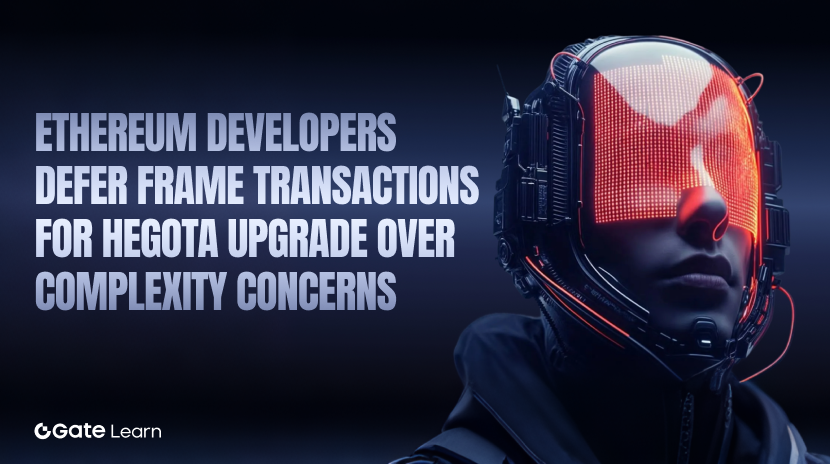
Ethereum developers have recently engaged in discussions regarding the Hegota upgrade, anticipated for release in 2026. Among the proposals, Frame Transactions attracted significant attention. However, after comprehensive deliberation, the development team concluded that the technical complexity of this proposal is currently too high, and has therefore not prioritized it for implementation. This debate underscores Ethereum’s ongoing challenge to strike a balance between improving user experience and maintaining development efficiency.
2026-04-03 14:46:11
At the EthCC conference in Cannes, France, Gnosis co-founder Friederike Ernst and Zisk founder Jordi Baylina unveiled a new initiative—the Ethereum Economic Zone (EEZ). Co-funded by the Ethereum Foundation, this project aims to create a new rollup architecture that allows various Layer 2 networks to synchronize and interact seamlessly with both the Ethereum mainnet and each other. By enabling cross-chain contract calls within a single trade, the EEZ seeks to resolve persistent challenges related to liquidity and fragmented user experiences across the Ethereum ecosystem.
2026-04-03 14:39:17
Lido DAO (LDO) is a liquid staking protocol that enables users to stake ETH while receiving a transferable staking derivative, stETH, allowing them to maintain liquidity. Through this mechanism, users can participate in the Ethereum network’s staking process and earn rewards without locking up their assets. The protocol is governed by a decentralized autonomous organization (DAO) and relies on smart contracts to manage staked assets, node operations, and reward distribution. This lowers the barrier to entry for staking and improves capital efficiency.
2026-04-03 13:40:54
As a liquid staking protocol built on Ethereum, Lido DAO (LDO) allows users to stake ETH and receive a transferable staking token called stETH. This enables users to participate in network validation and earn staking rewards while maintaining liquidity. The protocol is governed by a decentralized autonomous organization (DAO) and uses smart contracts to manage staked assets, node operations, and reward distribution. As a result, it lowers the barriers to traditional staking and improves capital efficiency.
2026-04-03 13:39:47