What Is an Ascending Channel Pattern?
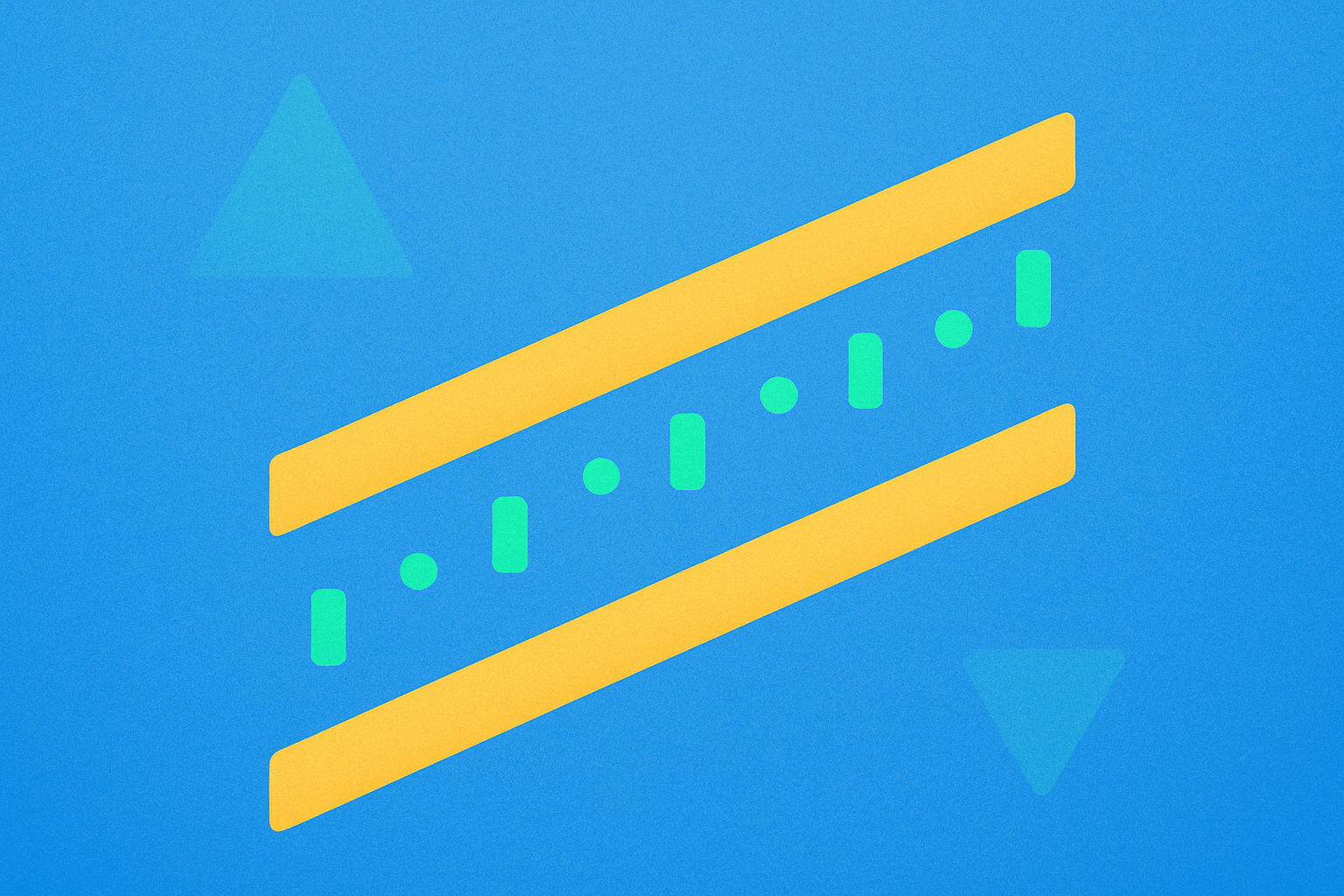
An ascending channel pattern is a bullish price formation where the price oscillates between two upward-sloping parallel lines. The lower boundary acts as support—like a floor holding up the price—while the upper boundary serves as resistance, limiting price rebounds like a ceiling.
On a chart, this pattern appears as a sequence of “higher highs and higher lows.” The pattern gains reliability when there are at least three touches on both the upper and lower boundaries, indicating that market participants are consistently repeating similar buying and selling behaviors.
How to Draw an Ascending Channel Pattern
To draw an ascending channel pattern, follow these steps:
Step 1: Select the timeframe. Align your chart’s timeframe with your trading plan—for example, use the 4-hour or daily chart for swing trading, and 15-minute or 1-hour chart for short-term trades.
Step 2: Identify higher lows. Mark at least two higher lows using candlestick wicks or closing prices, then connect them with a straight line to form the channel’s lower boundary. Candlesticks represent price movements over a specific period.
Step 3: Project the upper boundary. Duplicate the lower boundary as a parallel line and shift it upward to connect at least two higher highs. This becomes the channel’s upper resistance.
Step 4: Validate the channel. The channel is more reliable if the price touches both boundaries multiple times without significant breakouts and if the slope is moderate. If there’s only one touch on either boundary, the signal is insufficient.
Step 5: Set alerts. Use price alerts on both boundaries within your charting tool to avoid constant monitoring and execute your plan only when price touches the boundaries.
What Is the Logic Behind the Ascending Channel Pattern?
The ascending channel pattern reflects a balance between supply and demand. Buyers become more active near the lower boundary, which acts as a demand zone, while sellers cluster near the upper boundary, serving as a supply zone.
Participants repeatedly engage in “buying near the floor and selling near the ceiling,” creating orderly price swings. If trading volume increases near the lower boundary, it signals stronger buying interest; volume represents the number of trades within a period and helps gauge market participation.
Technical tools like moving averages can be used for further confirmation. If the channel’s direction aligns with a mid-term moving average, the pattern tends to be more stable. A moving average smooths out price action over time, acting as a trend indicator.
How to Trade the Ascending Channel Pattern
There are three common strategies for trading an ascending channel: swing trading within the channel, breakout trading on an upward move, or stop-loss/position reversal after a downward breakdown.
Step 1: Swing trading within the channel. Enter long positions in batches near the lower boundary, setting stop-losses just below it (typically 2%-3%). As price approaches the upper boundary, gradually reduce positions or move your stop-loss up to lock in profits.
Step 2: Following an upper boundary breakout. Wait for a confirmed breakout—meaning a close above the upper boundary with increased volume or a successful retest—before entering. Avoid chasing immediately after a minor breakout to prevent falling for a fakeout (where price briefly breaches the boundary but quickly returns inside).
Step 3: Stop-loss on breakdown below the lower boundary. If price closes below the support line with strong volume, execute your stop-loss as planned. In contract trading, consider reversing your position with smaller size and strict risk controls.
Risk management is essential. Limit risk per trade to 1%-2% of your account by adjusting position size based on stop-loss distance. Use volatility indicators like Average True Range (ATR) to set buffers—ATR measures average price fluctuation over recent periods.
Unique Features of Ascending Channels in Crypto Markets
In crypto markets, ascending channels often feature long wicks due to 24/7 trading and high volatility. Wicks indicate that price quickly touched certain levels before retreating, increasing the chance of false breakouts or breakdowns.
The funding rate in perpetual contracts affects holding costs. The funding rate is a mechanism where long and short positions pay or receive fees depending on market conditions—the longer you hold, the more impact it has on your cost basis.
News events also occur more frequently in crypto, causing sudden breaks in channel rhythm and premature pattern failures. Thus, always use alerts and stop-losses—patterns are not guarantees.
Common Misconceptions About Ascending Channel Patterns
Mistake 1: Forcing alignments. Subjectively drawing channels while ignoring actual touchpoints leads to unreliable patterns. Ensure at least two touches on both boundaries before considering the setup valid.
Mistake 2: Ignoring timeframe compatibility. Short-term channels are easily disrupted by noise. If your trading and holding timeframes don’t match, it can create execution confusion.
Mistake 3: Treating ascending channels as “guaranteed bullish signals.” No pattern is infallible—always predefine stop-losses and position sizing rules.
Mistake 4: Overusing leverage. Leverage amplifies both gains and losses; while channels provide structure, they are not foolproof, so adjust leverage according to volatility.
Comparison: Ascending Channel Pattern vs. Other Patterns
Ascending channels differ from ascending wedges. Wedges feature converging lines like tightening pincers, signaling weakening momentum; channels have parallel lines representing consistent push-and-pull action.
They also differ from flag patterns. Flags typically form after sharp rallies and are short-lived, slightly downward or flat corrections; ascending channels last longer as sustained trends.
Unlike a single trend line, an ascending channel defines both “floor” and “ceiling,” providing better planning for take-profit and position adjustments.
How to Apply Ascending Channel Patterns Practically on Gate
Turn your pattern analysis into actionable checklists to reduce subjectivity:
Step 1: Mark chart boundaries and set alerts. Draw both boundaries on Gate’s charting tools and set price alerts for each edge to avoid missing key levels.
Step 2: Place orders and manage positions. Near the lower boundary, use limit orders to enter small positions in several tranches (e.g., three levels). Don’t chase if unfilled—be patient.
Step 3: Set stop-losses and take-profits. Place stop-losses 2%-3% below the lower boundary (adjust for volatility) and take-profits incrementally at the upper boundary. Gate’s “take profit & stop loss” feature allows for preset automation.
Step 4: Manage contracts and leverage. When using Gate contracts, select low leverage and monitor funding rates to avoid high holding costs over time.
Step 5: Use grid trading for stable channels. When conditions are steady, deploy grid trading on Gate using the channel boundaries as limits—set appropriate grid spacing and capital allocation. Pause or tighten grids during strong trends or potential reversals.
These examples are for educational purposes only—not investment advice. Always assess your personal risk tolerance before trading.
What to Do If an Ascending Channel Pattern Fails
Step 1: Confirm breakdown. Check if price closes decisively below the lower boundary with increased volume or weak rebound attempts—these signal pattern invalidation.
Step 2: Execute stop-losses promptly. Do not wait for a recovery—stick to your pre-set exit plan to protect capital.
Step 3: Wait for retest opportunities. If price retests the broken support (now resistance) and fails again, you may trade based on “breakdown–retest–continuation,” but use smaller size for caution.
Step 4: Record your trades for review. Log your entries, exits, and reasoning to improve future charting, timeframe selection, and risk management settings.
If price quickly reclaims and holds above the former support line, treat prior moves as a false breakdown—but reduce size and wait for further candlestick confirmation.
Key Takeaways on Ascending Channel Patterns
Ascending channel patterns offer a structured framework for trend-following strategies: look for low-risk entries near support (“the floor”), tighten positions near resistance (“the ceiling”), and adapt when breakouts or breakdowns occur. No pattern is foolproof—position sizing, stop-losses, and disciplined execution are more important than any single chart setup. Use Gate’s alerting tools, automated take-profit/stop-loss features, and grid strategies to plan ahead and trade based on rules instead of emotions.
FAQ
How far does price typically drop after an ascending channel breakdown?
The post-breakdown decline often matches the width of the channel itself. For example, if a channel ranges from $1,000 to $1,200 (a $200 width), a breakdown could see prices fall toward $1,000. However, actual declines depend on market sentiment and broader trends—always consider support levels and stop-loss triggers rather than blindly shorting.
How can beginners tell if they’re looking at a true ascending channel?
A legitimate ascending channel requires at least three touchpoints (e.g., two highs plus one low or two lows plus one high) with a clear upward direction. Beginners often mistake sideways ranges for channels; it’s best to confirm with longer timeframes (daily charts), as short-term channels are more prone to false breakouts.
Should you always exit when price hits the top line within an ascending channel?
Not necessarily. Instead, plan your exit near the top line but observe how price reacts—if momentum fades and volume drops after touching resistance, consider reducing positions. If price breaks out above resistance on strong volume, it could signal trend acceleration—so stay flexible rather than mechanical.
How do you find optimal entry points within an ascending channel?
The best entry is just above support with a buffer (1-2% below the lower boundary). This confirms that support is intact while maximizing risk-reward potential. Also monitor whether bounces from support are backed by sufficient volume—low-volume rebounds may lack conviction.
How long should an ascending channel persist to be considered reliable?
A valid channel should run for at least 4-8 weeks to be meaningful—the longer it persists, the more participants are involved and the more stable it becomes. Channels lasting just 1-2 weeks that quickly break down indicate weak participation and carry higher risk—not recommended for large positions.