Last week, the U.S. Senate passed the controversial “Genius Stablecoin Act.” Once it passes the House of Representatives and receives the President’s signature, this will be the first law in U.S. history specifically tailored for “on-chain dollars.” To put it metaphorically: in the past, the dollar’s hegemony was like a game, starting from the initial “gold-backed dollar” to the main mission of the “petrodollar,” which has been going on for almost eighty years. Now, this bill is like a new “DLC” (downloadable content) in the game, opening up a whole new map for the dollar—Blockchain.
With this legislation, any “digital twin brother” of the US dollar (stablecoins like USDT, USDC) will be formally “certified” under US law, no matter which public chain they are on, and the rules of the global financial game have been reshuffled once again.
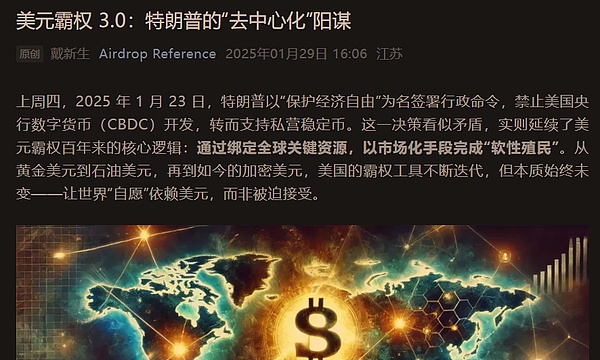
“Dollar Hegemony 3.0: Trump’s ‘Decentralized’ Conspiracy” was first published on January 29, 2025, telling the entire evolution story of dollar hegemony—from the gold-stacked Fort Knox to the oil-flowing Persian Gulf, and now to the virtual Blockchain world, how the United States has gradually induced the world to actively accept the dollar as a ‘necessity’.
By understanding these, you will not only be able to grasp the future trends of regulatory policies, capital flows, and international politics in advance, but you will also deeply understand: why mastering liquidity on the Blockchain is equivalent to mastering the financial discourse power of the next era.
This article will make you realize that this “Genius moment” is happening right in front of us.
Dollar Hegemony 3.0: Trump’s “Decentralized” Conspiracy (Original Title)
Last Thursday, January 23, 2025, Trump signed an executive order banning the development of a U.S. central bank digital currency (CBDC) in favor of private stablecoins in the name of “protecting economic freedom.” This decision seems contradictory, but in fact it continues the core logic of the US dollar hegemony for a century: ** by binding the world’s key resources and completing “soft colonization” by market-oriented means**. From the golddollar to the petrodollar and now the crypto-dollar, the hegemonic tools of the United States have been iterating, but the essence has remained the same - making the world “voluntarily” dependent on the dollar, rather than being forced to accept it.

I. The Three Anchoring Revolutions of Dollar Hegemony
1. Gold Dollar (1944-1971): The End of Physical Scarcity
The Second World War had just ended, and countries around the world urgently needed to rebuild their economies. At this time, the United States stepped onto the historical stage with a mountain of gold reserves. At the Bretton Woods Conference in 1944, an agreement firmly tied the dollar to gold: 1 ounce of gold was fixed at 35 dollars. Thus, the dollar was seen by many countries as the most reliable reserve and settlement currency.
At one point, the United States accounted for 75% of the world’s gold reserves. But it didn’t last long: more dollars were needed around the world for trade and investment, forcing the United States to keep exporting dollars while not being able to maintain enough gold reserves all the time. By 1971, there were more than 500 billion dollars in circulation in the world, but the United States had less than 8,000 tons of gold reserves left, and large amounts of dollars could not be exchanged for gold. In the face of such pressure, then US President Richard Nixon simply announced the “decoupling” of the dollar from gold, and the Bretton Woods system collapsed.
This scene also confirms the famous “Triffin Dilemma”. When the U.S. dollar has to meet the needs of the U.S. economy at home and shoulder the weight of the world’s reserve currency, it inevitably finds itself in a dilemma: it needs to provide the world with sufficient dollar liquidity, but it is difficult to maintain currency stability due to its limited gold reserves. Although the era of the “golden dollar” has come to an end, to this day, this experience has still saved a valuable foundation of global financial trust for the United States, and also laid the groundwork for the continuation of the dollar’s hegemony in the future.
2. Petrodollar (1974 to present): A cycle tied to the lifeblood of industry
After the “breakup” of gold and the US dollar, the United States urgently needed to find a new “anchor” for the dollar, and this anchor is oil. In 1974, the United States and Saudi Arabia reached an arrangement known as the “US-Saudi Agreement”: global oil trade is largely priced and settled in US dollars, and oil-producing countries like Saudi Arabia then recycle these dollars back to the United States to purchase US Treasury bonds and invest in the US financial markets. Thus, a closed loop named “Oil → Dollar → US Treasury Bonds” was officially formed and continues to this day.
As of 2023, about 80% of the world’s oil trade is still denominated in US dollars, and the millions of barrels of crude oil pouring into the oil market every day from Saudi Arabia and other countries are also injecting large sums of money into the US dollar in disguise. Since then, the United States no longer needs to use real gold to endorse the dollar, but relies on oil, the “blood” of the industrial age, to maintain its status as the world’s currency.
However, when the US dollar became the “trump card” for almost all cross-border transactions, it also gave rise to the “weaponization of sanctions”—as long as a country is cut off from the US dollar settlement channels or kicked out of the SWIFT system, its economic lifeline seems to be “pulled out from under it.” You may still remember:
- In 2000, Iraq announced that it would settle its oil exports in euros, shortly after which it was subjected to a large-scale military operation by the US-UK alliance.
- In 2022, due to the Ukraine crisis, several major banks in Russia were deprived of their SWIFT access, greatly affecting international capital flows.
Many people assert that the long arm jurisdiction of the “petrodollar” is still in effect, and once the core interests of the United States in the energy and financial systems are touched, there will be enormous pressure from sanctions. Of course, behind the Iraq War and the Russia-Ukraine conflict, there are broader geopolitical factors that cannot be simply attributed to “challenging the dollar.” However, it is undeniable that the dominant position of the dollar in oil trade and international finance gives the United States financial means that surpass most countries. For this reason, it is also described as a “soft weapon” in contemporary international relations, exerting significant power on a battlefield without gunpowder.
3. Crypto Dollar (from the 2020s): The Invisible Hegemony of the Code World
Imagine a scenario like this: in a crowded digital exchange, coin prices are fluctuating wildly on the screen, yet the most eye-catching are still the stablecoins starting with “US” that are pegged to the value of the US dollar. Nowadays, people can easily convert euros, rubles, or even Turkish lira into “on-chain US dollars” without going through traditional banks.
Looking at the entire blockchain ecosystem, USD stablecoins such as USDT and USDC are like “digital greenbacks,” accounting for about 90% of trading pairs. Even more exaggerated is the prediction by experts that by 2025, the average daily settlement volume of USDT could approach $53 billion, even surpassing the $42 billion transaction volume created by traditional payment giant VISA. In other words, the US dollar not only dominates in the physical world but is also riding the fast lane of stablecoins to achieve “borderless dollarization” in the virtual realm.
Unexpectedly, behind this crypto wave, you can also see the Trump administration’s “conspiracy”. He vetoed the Federal Reserve’s plan to issue a CBDC (central bank digital currency), but turned a blind eye to the stablecoin network launched by the private sector. In this way, he was able to declare “decentralization” and “technology neutrality” and avoid too much political controversy, while secretly strengthening the global penetration of the dollar. Rather than allowing government digital currencies to cause concern or a backlash, it is better to let the market drive the digitization of the dollar on its own, so that users around the world are willing to invest in this new dollar ecosystem.
The most ironic thing is that regions or individuals that have been sanctioned by the United States are sometimes using these stablecoins to circumvent financial blockades. Some businessmen in Russia exchanged their rubles for USDT through over-the-counter transactions, and used the blockchain to complete cross-border payments or asset transfers. Traditional banking channels may be “cut off” by SWIFT, but transfers on the blockchain are still unimpeded. In this way, under the banner of “decentralization”, the hegemony of the dollar has not only not been weakened, but has quietly expanded in the world of code.
II. Three Principles of the Dominance of Crypto-Dollar
1. Network Effects: Usage Equals Dependence
Imagine you open a decentralized finance (DeFi) platform, ready to collateralize your tokens to earn returns. Most protocols prefer to accept USD stablecoins like USDC and USDT—just as people are more willing to carry US dollars when traveling internationally. Once you choose this path, it means you have “locked yourself into” the dollar ecosystem: whether it’s lending, payments, or wealth management, USD stablecoins have become the most convenient and widely accepted “medium of exchange.”
Even better, USD transactions on the blockchain tend not to be directly interfered with by traditional monetary policy. Even if the Federal Reserve raises interest rates, on-chain funds can still flow freely and move quickly. This snowballing network effect has made the US dollar a “standard” in the crypto world - the US does not need to negotiate with other countries first, as long as companies like Circle (the issuer of USDC) are allowed to deploy smart contracts on various public chains, and the US dollar can naturally become the “unified language” of the code world. Some scholars call this “protocol imperialism”: when everyone is accustomed to using US dollar stablecoins as collateral, payment or liquidation, decentralized blockchains have silently expanded the US dollar’s sphere of influence.
2. Decoupling and Refactoring: Weakening Traditional Control
Surprisingly, the emergence of stablecoins seems to have somehow “bypassed” the most powerful financial weapon in the United States, the SWIFT system. In the past, the U.S. could freeze a country’s global trading channels by stripping it of its access to SWIFT; On the blockchain, peer-to-peer transfers can complete cross-border payments without going through SWIFT. It has been estimated that by 2024, about 67% of cross-border on-chain payments will use USD stablecoins, weakening the centralized control of money flows in the United States.
But the story isn’t that simple. No matter how “decentralized”, these stablecoins are still anchored to the credit of the dollar: as long as the Fed is willing to raise or lower interest rates, the cost of global capital will still be dragged away. What’s more, the private sector that issues stablecoins isn’t really independent of the U.S. legal system — in 2023, Tether froze $870 million in North Korea-related funds at the request of U.S. officials. This action is enough to prove that the so-called blockchain freedom cannot get rid of the actual control of the “dollar credit” in the United States. Once the U.S. wants to “show its sword”, stablecoins may still be a means for them to attack their opponents.
3. Risk Transfer: Firewall of the Private Sector
Another noteworthy phenomenon is that institutions like Tether (the issuer of USDT) often register in offshore areas. For the United States, this effectively establishes a “firewall” between regulation and accountability: on one hand, the U.S. can share in the benefits of the global expansion of stablecoins; on the other hand, in the event of a compliance or credit crisis, U.S. authorities can quickly disassociate themselves, claiming that this is a violation by a private institution and has no direct connection to the government.
At the same time, many individuals or businesses that are unable to obtain US dollars in compliance have to use stablecoin channels for cross-border payments or financing. These people often have to pay a cost of funding that is much higher than the domestic interest rate, such as a borrowing rate ranging from 4% to 11%, which is much higher than the bank’s average 1.5% term rate. Figuratively speaking, this is imposing an invisible “channel tax” on “people who can’t get through the front door”. From the perspective of the United States, this will not only allow the dollar to maintain its penetration of global trade and investment, but also shift the blame to the private sector at a critical time, which can be described as “killing two birds with one stone”.
Three Paths to Escape the Crypto Dollar Trap
1. Issuing Sovereign Stablecoins: Competing for On-Chain Pricing Power
To secure a “place” for its national currency in the blockchain world, the primary step is to launch its own sovereign stablecoin. Singapore’s XSGD and Indonesia’s IDRT have already saved considerable costs for cross-border payments, while China’s digital RMB has directly engaged in oil payment cooperation with Middle Eastern countries through projects like “mBridge,” gradually reducing its reliance on the US dollar.
The key to this initiative lies in maintaining sufficiently transparent reserves and strict regulation; otherwise, it may repeat the mistakes of certain countries with stablecoins that faced “insufficient reserves and capital flight.” Only when a country’s or region’s sovereign stablecoin can be widely used in cross-border trade, retail payments, and even DeFi protocols can it create a real pricing influence in the blockchain ecosystem.
2. Build a Regional Digital Currency Alliance: Breaking Down Network Effects
Going solo often makes it difficult to withstand the strong penetration of the US dollar on the Blockchain, so countries or regions need to work together to create regional digital currency alliances. Southeast Asia is trying to promote “payment interconnection,” allowing member countries to settle directly using local stablecoins, with the goal of replacing a certain percentage of SWIFT channels within a few years; Latin America is also testing the “digital currency corridor,” having achieved billions of dollars in cross-border transactions.
These joint actions can create a network effect within the region that can rival the dollar stablecoin, allowing local or regional currencies to gradually become the preferred choice for trade. However, for long-term survival, all parties need to unify technical standards, improve regulatory frameworks, and guard against the “reverse penetration” of the dollar stablecoin.
3. Restructuring the International Monetary Order: From Gold to Multipolar Anchors
As the petrodollar faces more and more challenges, the international community is also looking for new anchors. Increasing their holdings of gold is one strategy, with many countries already pushing their gold reserves to record highs; It has also been suggested that a new type of monetary system backed by high-tech or key resources such as chips and rare earths may emerge in the future. However, whether the new anchoring model can truly break the dominance of the dollar also depends on the evolution of the international financial landscape.
Although the share of the US dollar in global reserve currencies is continuously declining, achieving complete diversification still requires all parties to establish mature settlement networks, mutual trust mechanisms, and pricing benchmarks. If not handled properly, the United States may once again introduce new variants like the “Tech Dollar” to continue dominating the rules of the game in the next round of financial competition through innovative means. The so-called “Tech Dollar” may include using technologies such as AI, big data, and smart contracts to enhance the payment and settlement capabilities of the dollar, and even promote a “decentralized but regulated” on-chain ecosystem for the dollar.
Conclusion: Hegemony is not dead, it has just transformed
From gold at Fort Knox, to oil tankers in the Persian Gulf, to smart contracts on the blockchain, the United States has been adept at “binding the key resources of the times” and pushing the dollar around the world in a seemingly “market-oriented” way. The XAUDOUD is backed by scarce metals, the petrodollar captures the lifeblood of the industrial age, and today’s crypto dollar is seeing the “blockchain ecosystem” as the next core resource: it uses decentralized technology and the efficiency of cross-border transactions to infiltrate the dollar into almost every nook and cranny of the chain.
One might wonder why the crypto world is still dominated by the US dollar, given that the crypto world claims to be “decentralized”. The logic behind this is that the U.S. dollar’s network effects and trust foundation are still irreplaceable, making it the “default monetary language” on the chain. Once the global user accepts the dollar stablecoin, it is equivalent to being included in the “extended version” of the US financial system, which is the so-called “soft colonization”: no need for force, no direct pressure, as long as it provides irresistible services and liquidity, the world can be unknowingly “captured” by the dollar system.
For other countries, this is both a crisis and an opportunity. Sovereign stablecoins, regional digital alliances, technological and institutional firewalls, and the exploration of new resource anchors are all likely to win them greater monetary autonomy. After all, “marketization” is not the same as fairness, and the core is who can control key resources and dominate the formulation of rules. In this quiet currency war, if you want to avoid passive involvement, you must be well versed in the rules of the game and do a good job of multi-party layout. As Bank Indonesia’s Governor put it: “The current battle for monetary sovereignty has shifted from gold to code – whoever has on-chain liquidity will have a head start in the global financial order.” ”


