
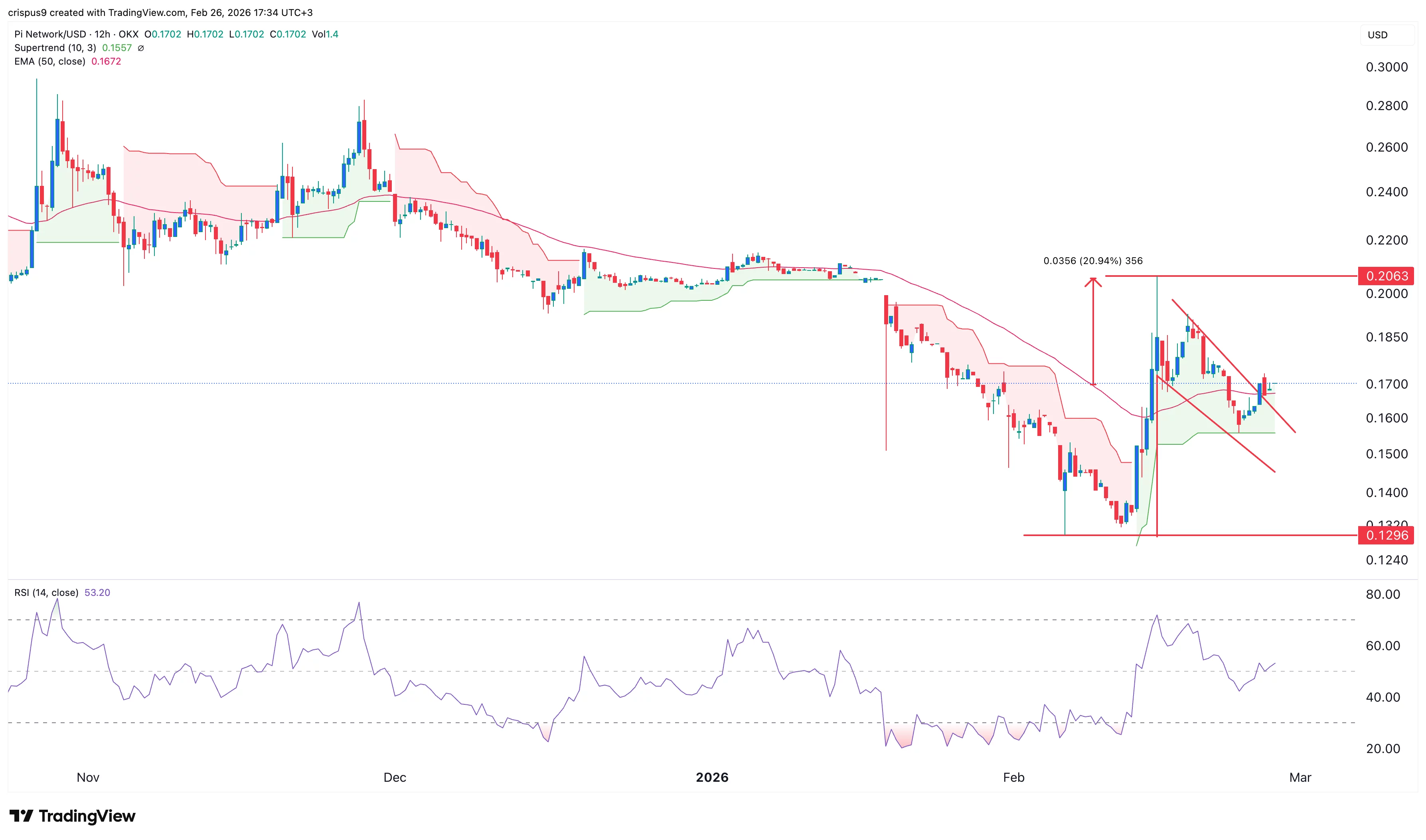
Pi Network (PI) tokens rebounded to $0.1700, with a total increase of over 31% this month. The 12-hour chart shows that PI has formed a bullish flag pattern, with the token price moving above the Super Trend indicator. Meanwhile, the protocol upgrade countdown, whale accumulation, and potential new listings on centralized exchanges (CEX) form a multi-faceted catalytic setup for PI.
Bullish Flag Pattern: A Key Technical Signal
 (Source: TradingView)
The bullish flag pattern in Pi Network consists of two parts: the steep “flagpole” from the initial surge, and the subsequent downward-sloping channel “flag.” When the price effectively breaks above the upper boundary of the channel, the bullish pattern is confirmed, with the technical target typically extending upward by the height of the flagpole.
The 12-hour chart indicates that PI has broken through the upper boundary of the channel, supported by the following technical factors:
Price above the Super Trend indicator: Bulls currently hold short-term dominance
Price slightly above the 50-week moving average: Mid-term momentum is turning positive
RSI trending upward: Buying momentum is accumulating
Based on pattern measurements, recent technical analysis suggests a target of approximately $0.2065, representing about 20% potential upside from current levels.
In-Depth Analysis of Three Major Catalysts
Catalyst 1: Stellar Consensus Protocol Upgrade Countdown
Pi Network’s development team announced on Thursday that the deadline for the next major protocol upgrade is March 1, aiming to migrate to the latest version of the Stellar Consensus Protocol (SCP). The version 19.9 upgrade is progressing through four main phases, with the final phase expected to be completed by April this year. Once fully implemented, the network will benefit from faster transaction speeds and enhanced functionalities.
Rebounds before protocol upgrades are common in crypto markets, as market participants often price in anticipated improvements ahead of time. The current rebound coincides with the countdown to the upgrade.
Catalyst 2: Whale Accumulation Continues
On-chain data shows that the number of whale addresses holding PI has increased to 20. The largest whale holds over 383 million PI tokens and has purchased more than 17 million this month, indicating that large holders have a clear bullish outlook for the medium term. Such contrarian accumulation during generally bearish market sentiment is often viewed as a bottoming signal.
Catalyst 3: Potential Impact of CEX Listings
If a new round of CEX listings is successful, it would not only expand PI’s legitimate circulation channels in the US market but could also trigger a chain reaction, prompting other major exchanges to list the token. Historically, announcements of listings on major exchanges tend to produce significant short-term price boosts.
Additionally, the team is advancing the development of KYC as a Service (KYCaaS), leveraging the existing verified user base of over 16 million to provide identity verification services. This move aims to create a new long-term business model competing with Humanity Protocol and Worldcoin, adding a new dimension to the network’s value proposition.
Frequently Asked Questions
Is the bullish flag breakout for Pi Network reliable?
Bullish flags are among the more credible patterns in technical analysis; a breakout above the channel’s upper boundary is generally considered a confirmation signal. However, subsequent price action should be confirmed by increased volume—if the breakout occurs on low volume, the pattern may fail and lead to a retest. Currently, PI’s technical structure has some credibility, but investors should also consider the overall market environment.
How does the KYCaaS plan add value to PI tokens?
If successfully implemented, Pi Network’s decentralized identity infrastructure could be opened to third-party platforms, creating practical utility beyond mere token trading. This transition could help shift PI’s valuation from purely network effects to include service revenue. However, this development is still in planning stages and not yet commercialized.
Disclaimer: The information on this page may come from third parties and does not represent the views or opinions of Gate. The content displayed on this page is for reference only and does not constitute any financial, investment, or legal advice. Gate does not guarantee the accuracy or completeness of the information and shall not be liable for any losses arising from the use of this information. Virtual asset investments carry high risks and are subject to significant price volatility. You may lose all of your invested principal. Please fully understand the relevant risks and make prudent decisions based on your own financial situation and risk tolerance. For details, please refer to
Disclaimer.
Related Articles
Pi Network 18 million users complete KYC, and 26.5 million PI are issued to verifiers
Pi Network distributes 26.5 million PI tokens to more than 1 million community members who have completed KYC verification, to accelerate user identity verification and strengthen the decentralized model. 18 million already-verified users have laid the groundwork for the ecosystem’s development, but the key lies in how to convert these users into active participants. With the protocol upgrade, Pi Network is moving toward the open network phase, and smart contract support signals richer application scenarios.
MarketWhisper15h ago
Pi Network price hits a new 7-week low as a wave of 60 million token unlocks comes in
Pi Network's native token PI fell to $0.165 in April, hitting a 7-week low and leaving market sentiment weak. The unlock peak will release more than 60 million PI, adding downward pressure. Despite the core team recently publishing technical updates, it failed to improve market confidence and instead drew community criticism due to KYC access issues and the ongoing slide in price. Increased future supply could further drive prices lower.
MarketWhisper17h ago
Pi Network Distributes 26.5M PI to 1M KYC Validators
Pi Network has taken another step forward in building its ecosystem. The project recently distributed 26.5 million PI tokens to more than 1 million KYC validators.
These rewards were given to users who helped verify identities on the network. This process is important. Because it ensures that
Coinfomania04-13 13:30
Pi Network PIRC baseline protection mechanism sparks controversy, implying a “quasi-stablecoin” logic
Pi Network member Daniel F raised a logical contradiction in the PIRC token design, noting that if it has a 23.8% floor protection, it would need to behave like a stablecoin, which conflicts with its high volatility on CEX. This floor is based on Pi’s price calculations; if Pi itself fluctuates significantly, it will be unable to effectively protect holders. Daniel emphasized the importance of transparency, but the project team did not respond to it, leading the community to continue speculating about the reasons for its silence.
MarketWhisper04-13 02:23
Pi Network Major Transformation: 210 Ecosystem Applications Deployed, 23k Developers Ready
The Pi Network ecosystem is accelerating its transition, with more than 210 active applications and 23,000 developers actively participating in Pi Studio, spanning multiple areas such as payments, community engagement, education, and gaming. The ecosystem’s diversity shows indicators of healthy development, and developers’ engagement is driving ongoing application optimization. In the future, improving the usefulness of the mainnet will be a key challenge, including issues that need to be urgently addressed such as scalability, security, and user adoption rates.
MarketWhisper04-13 02:06


