
The U.S. Securities and Exchange Commission (SEC) has officially dismissed the civil enforcement lawsuit against BitClout founder Nader Al-Naji and other defendants. According to joint documents filed with the Southern District of New York on March 12, the SEC stated that after “re-evaluating the evidentiary record,” it exercised its discretion to dismiss all claims.
Case Summary: The End of the $257 Million Unregistered Securities Allegation
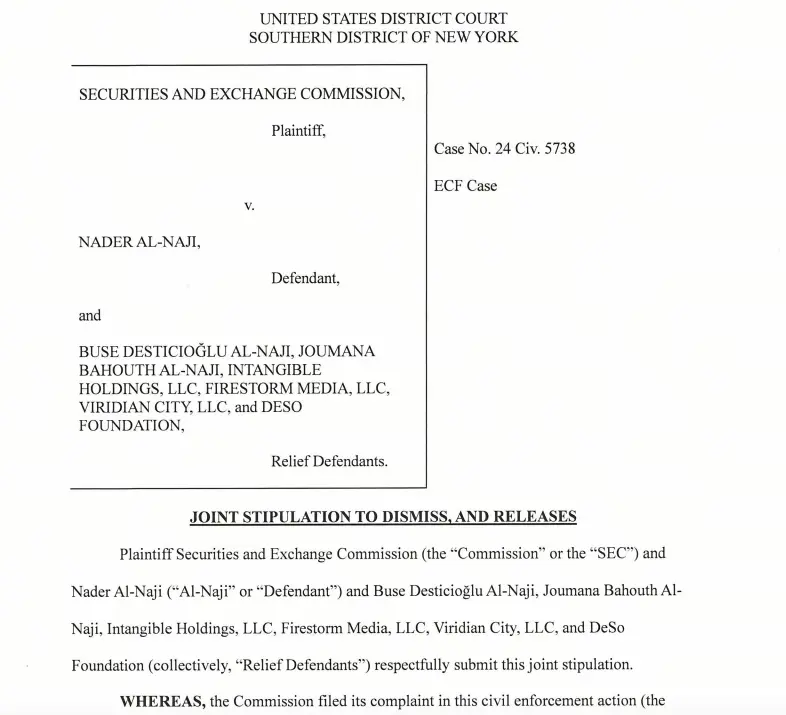 (Source: SEC)
The SEC’s civil lawsuit was initially filed in July 2024, alleging that Al-Naji raised over $257 million through the sale of BitClout tokens without proper securities registration under federal law, violating U.S. securities issuance regulations.
The full timeline of the proceedings is as follows:
July 2024: SEC files civil enforcement lawsuit in the Southern District of New York
March 2025: U.S. Department of Justice drops telecom fraud charges against Al-Naji (withdrawn “without prejudice,” allowing for re-filing), while the SEC lawsuit remains ongoing
March 12, 2026: SEC and defendants’ representatives sign joint documents, officially submitting to the court to dismiss all claims, ending all known legal allegations
The wording in SEC’s dismissal documents is noteworthy; the official statement is that “the Commission, exercising its discretion, has determined that dismissal is appropriate,” rather than stating the case was unfounded—this phrasing leaves room for potential future charges if necessary, though under the current regulatory direction of the Trump administration, such possibilities are less likely.
BitClout: A Tokenized Community Platform Backed by a16z
Nader Al-Naji was a software engineer at Google before entering the crypto industry. He founded BitClout, a decentralized social media platform whose core mechanism tokenizes user profiles on Twitter (now X)—each account has a corresponding “creator token” that others can buy and sell, with prices fluctuating based on holder count.
Participation requires users to exchange Bitcoin for the platform’s native tokens before engaging or claiming their profiles. This design drew widespread attention during its initial launch and attracted funding from top-tier investment firms:
· Andreessen Horowitz (a16z)
· Coinbase Ventures
· Tyler and Cameron Winklevoss, founders of Gemini
However, as questions about the token economy’s sustainability arose and legal challenges emerged, BitClout eventually ceased operations, and the platform is now closed.
Crypto Regulation Shift During Trump Era: Growing List of Withdrawals
The dismissal of the BitClout case is the latest example since Donald Trump returned to the White House last year of the SEC broadly withdrawing enforcement actions related to cryptocurrencies. Under the new SEC leadership, the agency’s official stance is that it generally believes it should not intervene in most crypto activities. Several high-profile cases, including Ripple and Coinbase, have been dismissed.
Notably, not all cases end with complete withdrawal. Earlier this month, the SEC settled with Tron founder Justin Sun, requiring Rainberry Inc., the company behind the BitTorrent protocol, to pay a $10 million civil fine—an uncommon case under the new crypto regulatory norm of the Trump administration.
Frequently Asked Questions
How does the Department of Justice’s withdrawal differ from the SEC’s?
The DOJ’s withdrawal (March 2025) involved criminal telecom fraud charges and was done “without prejudice,” meaning the case could be refiled. The SEC’s dismissal pertains to civil enforcement claims centered on unregistered securities sales. The two are legally different—criminal cases involve personal liberty, while civil cases mainly seek monetary damages and injunctions. Both cases have now been withdrawn, marking a relatively complete legal resolution for Al-Naji.
Does the BitClout token constitute an unregistered security?
This is the core legal issue of the case. The SEC argues that BitClout tokens meet the “Howey Test” criteria for investment contracts (i.e., securities)—investors contribute funds expecting profits from others’ efforts. The tokenization mechanism and secondary market trading give it strong securities characteristics. However, since the SEC withdrew the case under the Trump administration, this legal classification has not been definitively settled by court ruling.
What does the case’s withdrawal mean for other similar crypto projects?
In the current regulatory environment, the case’s withdrawal reinforces market expectations that the Trump-era SEC is less aggressive in pursuing unregistered token sales. In the short term, this may reduce compliance pressures on crypto projects. However, regulatory stances could change with future administrations, and the “without prejudice” withdrawal leaves open the possibility for re-litigation. Long-term, maintaining compliance remains the more prudent strategy for crypto projects to mitigate legal risks.
Disclaimer: The information on this page may come from third parties and does not represent the views or opinions of Gate. The content displayed on this page is for reference only and does not constitute any financial, investment, or legal advice. Gate does not guarantee the accuracy or completeness of the information and shall not be liable for any losses arising from the use of this information. Virtual asset investments carry high risks and are subject to significant price volatility. You may lose all of your invested principal. Please fully understand the relevant risks and make prudent decisions based on your own financial situation and risk tolerance. For details, please refer to
Disclaimer.
Related Articles
Trump Softens Prediction Market Criticism, Cites Support from 'Smart People'
President Donald Trump reversed his recent criticism of prediction markets on Saturday, telling reporters that "very smart" people he knows support the industry, despite his Thursday comments characterizing the sector as contributing to turning "the whole world" into "somewhat of a casino." The
CryptoFrontier4h ago
French Prosecutors Charge 88 in Crypto Wrench Attack Ring
French authorities have charged 88 individuals, including 10 minors, in connection with kidnappings and extortions targeting cryptocurrency owners, according to a statement from the National Public Prosecutor's Office for Organized Crime (PNACO) released Friday. The charges are tied to 12 ongoing
CryptoFrontier9h ago
22-Year-Old Sentenced to 70 Months for $263M Crypto Theft Money Laundering
Evan Tangeman, a 22-year-old California resident, was sentenced on Friday to 70 months in federal prison for his role laundering proceeds from a multi-state cryptocurrency theft ring that stole around $263 million in digital assets from victims, according to a statement from the U.S. Department of
CryptoFrontier14h ago
Republican Sen. Tillis: The criminal investigation into Powell is over; it will no longer block Wash from serving as chair.
Republican Sen. Tom Tillis posted on the X platform on Sunday, announcing that after the U.S. Department of Justice (DOJ) concluded its criminal investigation into Federal Reserve Chair Jerome Powell’s involvement in the Federal Reserve headquarters renovation project, he will no longer block the procedure for confirming Kevin Warsh’s nomination as Federal Reserve chair, and said he is “looking forward” to supporting Warsh’s appointment.
MarketWhisper15h ago
Chainalysis: The EU's 20th round of sanctions covers RUBx, the digital ruble, and Meer exchanges
According to an analysis published by blockchain intelligence firm Chainalysis on April 24, the EU has recently released its 20th round of sanctions against Russia. For the first time, it treats the entire Russian cryptocurrency industry as a whole for sanctions purposes, rather than targeting only individual entities. The scope of this round of sanctions includes the Kyrgyz exchange Meer, the ruble-backed stablecoin RUBx, and Russia’s central bank digital currency (CBDC), “Digital Ruble.”
MarketWhisper16h ago
Research reveals: Polymarket players take home 30% of profits by winning 3% of the positions—more than 70% of players absorb all losses
A new study analyzes Polymarket’s trading records from 2023–2025 and shows that only 3.14% of experienced winners control more than 30% of the profits. Crowd participation alone is not enough to explain overall accuracy; at the same time, it tracks 1,950 highly suspicious insider trading accounts that, while not driving predictions, amplified price volatility. The case shows that large bets were placed and profits were made before the U.S. announced developments regarding Venezuela. The research questions “wisdom of crowds” and emphasizes the need for increasingly strict regulation.
ChainNewsAbmedia18h ago


