


Futures
Access hundreds of perpetual contracts
TradFi
Gold
One platform for global traditional assets
Options
Hot
Trade European-style vanilla options
Unified Account
Maximize your capital efficiency
Demo Trading
Introduction to Futures Trading
Learn the basics of futures trading
Futures Events
Join events to earn rewards
Demo Trading
Use virtual funds to practice risk-free trading
Launch
CandyDrop
Collect candies to earn airdrops
Launchpool
Quick staking, earn potential new tokens
HODLer Airdrop
Hold GT and get massive airdrops for free
Launchpad
Be early to the next big token project
Alpha Points
Trade on-chain assets and earn airdrops
Futures Points
Earn futures points and claim airdrop rewards


More




USDC Centralized Risk Reignites Attention: ZachXBT Reveals Circle Wallet Freeze Incident
On-Chain Investigator and Independent Researcher ZachXBT recently spotlighted the boundaries of authority exercised by stablecoin issuers. He publicly accused USDC issuer Circle of mistakenly freezing 16 wallets associated with crypto exchanges, online casinos, and foreign exchange businesses, describing it as “perhaps the most unprofessional freezing operation in over five years of investigation.” The incident quickly sparked widespread discussion in the crypto community, raising questions not only about the legitimacy of the specific freeze but also about the fundamental operational logic of centralized stablecoins under regulatory pressure.
The Mystery of 16 Operational Wallets Being Frozen
According to ZachXBT’s public statement, Circle froze 16 USDC wallets due to an ongoing U.S. civil legal case. These wallets are not personal accounts or suspected illicit channels but belong to active crypto exchanges, online casinos, and forex platforms. ZachXBT emphasized that these wallets “appear completely unrelated,” and “any investigator with basic analysis tools could identify these as operational business wallets within minutes from thousands of transactions they handle.”
ZachXBT further noted that the case is currently under “seal,” meaning the public cannot access specific legal grounds. He argued that Circle’s decision to freeze assets without clear justification is a result of “outsourcing the freeze decision to any random federal judge rather than establishing internal due diligence processes.”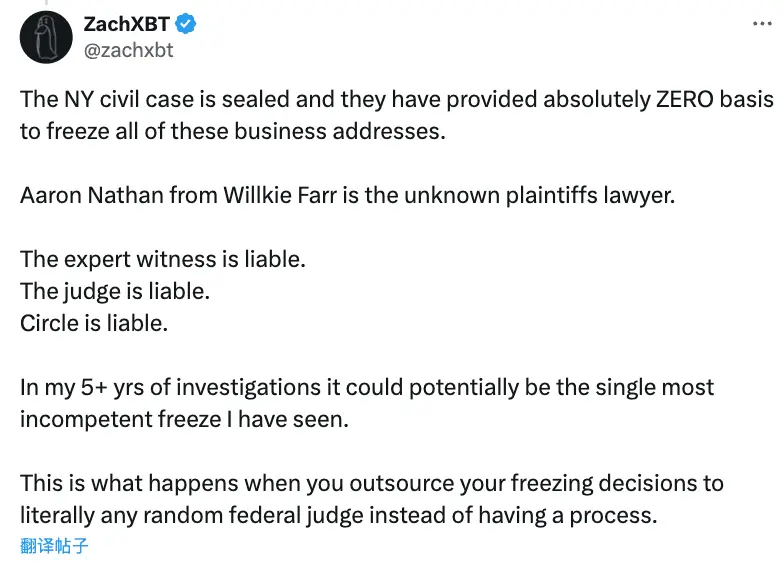
From Sealed Case to On-Chain Exposure
The ability of stablecoin issuers to freeze on-chain assets has long been a core tension between centralized stablecoins and the decentralized crypto ethos. As one of the most compliant USD stablecoins, USDC’s issuer Circle has maintained close cooperation with U.S. regulators and has cooperated in multiple enforcement actions, freezing addresses designated by law enforcement.
The timeline of this incident remains incomplete due to the sealed case, with limited public information. Based on available data:
On-Chain Data Debate: Operational Wallets and Possible Misjudgments
From an on-chain data perspective, ZachXBT’s core accusation is that the frozen wallets exhibit clear “business operation” transaction patterns.
ZachXBT’s conclusions are based on the verifiability of such on-chain data. He argues that if Circle or its analysis team had basic on-chain investigation capabilities, they should have quickly identified these wallets as operational, rather than freezing them en masse.
Market Perspectives: From Power Criticism to Systemic Concerns
The community’s discussion has formed multiple clear viewpoints:
Figures like Mert Mumtaz, founder of Helius, emphasize: “This is your tenth reminder — centralized stablecoins do not truly belong to you; they can be frozen, unlike cash.” This perspective reaffirms the fundamental property of centralized stablecoins, warning users to be aware of counterparty risks when holding assets like USDC.
ZachXBT himself criticizes the disconnect between legal procedures and compliance execution. He believes Circle outsourcing freeze decisions “to court orders” rather than establishing internal assessments based on on-chain data and business context, leading to significant execution errors. This view focuses on the prudence of compliance processes rather than the inherent nature of stablecoins.
Jean Rausis, co-founder of Smardex, points to deeper systemic design issues. He notes that provisions in the GENIUS stablecoin regulation framework effectively pave the way for “privately managed central bank digital currencies.” Centralized stablecoins grant issuers and CBDC-like entities similar financial monitoring and asset freeze powers, which run counter to the original values of the crypto movement.
Industry Impact: Reassessing Trust Costs in Stablecoins
This incident impacts the crypto industry along three dimensions:
It reinforces the understanding that centralized stablecoins are not fully autonomous. For long-term holders or high-frequency traders of USDC, the risk of assets being frozen—even under compliant operations—becomes a non-negligible factor. This may lead some users to diversify into decentralized stablecoins or self-custody solutions.
The wallets involved include exchange operational addresses, meaning even compliant exchanges could have USDC assets frozen due to external legal procedures. This risk might push exchanges to manage stablecoin holdings more cautiously and improve communication with issuers to reduce misfreezing caused by information asymmetry.
The timing of this event aligns with the advancement of frameworks like the GENIUS bill. Regulators and lawmakers advocate for using centralized stablecoins to achieve AML and financial stability goals, but industry concerns suggest this path could undermine the core value proposition of crypto assets. The conflicting narratives are further amplified here.
Three Possible Evolution Paths
Based on current information, the incident could evolve along these trajectories:
If the controversy persists and gains enough public pressure, Circle might enhance internal verification mechanisms, such as cross-referencing on-chain data or establishing more transparent dispute channels. This could turn the incident into a catalyst for improving stablecoin compliance procedures.
If the sealed case is eventually unsealed or legal documents are disclosed, the public can better assess the connection between the freeze and the case. If the legal basis is solid but execution flawed, market confidence in centralized stablecoins might recover; if the basis is weak, Circle could face reputational damage.
If users and institutions lose trust in USDC due to this incident, the market may accelerate adoption of decentralized stablecoins or diversified reserves. While this could reshape the stablecoin landscape, the current liquidity and application ecosystem of decentralized options limit immediate full replacement.
Conclusion
ZachXBT’s allegations against Circle’s wallet freezes have once again highlighted the boundaries of stablecoin issuers’ authority and the transparency of compliance processes. Whether through professional on-chain investigation or community vigilance, the core industry question remains: how should stablecoin ecosystems balance regulatory compliance with the foundational crypto principle of asset autonomy? This incident underscores the “trust cost” associated with centralized assets. Regardless of legal or public judgment, it will serve as a significant milestone in the evolution of stablecoins, influencing how the industry perceives and practices “asset sovereignty.”