
#TrumpDelaysIranStrike
Trump Delays Iran Strike – Global Macro Shock, BTC vs Oil vs Gold
Trump’s decision to delay the planned military strike on Iranian energy infrastructure has become one of the most important macro developments of 2026, reshaping sentiment across global financial markets, commodities, and digital assets in real time. This delay has temporarily reduced immediate escalation fears, but it has not removed the structural geopolitical tension surrounding the Strait of Hormuz, which remains one of the most sensitive and strategically critical oil transit chokepoints in the global economy. Markets are interpreting this move as a short-term cooling phase rather than a permanent resolution, and therefore volatility remains extremely elevated across all major asset classes.
Global traders are currently operating in a high-volatility geopolitical rotation environment, where capital is continuously shifting between risk assets like Bitcoin and defensive assets such as gold and crude oil. The psychological state of the market is highly reactive, meaning even small updates or diplomatic signals are capable of triggering large price swings, forced liquidations, and rapid repositioning across institutions and retail traders alike.
Bitcoin (BTC) Market Structure – Current Price, Behavior, and Outlook
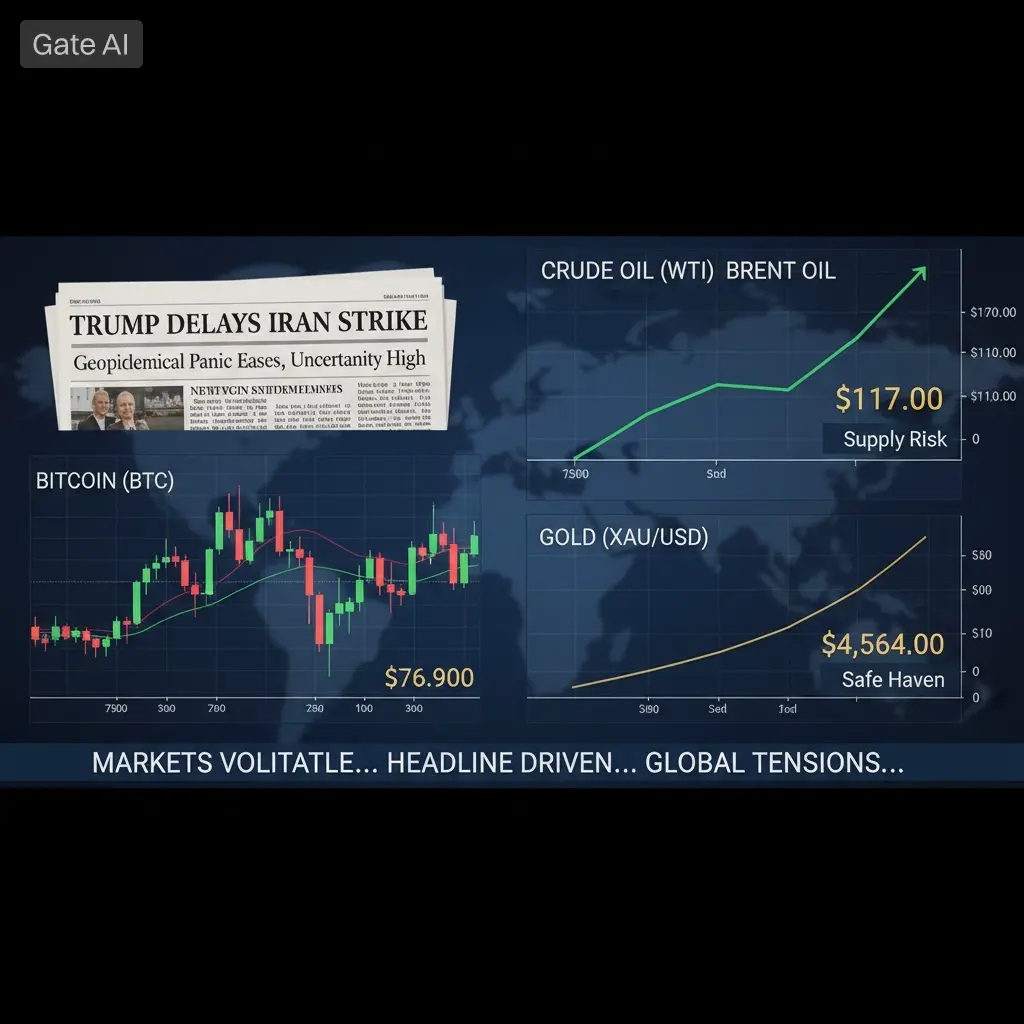
Bitcoin is currently trading around $76,908, stabilizing after intense volatility caused by geopolitical uncertainty. Earlier escalation fears led to liquidation-driven downside pressure, but the delay in military action has helped stabilize sentiment and reduce panic selling in the short term.
BTC is now positioned inside a tight consolidation zone between $75,000 support and $80,000 resistance, forming a high-volatility compression structure where the next breakout direction will define the broader macro trend for the coming weeks.
Current BTC Market Levels
Current Price: $76,900 – $77,200 range
Immediate Support: $75,000
Strong Support Zone: $72,000
Resistance Zone: $80,000
Major Breakout Resistance: $85,000 – $90,000
Extended Bull Scenario: $100,000+ potential
Bitcoin Market Interpretation
Bitcoin is currently behaving as a hybrid macro-risk asset, meaning it reacts negatively during geopolitical panic but rebounds strongly once conditions stabilize. The delay in Iran strike has improved sentiment, but BTC is still not in a full bullish expansion phase due to persistent global uncertainty.
Institutional participation and ETF inflows continue to provide structural demand support, while retail traders remain highly reactive to geopolitical headlines. This creates a market environment dominated by liquidity hunts and volatility-driven price movement rather than clean directional trends.
BTC Forecast and Trading Outlook
If geopolitical conditions remain controlled, Bitcoin can gradually move toward $80,000 and $85,000, with extended bullish potential toward $90,000 and even $100,000 in a strong macro risk-on environment. However, any renewed escalation could push BTC back toward $72,000 or $69,000 liquidity zones, where long-term accumulation demand is expected to return.
BTC Trading Strategy
Traders are currently focusing on range-bound strategies instead of aggressive trend positioning, accumulating near $74K–$75K support zones and taking profits near $79K–$80K resistance. Risk management is critical because geopolitical headlines can trigger instant volatility spikes and liquidation cascades. Long-term investors continue using dollar-cost averaging while monitoring macro sentiment shifts.
Crude Oil & Brent Oil – Geopolitical Energy Shock and Risk Premium Expansion
Crude oil and Brent oil have been the most sensitive assets in response to Iran-related geopolitical tension. Even with the strike delay, energy markets continue to price in a significant geopolitical risk premium due to concerns over potential disruption in the Strait of Hormuz, which handles nearly 20% of global oil flows.
Current Oil Market Prices
Crude Oil (WTI): $107.5
Brent Oil: $111.5
These elevated levels reflect not only supply-demand fundamentals but also fear-based pricing driven by geopolitical instability and potential shipping route disruptions.
Oil Market Behavior
Oil markets are currently in a geopolitical volatility expansion phase, where price action is heavily headline-driven. The Trump delay has slightly reduced immediate panic, but it has not eliminated structural uncertainty. Traders continue to price scenarios including shipping disruptions, insurance cost increases, and potential supply chain delays.
Oil Forecast and Market Direction
If diplomatic efforts continue successfully, oil may stabilize within a broader range. However, renewed escalation could push Brent toward $115–$120+ levels, while WTI follows a similar bullish trajectory. On the downside, full de-escalation could trigger corrections toward the $95–$100 Brent zone, although that scenario currently appears less dominant.
Should Traders Buy Oil?
Oil at current levels is considered high-risk momentum territory, not a stable accumulation zone. Buying at peaks carries significant risk because geopolitical spikes often reverse sharply. Traders are advised to focus on pullback entries rather than chasing breakouts.
Preferred strategies include:
Buying dips after volatility spikes
Avoiding late-stage breakout entries
Trading volatility instead of directional bias
Gold – Safe Haven Strength and Macro Hedge Dominance
Gold continues to act as the primary global safe-haven asset, benefiting from geopolitical uncertainty, inflation pressure, and currency risk hedging demand. Currently trading around $4,564 per ounce, gold has maintained strong structural bullish momentum throughout 2026.
Gold Market Behavior
Gold is experiencing consistent institutional accumulation, with central banks increasing reserves amid global instability. Unlike Bitcoin and oil, gold demonstrates steady and controlled upward movement, making it one of the most reliable hedging instruments in the current macro cycle.
Gold Forecast Outlook
If geopolitical uncertainty persists, gold has potential to move toward $4,700–$5,000+ levels in the medium term. Even in a de-escalation scenario, gold is expected to remain structurally supported due to long-term inflation concerns and continued institutional demand.
Gold Trading Strategy
Gold is suitable for:
Trend-following strategies
Swing trading on pullbacks
Long-term accumulation
Breakout trading above resistance zones
Core holdings are typically maintained while traders scale entries during corrective dips.
BTC vs Oil vs Gold – Full Market Structure Comparison
The global market is currently operating under a three-layer capital rotation system:
Bitcoin = Digital risk sentiment and speculative liquidity flow
Oil = Geopolitical supply shock pricing and inflation engine
Gold = Safe haven capital preservation and macro uncertainty hedge
During escalation phases:
Oil rises aggressively
Gold strengthens steadily
Bitcoin faces short-term pressure due to liquidity exits
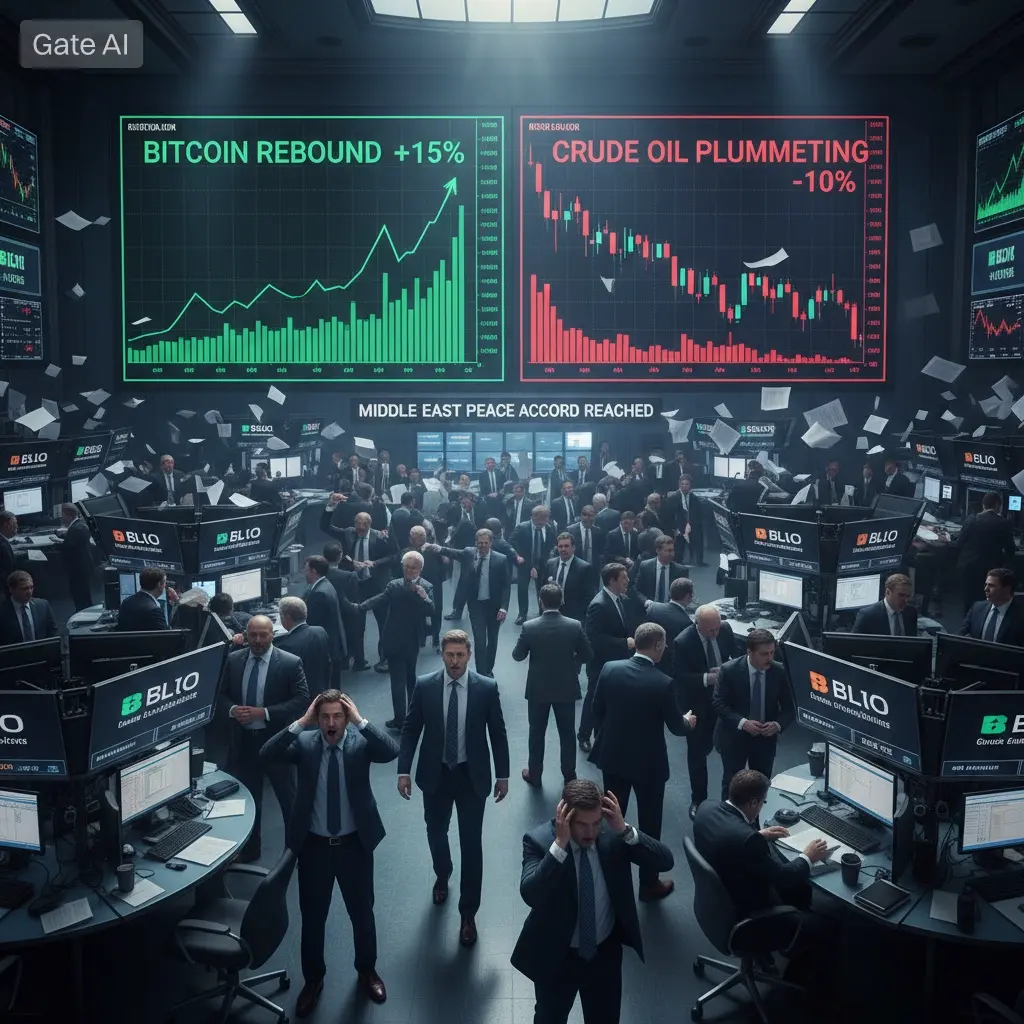
During de-escalation phases:
Bitcoin rebounds strongly
Oil stabilizes or corrects
Gold remains structurally firm
This confirms that modern markets are deeply interconnected and increasingly driven by geopolitical sentiment cycles rather than isolated technical structures.
Market Sentiment and Trader Psychology
Trader sentiment is currently divided into three major groups:
Risk-off capital moving into gold for protection
Momentum traders exploiting oil volatility spikes
Crypto traders waiting for Bitcoin breakout confirmation above $80,000
Market psychology is highly emotional and headline-driven, creating frequent false breakouts, liquidity traps, and sharp reversals across all asset classes. This environment rewards disciplined risk management more than directional prediction.
Final Outlook and Strategic Conclusion
The Trump delay in the Iran strike has temporarily reduced extreme panic but has not removed underlying geopolitical risk. Markets are now in a controlled uncertainty phase, where volatility remains high and direction remains fluid.
Bitcoin at $76,908 is consolidating with upside potential toward $80,000–$85,000, while downside remains open toward $72,000 in case of renewed escalation. Crude oil at $107.5 and Brent at $111.5 remain highly sensitive to geopolitical developments with strong risk premiums. Gold at $4,564 continues to act as the most stable hedge with long-term bullish structure intact.
Overall, this is not a trending market but a rotation-driven macro environment, where capital constantly shifts between fear and opportunity. Traders must rely on strict risk control, adaptive strategies, and real-time news awareness because price action is being driven more by geopolitics than technical structure in this phase of 2026.
Trump Delays Iran Strike – Global Macro Shock, BTC vs Oil vs Gold
Trump’s decision to delay the planned military strike on Iranian energy infrastructure has become one of the most important macro developments of 2026, reshaping sentiment across global financial markets, commodities, and digital assets in real time. This delay has temporarily reduced immediate escalation fears, but it has not removed the structural geopolitical tension surrounding the Strait of Hormuz, which remains one of the most sensitive and strategically critical oil transit chokepoints in the global economy. Markets are interpreting this move as a short-term cooling phase rather than a permanent resolution, and therefore volatility remains extremely elevated across all major asset classes.
Global traders are currently operating in a high-volatility geopolitical rotation environment, where capital is continuously shifting between risk assets like Bitcoin and defensive assets such as gold and crude oil. The psychological state of the market is highly reactive, meaning even small updates or diplomatic signals are capable of triggering large price swings, forced liquidations, and rapid repositioning across institutions and retail traders alike.
Bitcoin (BTC) Market Structure – Current Price, Behavior, and Outlook
Bitcoin is currently trading around $76,908, stabilizing after intense volatility caused by geopolitical uncertainty. Earlier escalation fears led to liquidation-driven downside pressure, but the delay in military action has helped stabilize sentiment and reduce panic selling in the short term.
BTC is now positioned inside a tight consolidation zone between $75,000 support and $80,000 resistance, forming a high-volatility compression structure where the next breakout direction will define the broader macro trend for the coming weeks.
Current BTC Market Levels
Current Price: $76,900 – $77,200 range
Immediate Support: $75,000
Strong Support Zone: $72,000
Resistance Zone: $80,000
Major Breakout Resistance: $85,000 – $90,000
Extended Bull Scenario: $100,000+ potential
Bitcoin Market Interpretation
Bitcoin is currently behaving as a hybrid macro-risk asset, meaning it reacts negatively during geopolitical panic but rebounds strongly once conditions stabilize. The delay in Iran strike has improved sentiment, but BTC is still not in a full bullish expansion phase due to persistent global uncertainty.
Institutional participation and ETF inflows continue to provide structural demand support, while retail traders remain highly reactive to geopolitical headlines. This creates a market environment dominated by liquidity hunts and volatility-driven price movement rather than clean directional trends.
BTC Forecast and Trading Outlook
If geopolitical conditions remain controlled, Bitcoin can gradually move toward $80,000 and $85,000, with extended bullish potential toward $90,000 and even $100,000 in a strong macro risk-on environment. However, any renewed escalation could push BTC back toward $72,000 or $69,000 liquidity zones, where long-term accumulation demand is expected to return.
BTC Trading Strategy
Traders are currently focusing on range-bound strategies instead of aggressive trend positioning, accumulating near $74K–$75K support zones and taking profits near $79K–$80K resistance. Risk management is critical because geopolitical headlines can trigger instant volatility spikes and liquidation cascades. Long-term investors continue using dollar-cost averaging while monitoring macro sentiment shifts.
Crude Oil & Brent Oil – Geopolitical Energy Shock and Risk Premium Expansion
Crude oil and Brent oil have been the most sensitive assets in response to Iran-related geopolitical tension. Even with the strike delay, energy markets continue to price in a significant geopolitical risk premium due to concerns over potential disruption in the Strait of Hormuz, which handles nearly 20% of global oil flows.
Current Oil Market Prices
Crude Oil (WTI): $107.5
Brent Oil: $111.5
These elevated levels reflect not only supply-demand fundamentals but also fear-based pricing driven by geopolitical instability and potential shipping route disruptions.
Oil Market Behavior
Oil markets are currently in a geopolitical volatility expansion phase, where price action is heavily headline-driven. The Trump delay has slightly reduced immediate panic, but it has not eliminated structural uncertainty. Traders continue to price scenarios including shipping disruptions, insurance cost increases, and potential supply chain delays.
Oil Forecast and Market Direction
If diplomatic efforts continue successfully, oil may stabilize within a broader range. However, renewed escalation could push Brent toward $115–$120+ levels, while WTI follows a similar bullish trajectory. On the downside, full de-escalation could trigger corrections toward the $95–$100 Brent zone, although that scenario currently appears less dominant.
Should Traders Buy Oil?
Oil at current levels is considered high-risk momentum territory, not a stable accumulation zone. Buying at peaks carries significant risk because geopolitical spikes often reverse sharply. Traders are advised to focus on pullback entries rather than chasing breakouts.
Preferred strategies include:
Buying dips after volatility spikes
Avoiding late-stage breakout entries
Trading volatility instead of directional bias
Gold – Safe Haven Strength and Macro Hedge Dominance
Gold continues to act as the primary global safe-haven asset, benefiting from geopolitical uncertainty, inflation pressure, and currency risk hedging demand. Currently trading around $4,564 per ounce, gold has maintained strong structural bullish momentum throughout 2026.
Gold Market Behavior
Gold is experiencing consistent institutional accumulation, with central banks increasing reserves amid global instability. Unlike Bitcoin and oil, gold demonstrates steady and controlled upward movement, making it one of the most reliable hedging instruments in the current macro cycle.
Gold Forecast Outlook
If geopolitical uncertainty persists, gold has potential to move toward $4,700–$5,000+ levels in the medium term. Even in a de-escalation scenario, gold is expected to remain structurally supported due to long-term inflation concerns and continued institutional demand.
Gold Trading Strategy
Gold is suitable for:
Trend-following strategies
Swing trading on pullbacks
Long-term accumulation
Breakout trading above resistance zones
Core holdings are typically maintained while traders scale entries during corrective dips.
BTC vs Oil vs Gold – Full Market Structure Comparison
The global market is currently operating under a three-layer capital rotation system:
Bitcoin = Digital risk sentiment and speculative liquidity flow
Oil = Geopolitical supply shock pricing and inflation engine
Gold = Safe haven capital preservation and macro uncertainty hedge
During escalation phases:
Oil rises aggressively
Gold strengthens steadily
Bitcoin faces short-term pressure due to liquidity exits
During de-escalation phases:
Bitcoin rebounds strongly
Oil stabilizes or corrects
Gold remains structurally firm
This confirms that modern markets are deeply interconnected and increasingly driven by geopolitical sentiment cycles rather than isolated technical structures.
Market Sentiment and Trader Psychology
Trader sentiment is currently divided into three major groups:
Risk-off capital moving into gold for protection
Momentum traders exploiting oil volatility spikes
Crypto traders waiting for Bitcoin breakout confirmation above $80,000
Market psychology is highly emotional and headline-driven, creating frequent false breakouts, liquidity traps, and sharp reversals across all asset classes. This environment rewards disciplined risk management more than directional prediction.
Final Outlook and Strategic Conclusion
The Trump delay in the Iran strike has temporarily reduced extreme panic but has not removed underlying geopolitical risk. Markets are now in a controlled uncertainty phase, where volatility remains high and direction remains fluid.
Bitcoin at $76,908 is consolidating with upside potential toward $80,000–$85,000, while downside remains open toward $72,000 in case of renewed escalation. Crude oil at $107.5 and Brent at $111.5 remain highly sensitive to geopolitical developments with strong risk premiums. Gold at $4,564 continues to act as the most stable hedge with long-term bullish structure intact.
Overall, this is not a trending market but a rotation-driven macro environment, where capital constantly shifts between fear and opportunity. Traders must rely on strict risk control, adaptive strategies, and real-time news awareness because price action is being driven more by geopolitics than technical structure in this phase of 2026.