
Futures
Access hundreds of perpetual contracts
CFD
Gold
One platform for global traditional assets
Options
Hot
Trade European-style vanilla options
Unified Account
Maximize your capital efficiency
Demo Trading
Introduction to Futures Trading
Learn the basics of futures trading
Futures Events
Join events to earn rewards
Demo Trading
Use virtual funds to practice risk-free trading
Launch
CandyDrop
Collect candies to earn airdrops
Launchpool
Quick staking, earn potential new tokens
HODLer Airdrop
Hold GT and get massive airdrops for free
Pre-IPOs
Unlock full access to global stock IPOs
Alpha Points
Trade on-chain assets and earn airdrops
Futures Points
Earn futures points and claim airdrop rewards


Promotions
AI
Gate AI
Your all-in-one conversational AI partner
Gate AI Bot
Use Gate AI directly in your social App
GateClaw
Gate Blue Lobster, ready to go
Gate for AI Agent
AI infrastructure, Gate MCP, Skills, and CLI
Gate Skills Hub
10K+ Skills
From office tasks to trading, the all-in-one skill hub makes AI even more useful.
GateRouter
Smartly choose from 40+ AI models, with 0% extra fees
U.S. 30-Year Treasury Yield Soars to 5.18%, "Reaching a 19-Year High"!Inflation and Massive Deficits Are the Culprits
Global Bond Market Massacre! Due to persistently high U.S. inflation data and nearly $2 trillion in massive fiscal deficits, the U.S. 30-year government bond yields have recently soared, reaching a high of 5.18%, the highest in 19 years since the eve of the 2007 financial crisis. Market expectations for the Federal Reserve (Fed) to cut interest rates have been completely shattered, and traders are even betting on the possibility of rate hikes by the end of the year. As the "risk-free rate" skyrockets, borrowing costs have surged significantly, posing a severe test for risk assets such as tech stocks and cryptocurrencies.
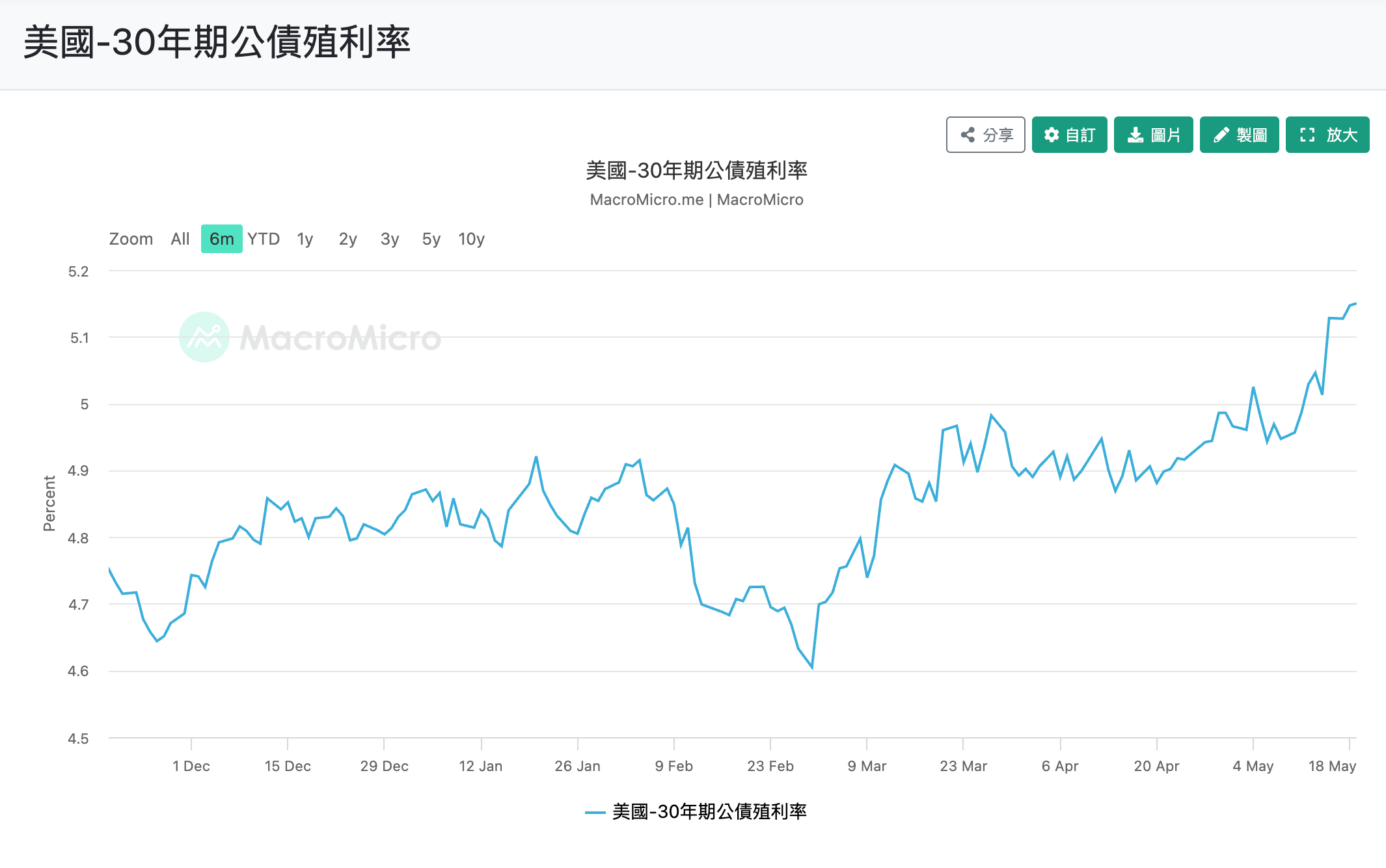

(Background: U.S. Treasury 5% defense line fully breached! Bank of America calls it doomsday, Goldman Sachs urges buying, Japan directly sells off)
(Additional context: Stablecoin giant Tether raked in $1.04 billion in Q1! Excess reserves soared to $8.23 billion, a new all-time high, maintaining its position as the 17th largest U.S. debt holder globally)
The global financial markets are shrouded in the shadow of soaring yields. The bond market, most sensitive to interest rates, is telling investors directly: don’t expect the Fed to cut rates anytime soon.
According to the latest market data, as of May 19, 2026, the U.S. 30-year Treasury yield experienced a fierce surge, breaking through the psychological barrier of 5%, with intraday highs approaching 5.18%. This is not only a rapid jump from 5.0% but also a new 19-year high since June-July 2007.
Meanwhile, the 10-year Treasury yield, regarded as the global asset pricing anchor, also climbed to around 4.5% to 4.6%. But the gains on the long end (30 years) are even more astonishing, highlighting deep market concerns over long-term inflation and the U.S. fiscal situation.
### Analyzing the Three Major Drivers Behind the U.S. Bond Selloff
The wave of soaring U.S. bond yields (meaning bond prices plummeting) is mainly driven by the following macro forces:
2. Replaying the Inflation Nightmare (Sticky Inflation): U.S. April CPI year-over-year rebounded to 3.8%, and PPI data also exceeded market expectations. The main reason behind this is geopolitical tensions in the Middle East (such as Iran conflicts) keeping international oil prices high, which exacerbates the "stickiness" of inflation.
4. Fed Expectations "Flip": The market was originally optimistic about a rate-cut cycle this year, but according to the latest FedWatch tool pricing, traders now not only bet on the Fed holding steady in June but also start to anticipate the possibility of "restarting rate hikes" by the end of the year.
6. $2 Trillion Massive Deficit: The U.S. government’s fiscal deficit is projected to approach $2 trillion this year. To support such massive spending, the Treasury must issue大量 government bonds, and in an oversupply situation, higher yields are needed to attract buyers.
Moreover, this is not unique to the U.S.; global government bond yields, including Japan and the UK, are also rising in tandem, forming a worldwide bond selloff wave.
### Skyrocketing Risk-Free Rates, Warning Signals for Risk Assets
The 30-year yield hitting a new high since 2007—what does it mean for the real economy and investment markets?
The most immediate impact is a comprehensive rise in borrowing costs. This will further push up mortgage rates and corporate financing costs, which in the long run will likely suppress the real estate market and corporate capital expenditures. For stocks and cryptocurrencies, this is also a dangerous signal. The surge in U.S. bond yields equates to "tightening financial conditions"; when investors can easily earn over 5% risk-free returns from U.S. Treasuries, capital often flows out of overvalued tech stocks and high-risk digital assets.
Although recent stock market performance shows some resilience, and the current macro environment is quite different from the pre-2007 subprime crisis, sustained high interest rates above 5% undoubtedly reflect deep market concerns about the sustainability of U.S. fiscal policy. In the short term, whether this yield storm will subside depends heavily on subsequent oil price trends and Fed officials’ statements.