InvestingWithBrandon

vip
Age 1.4 Yıl
Peak Tier 0
No content yet
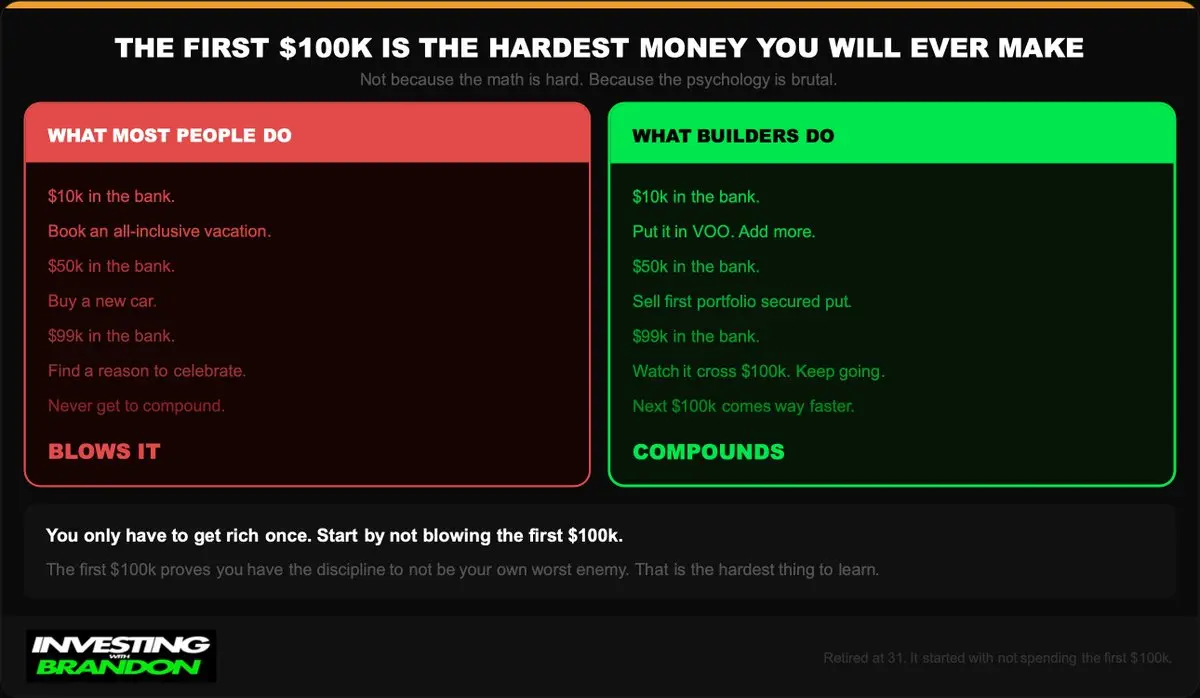
The first $100,000 is the hardest money you will ever make.
Not because the math is hard.
Because the psychology is brutal.
$10k in the bank. You want a vacation.
$50k in the bank. You want a new car.
$99k in the bank. You want to celebrate.
The people who blow it there never get to compound.
The people who hold it there watch the next $100k come way faster.
Then the next one. Then the next one.
The first $100k proves something more important than money.
It proves you have the discipline to not be your own worst enemy.
That is the hardest thing to learn.
COMP4,47%
post-image
  • Reward
  • Comment
  • Repost
  • Share
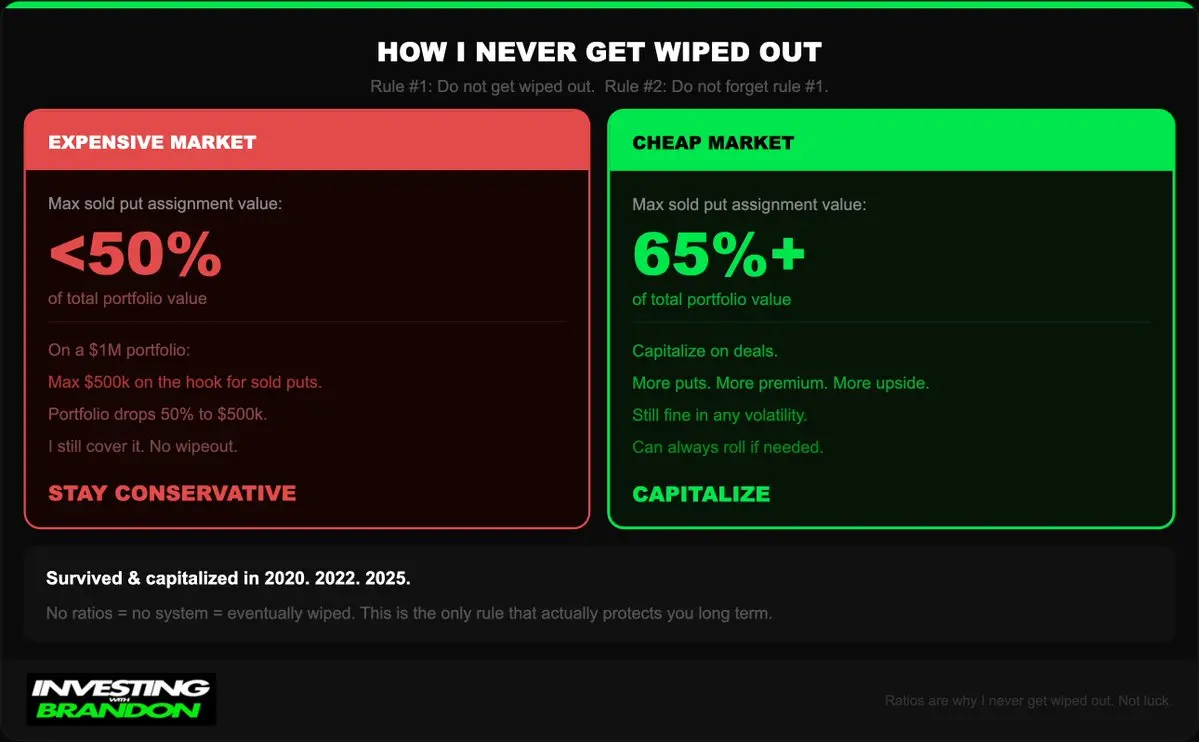
Rule #1 in investing: do not get wiped out.
Rule #2: do not forget rule #1.
Here is exactly how I keep ratios in check when I sell portfolio secured puts & beat the market at the same time.
Expensive market:
Max sold put assignment = < 50% of portfolio value.
Cheap market:
Max assignment = 65% or more of portfolio value to capitalize on deals but still be fine in volatility.
On a $1M portfolio in a expensive market that means max $500k on the hook for to buy of shares for sold puts.
Even if the portfolio falls 50% to $500k I still cover it.
(I can roll too, but just showing I have the cash if
post-image
  • Reward
  • Comment
  • Repost
  • Share
My option strategy is base hits all day.
Not home runs.
When you swing for homers you strike out more.
When you keep striking out you eventually wipe out the account.
& you cannot compound from zero.
(this boring system is what I use to beat the market in the last 10+ years which is what most people do not even get close to doing)
Base hit system:
Build base portfolio
Do options with conservative strike prices.
1 year+ duration to give EPS time to grow.
Ratios in check to be fine in any volatility.
Only great companies at good prices.
Home run swinger:
Aggressive bets.
Short duration.
Win b
  • Reward
  • Comment
  • Repost
  • Share
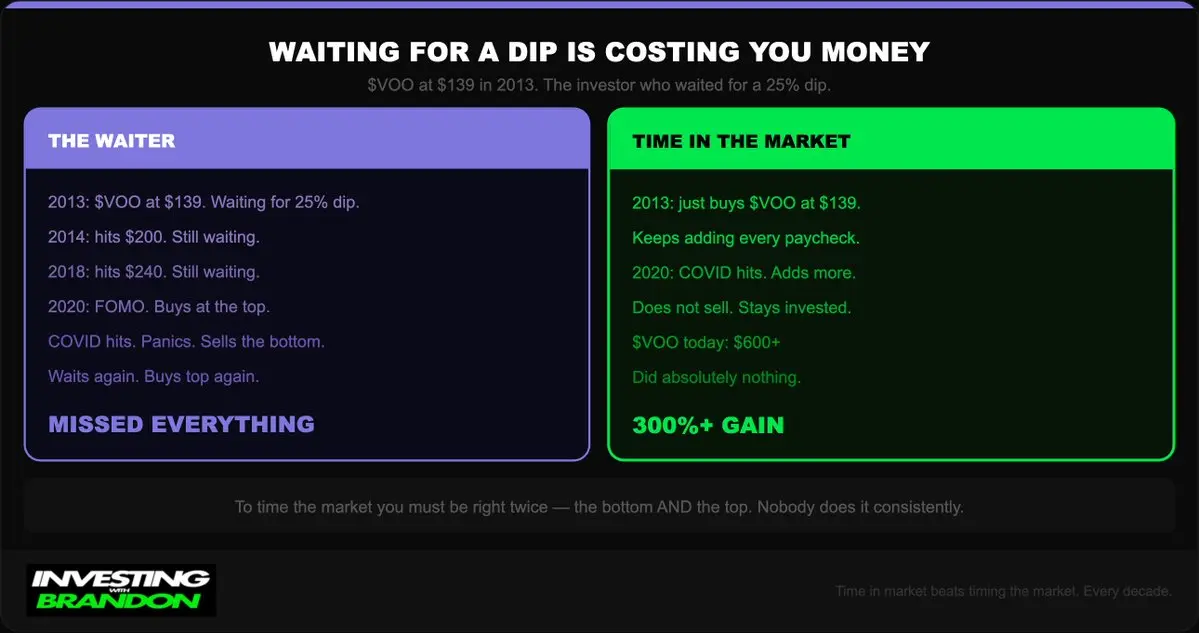
$VOO was $139 in 2013.
Investor says: "I am waiting for a 25% dip."
2014: market hits $200. Still waiting.
2018: market at $240. Still waiting.
2020: FOMO. Buys at the top. COVID hits. Panics. Sells bottom.
Waits again. Buys top again.
Meanwhile the person who just bought in 2013 & held?
VOO is at $600+.
300%+ return.
Did absolutely nothing.
To time the market you have to be right twice.
The bottom AND the top.
Nobody does it consistently.
Time in the market beats timing the market. Every decade.
post-image
  • Reward
  • Comment
  • Repost
  • Share
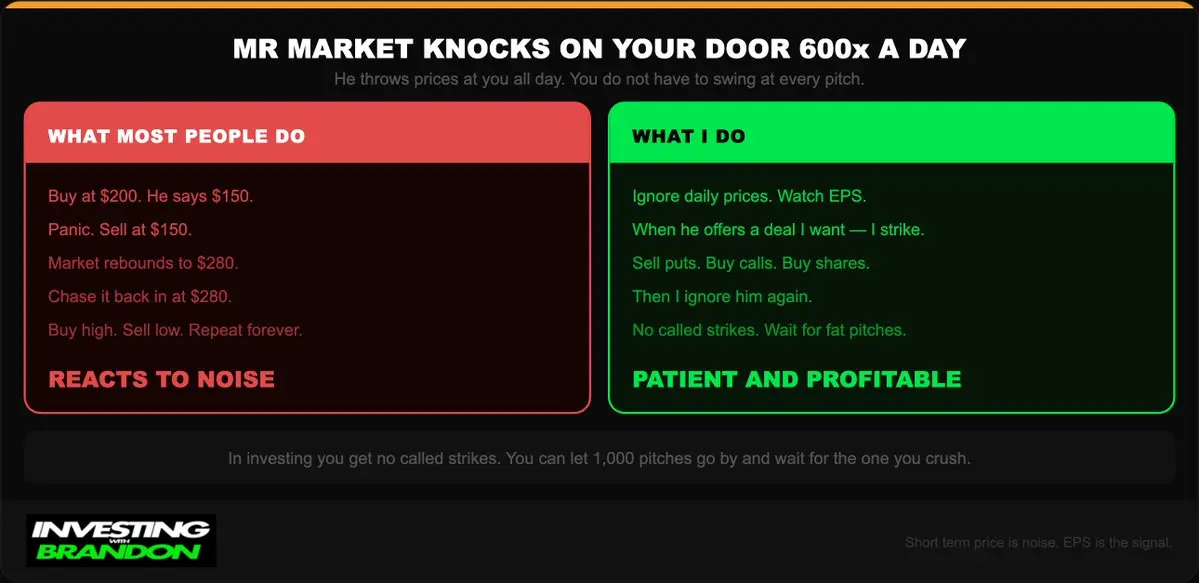
Mr. Market knocks on your door 600 times a day.
He offers you Apple at $200.
Then $150.
Then $250.
Then $180.
None of it is the true value.
Most people react to every knock.
Buy at $200. He says $150. They panic sell.
Market rebounds to $280. They chase back in.
Buy high. Sell low. Repeat forever.
Here is what I do.
I ignore his daily prices.
I watch the true fundamentals of the business.
& when he offers me something truly cheap I strike.
In investing you get no called strikes.
You can let 1,000 pitches go by.
Swing only at the fat ones.
post-image
  • Reward
  • Comment
  • Repost
  • Share
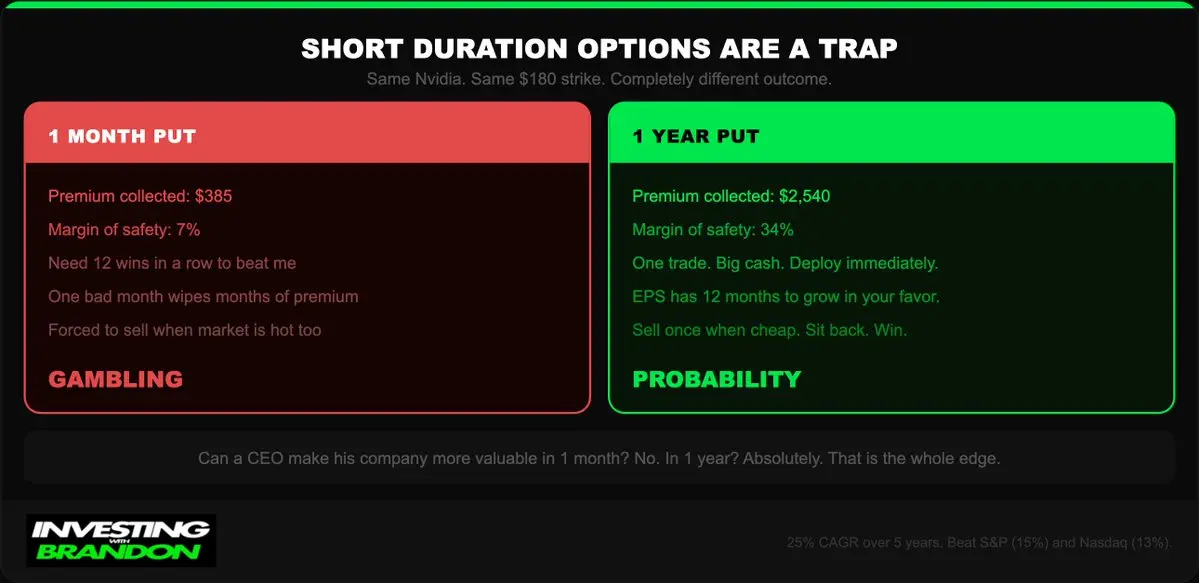
Same Nvidia.
Same $180 strike.
Completely different outcome.
1 month put: collect $385. Margin of safety: 7%.
1 year put: collect $2,540. Margin of safety: 34%.
Safety comes from buying below fair value & EPS growth in the time frame.
To beat me with monthlies you need 8 wins in a row.
One bad month wipes everything.
& you are forced to sell puts when the market is hot & there is less deals too.
Can a CEO make his company more valuable in 1 month?
No.
In 1 year? Absolutely.
Stocks follow the profits.
That does not materially change in a month...
post-image
  • Reward
  • Comment
  • Repost
  • Share
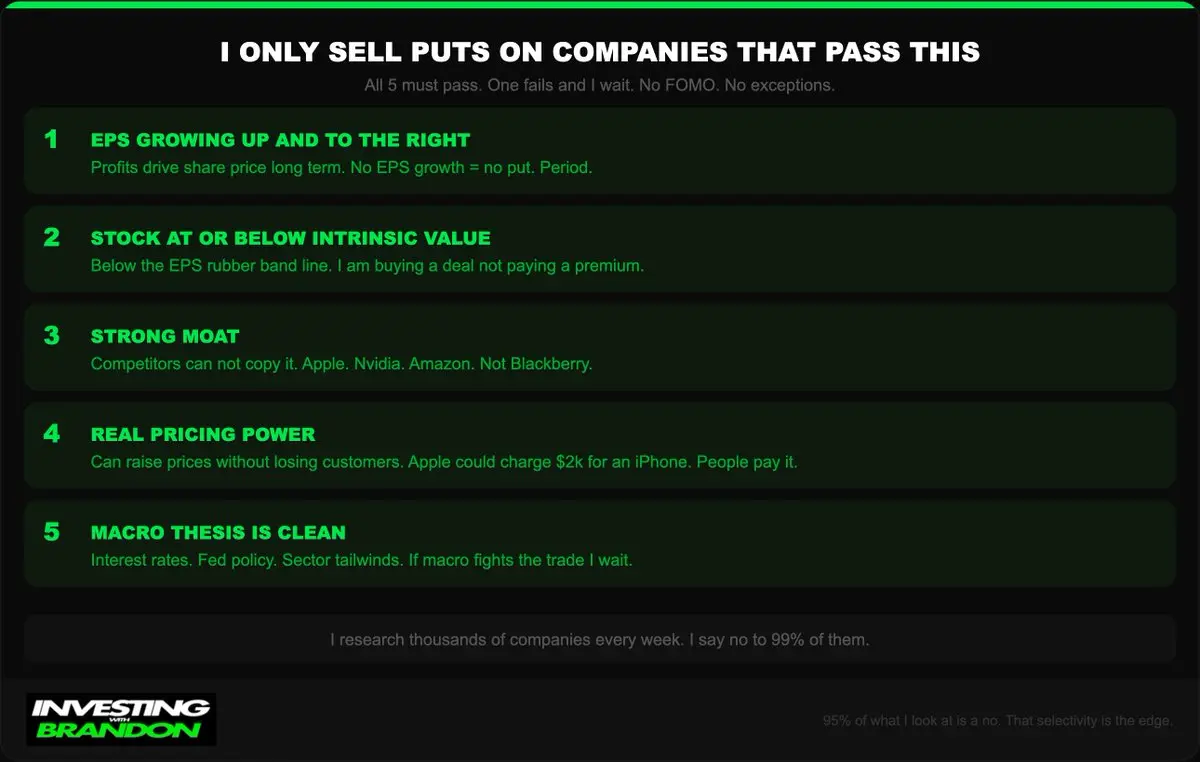
I look at thousands of companies every week.
I say no to 99% of them.
Here is the exact 5 point filter.
All 5 must pass.
1. EPS growing up & to the right.
2. Stock at or below intrinsic value.
3. Real moat competitors can not copy.
4. Genuine pricing power.
5. Macro thesis is clean.
One fails & I wait.
No FOMO. No chasing. No exceptions.
Apple could charge $2,000 for an iPhone.
People pay it.
That is pricing power.
That is what I want behind my sold puts.
post-image
  • Reward
  • Comment
  • Repost
  • Share
$500 per bulan.
30 tahun.
3 strategi berbeda.
1. S&P 500 saja (10% rata-rata): $1 juta.
2. Base + portfolio secured puts (20% rata-rata): $9 juta.
3. Base + puts + LEAPS (25% rata-rata): $61 juta.
Sama $500/bulan. Sama 30 tahun.
Satu-satunya variabel adalah sistem Anda.
Kesenjangan dari $1M ke $61M bukan keberuntungan.
Ini adalah pinjaman gratis double dip seperti yang saya sebut.
Uang di dua tempat sekaligus.
Saham menghargai + dijual puts menghasilkan pendapatan + LEAPS memperbesar keyakinan.
Lapisan opsi tidak hanya membuat pendapatan.
Ini adalah akselerator perpaduan.
  • Reward
  • Comment
  • Repost
  • Share
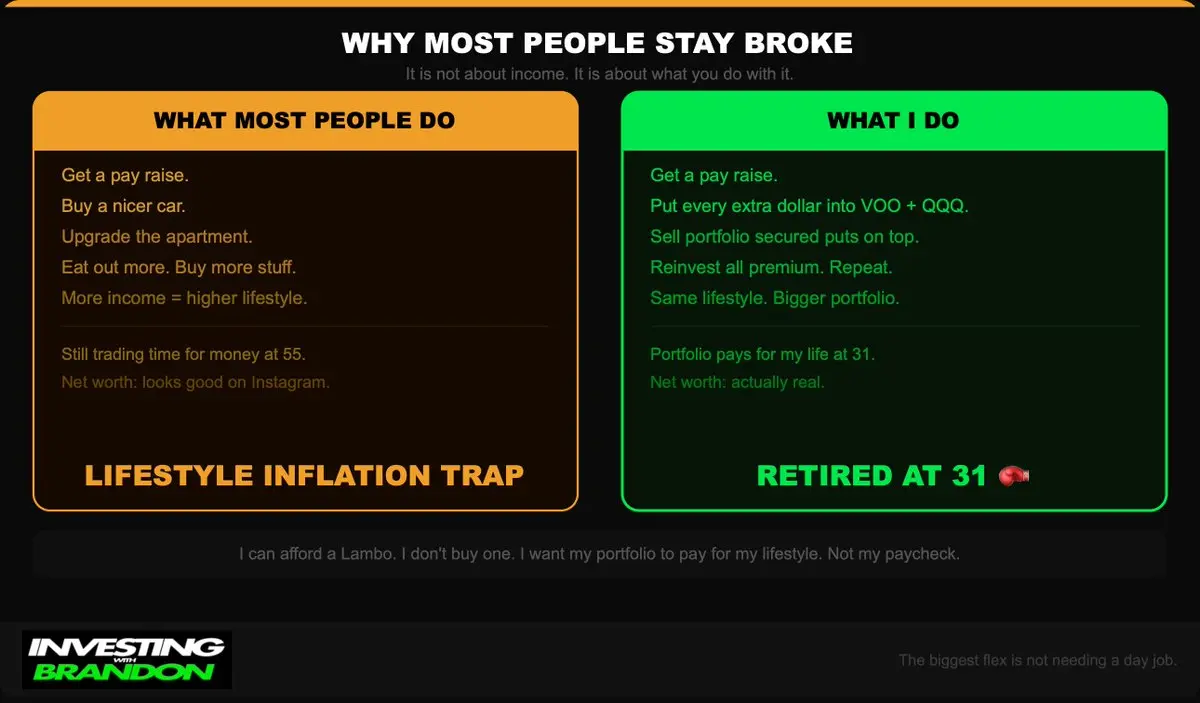
ほとんどの人は給料が上がるとすぐにライフスタイルをアップグレードします。
新しい車。より良い場所。より高級なレストラン。
これがほとんどの人が破産している理由です。
私は今すぐランボルギーニを買うことができます。
私は今すぐ飛行機を買うことができます。(私はプライベートパイロットです)
しかし私はそうしません。
なぜなら、その金を使った瞬間にお金は私のために働くことをやめるからです。
私の目標はシンプルです。
ポートフォリオを、私のライフスタイル全体を何倍にもしてカバーできるレベルまで成長させることです。
最大の自慢は昼間の仕事が必要ないということです。
post-image
  • Reward
  • Comment
  • Repost
  • Share
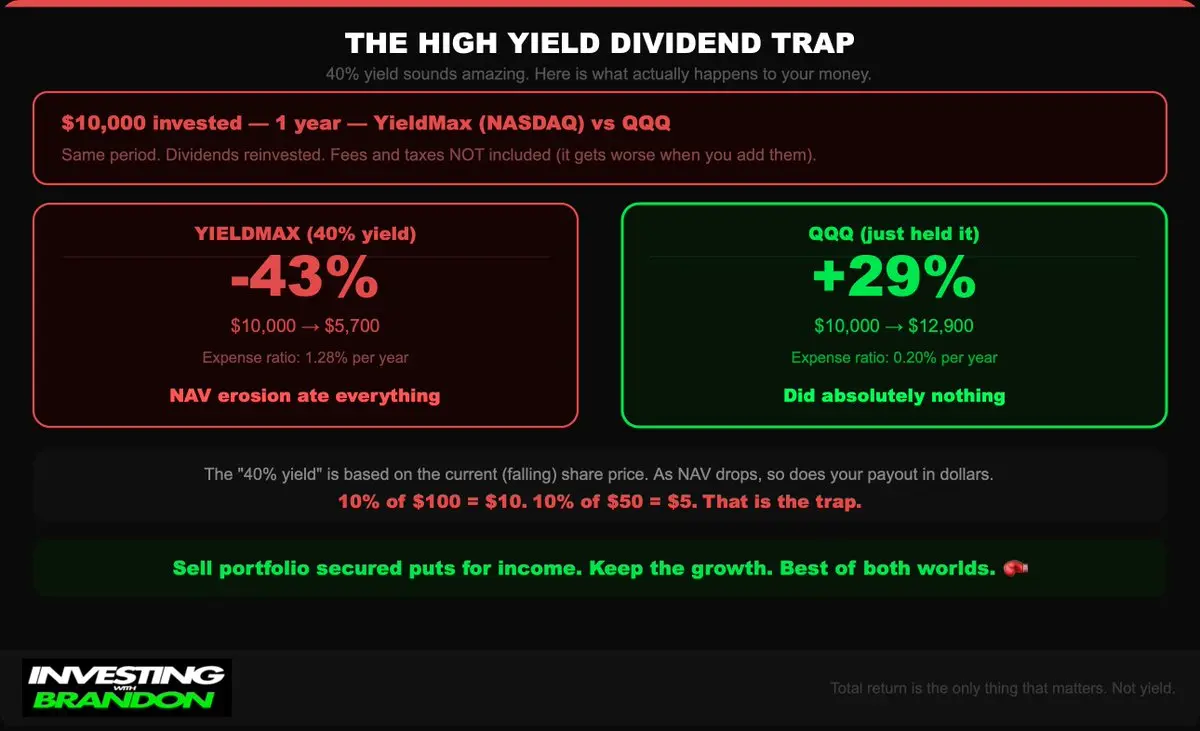
YieldMax is paying a 40% dividend yield.
(here is what that actually means for your money)
$10,000 invested for 1 year.
Dividends reinvested.
YieldMax: down 43%.
You have $5,700.
Q: up 29%.
You have $12,900.
The yield is based on the current share price.
As NAV drops.
Your payout drops too.
10% of $100 = $10.
10% of $50 = $5.
That is the trap.
The yield looks great because the share price is falling. But don't be tricked... Its a percent of the lower share price... Not your basis.
Sell portfolio secured puts for income. Keep the growth. Best of both worlds.
post-image
  • Reward
  • Comment
  • Repost
  • Share
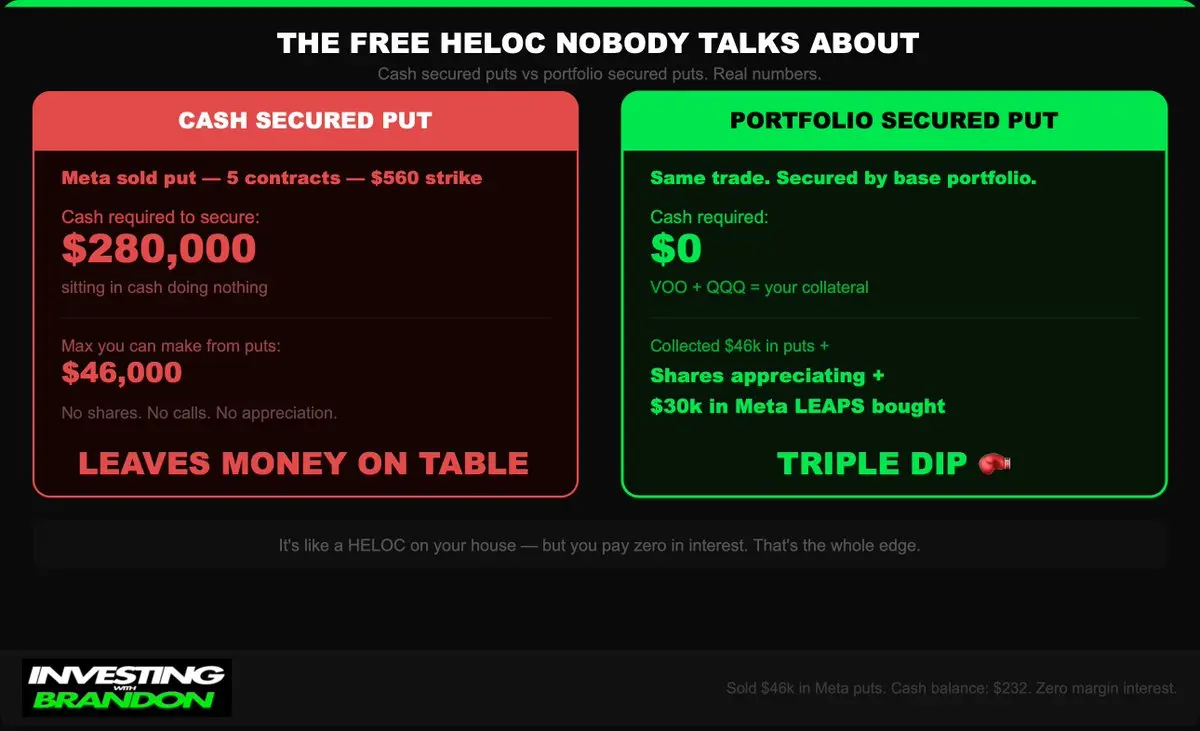
I sold puts on Meta.
Collected $46,000 instantly.
My cash balance? $232.
Cash secured put on the same trade would have required $280,000 sitting in cash doing nothing.
Instead I used my base portfolio as collateral.
Took that $46k & bought Meta LEAP calls.
Took the rest & bought VOO, Q & META shares.
Zero margin interest.
Zero cash drag.
Full upside intact.
Ratios in check to be fine in any downturn.
It is exactly like a HELOC on your house.
Except you pay nothing in interest.
That gap = $280k working vs $280k sleeping
This is a MAJOR difference.
post-image
  • Reward
  • Comment
  • Repost
  • Share
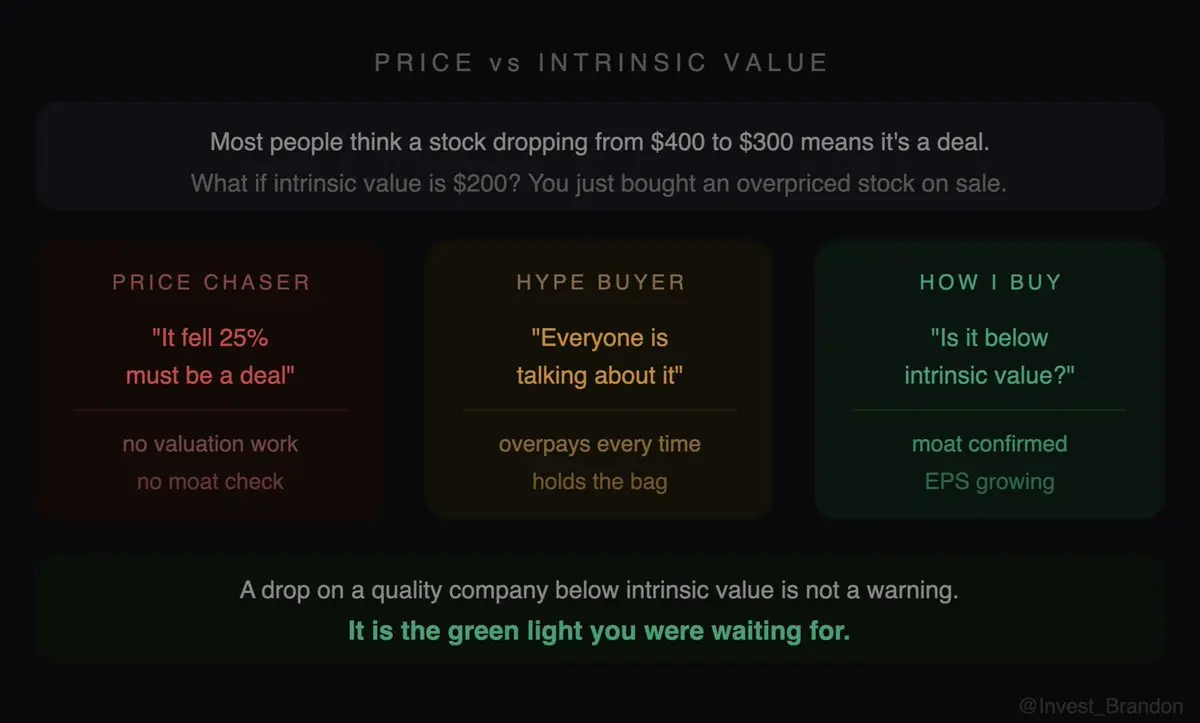
Most people think a stock dropping 25% automatically makes it a buy.
It does not.
If a stock fell from $400 to $300 but intrinsic value is $200.
You just bought an overpriced stock on sale.
That is not investing.
Here is what I check before I buy anything.
Is it trading at or below intrinsic value?
Does it have a real moat?
Is EPS growing up & to the right?
Does it have pricing power?
Is the macro thesis clean?
All yes?
I back the truck up.
One no?
I wait.
Price is what you pay.
Value is what you get.
Learn the difference & you will never panic buy again.
post-image
  • Reward
  • Comment
  • Repost
  • Share
The S&P 500 has never once failed to hit new all time highs after a crash.
Not after 1987.
Not after 2000.
Not after 2008.
Not after 2020.
Not after 2022.
Every single time the experts said it was different this time.
Every single time they were wrong.
The crash feels like the end when you are in it.
Then you look back 5 years later & realize it was the best buying opportunity of your life.
The people who panicked out locked in permanent losses.
The people who had structure & stayed in made a killing.
Volatility is not the risk.
Permanent decisions made out of temporary fear is the risk.
post-image
  • Reward
  • Comment
  • Repost
  • Share
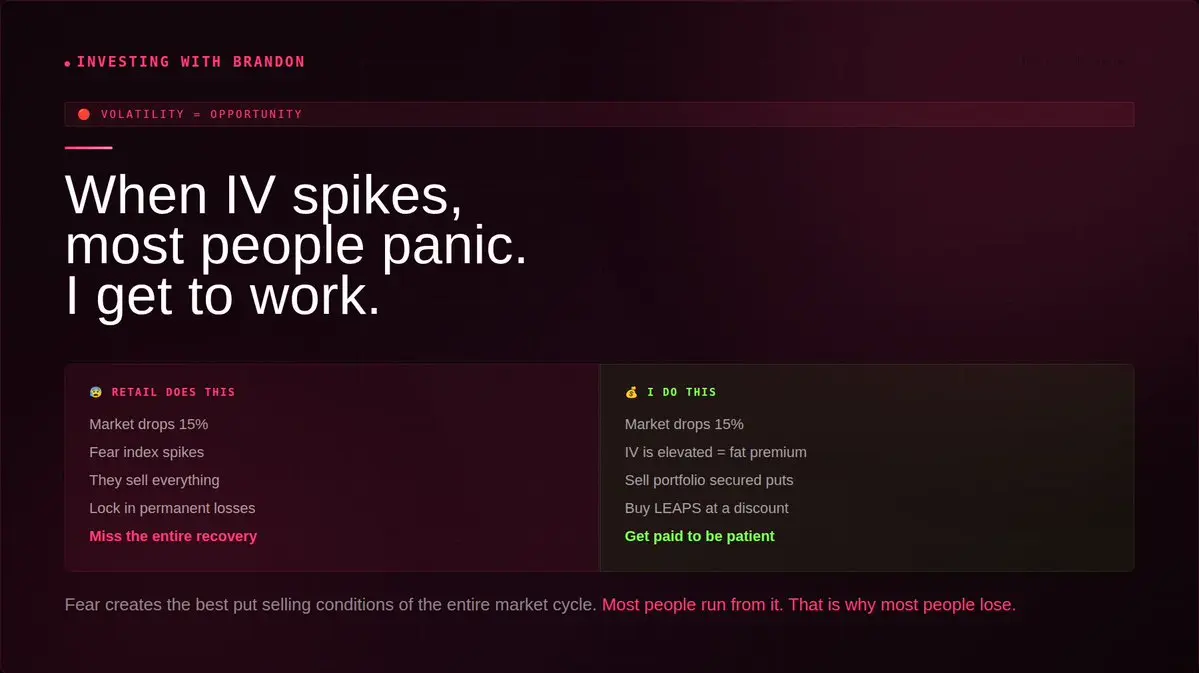
When volatility spikes most people panic.
This is when I get excited.
Market drops 15%.
Fear index explodes.
Everyone is selling.
Put premiums are the fattest they will be all year.
That is when I sell portfolio secured puts on quality companies now trading at a discount.
Take that premium & buy shares + LEAP calls at the same time.
Getting paid to be patient while everyone else panics out.
Fear creates the best put selling conditions of the entire market cycle.
Most people run from it.
That is exactly why most people lose.
post-image
  • Reward
  • Comment
  • Repost
  • Share
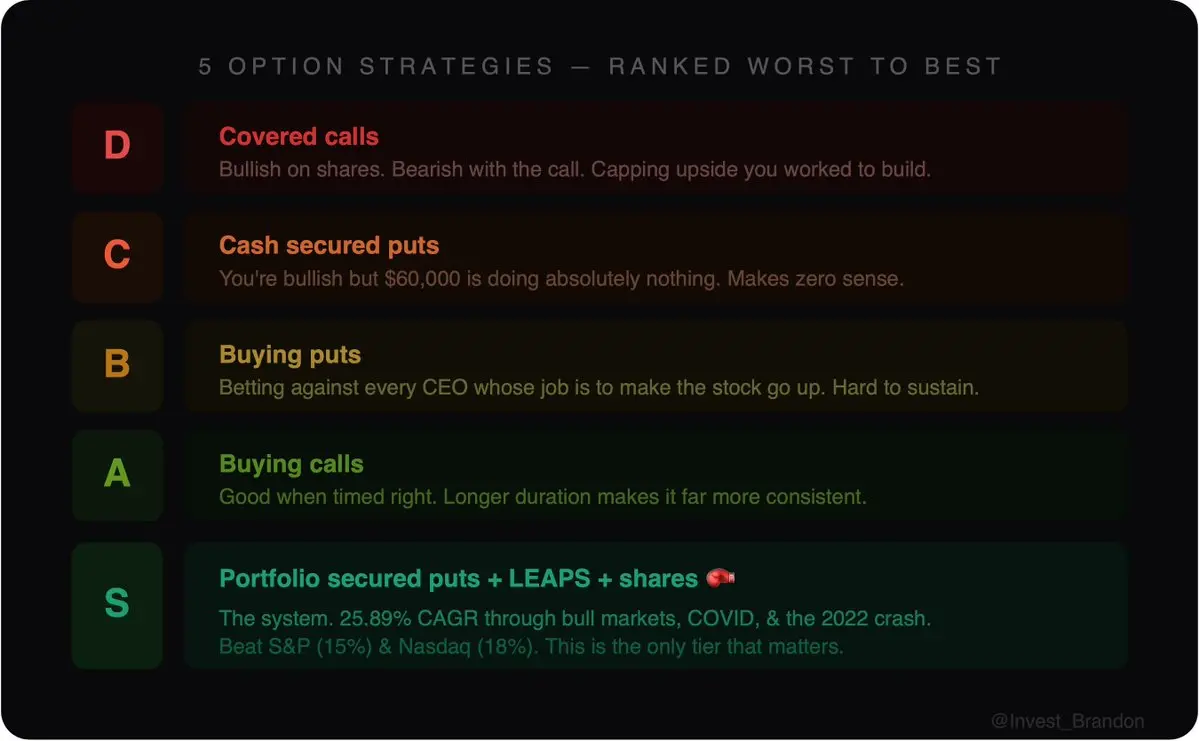
The 5 most popular option strategies ranked.
(only 1 actually works long term)
🔴 D tier — Covered calls. Bullish with one hand. Cap your upside with the other. Doesn't protect downside. Usually makes no sense....
🔴 C tier — Cash secured puts. Bullish to sell put, but sitting in cash doing nothing while the stock runs.
🟡 B tier — Buying puts. You're betting against every CEO whose job is to prove you wrong.
🟡 A tier — Buying calls. Better but timing still has to be perfect. Hard to do consistently.
🟢 S tier — Portfolio secured puts + LEAPS + shares. This is what scaled me to 7 figures th
post-image
  • Reward
  • Comment
  • Repost
  • Share
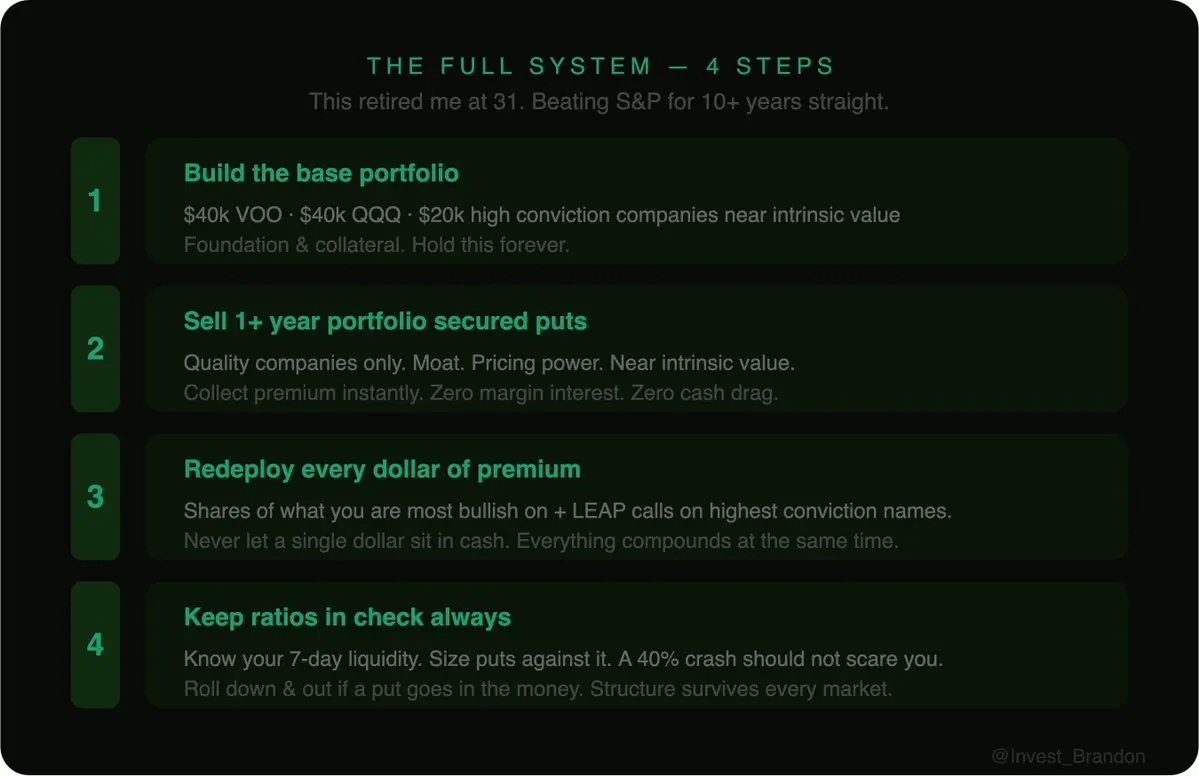
I retired at 31 doing this.
Step 1. Build your base.
$40k VOO. $40k Q. $20k high conviction companies near intrinsic value.
This is your foundation & your collateral.
Step 2. Sell 1+ year portfolio secured puts.
Quality companies only.
Moat.
Pricing power.
Good valuation.
Collect the premium.
Pay zero margin interest.
Step 3. Redeploy every dollar of premium.
More shares.
LEAPS on your highest conviction names.
Never let it sit as cash.
Step 4. Keep ratios in check.
Always know your 7-day liquidity.
A 40% crash should not keep you up at night.
That is it.
No day trading.
No covered calls
post-image
  • Reward
  • Comment
  • Repost
  • Share
Show me 1 day trader billionaire.
  • Reward
  • Comment
  • Repost
  • Share
Human emotion is completely predictable.
That is how I generate $30k a month on average with options.
When the market crashes everyone panics.
They flood into put options for protection.
Put premiums go through the roof.
Nobody wants call options.
Calls go on sale.
I do the exact opposite of the herd.
I sell puts for top dollar because everyone is panicking to buy them.
I take that premium & buy calls for bottom dollar because nobody wants them.
Then the sentiment flips.
Market starts to recover.
Puts are suddenly worthless.
Calls explode in value.
On AMD I held 2-year contracts for 3 months.
post-image
  • Reward
  • Comment
  • Repost
  • Share
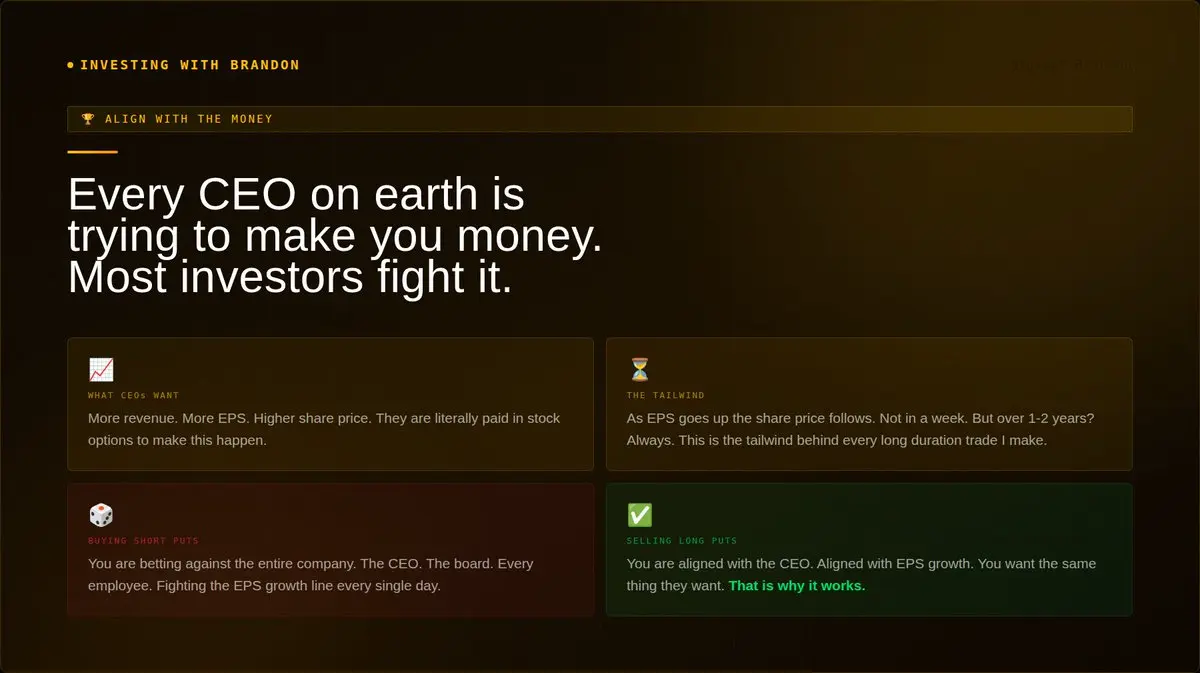
Every single CEO wakes up every single day trying to make you money.
(most retail traders fight it anyway)
Every executive at every company wants the same thing.
More revenue.
Higher earnings per share.
Higher share price.
They are literally paid in stock options to make it happen.
As EPS goes up the share price follows.
Not in a week.
Not in a month.
But over 1-2 years?
It almost always follows.
That EPS growth line is the most powerful tailwind in investing.
When I sell 1+ year portfolio secured puts on quality companies, I am not gambling.
I am aligning myself with every person at that comp
post-image
  • Reward
  • Comment
  • Repost
  • Share
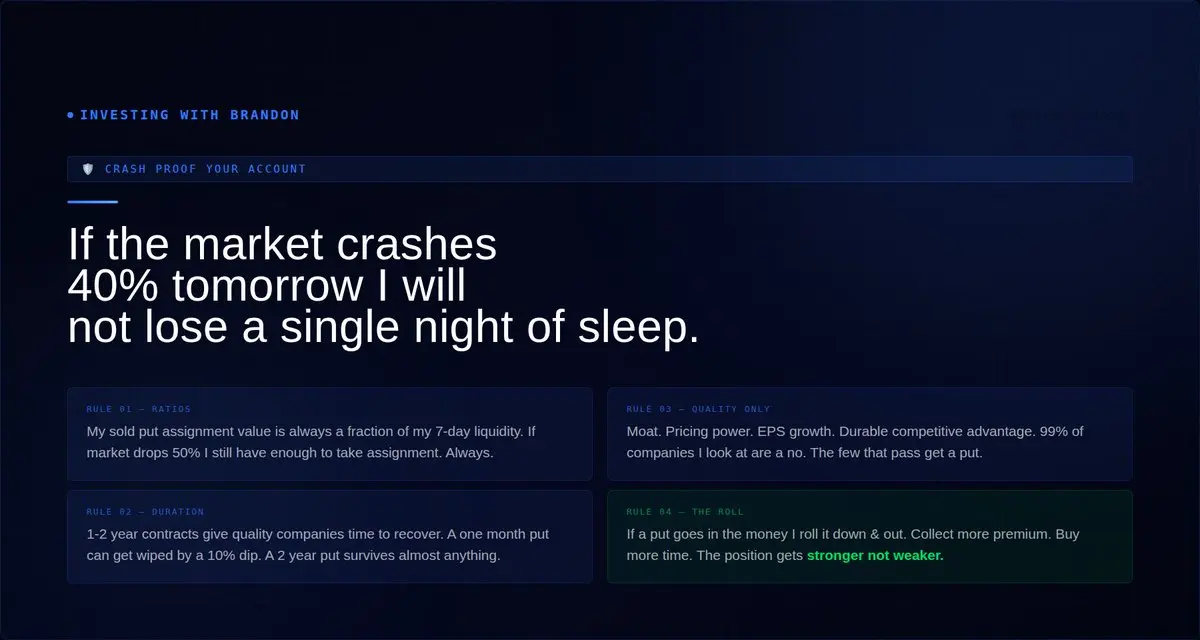
If the market crashes 40% tomorrow I will not lose a single night of sleep.
(here is exactly why)
Most people hear my options system, & immediately think I am reckless.
I am the opposite.
I walked through 2008 month by month using this system.
I came out just fine.
Here is how ratios keep you safe.
My sold put assignment value is always a fraction of my 7-day liquidity.
Right now the market is a little hot.
So my assignment value is lower.
When the market gets cheap I raise it because the downside risk is actually lower in a cheap market.
On top of that I only sell puts on companies with a moa
post-image
  • Reward
  • Comment
  • Repost
  • Share
  • Pin